
Context:
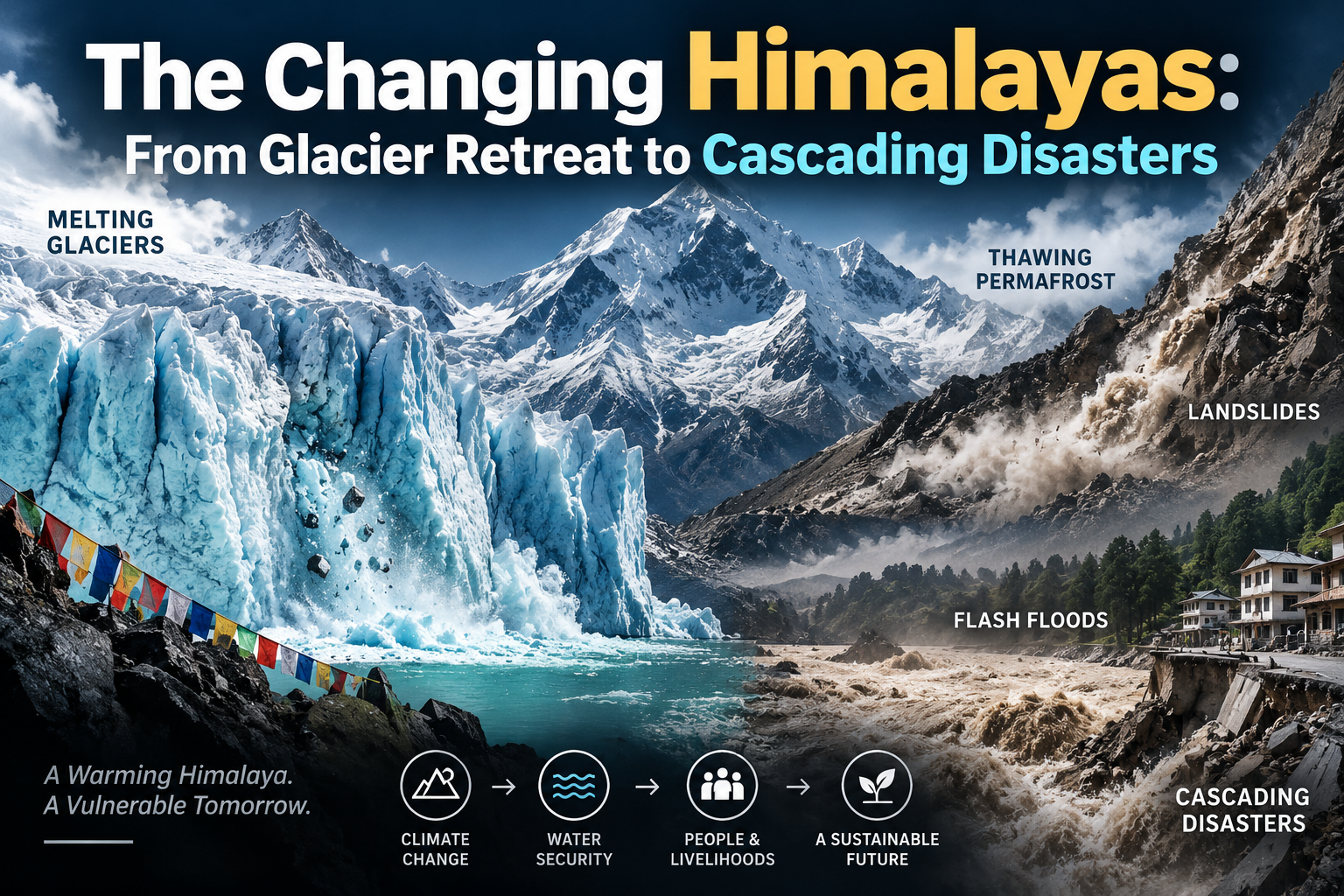
In recent years, the increasing occurrence of floods, landslides, glacial lake outbursts, avalanches and glacier collapses in the Himalayan region has made it important to consider whether the Himalayas are moving towards a broader ‘tipping point’.
In September 2026, the International Centre for Integrated Mountain Development (ICIMOD) released the report ‘Prosperous and Resilient Himalayas’, which indicated that glaciers in the Hindu Kush-Himalaya (HKH) region are rapidly losing mass, thereby increasing both water-security concerns and disaster risks.
The devastating flood and debris-flow event in Nepal in August 2026 further highlighted this crisis. The event involved interconnected processes such as the collapse of glacier and ice-rock debris, instability of mountain slopes, and sudden increases in river discharge. It serves as a serious warning of the emerging ‘cascading cryospheric hazards’ in the Himalayas.
Why is the Himalayas Important?
The Himalayas are not merely a mountain range; they form the foundation of Asia’s water and ecological security. Rivers originating in the Hindu Kush-Himalaya region affect hundreds of millions of people across countries including India, Nepal, Bhutan, Bangladesh, Pakistan and China.
Glaciers act as natural reservoirs for these rivers. During winter, water is stored in the form of snow and ice, while during warmer months, melting contributes to maintaining river flows. Therefore, changes in glaciers are not limited to mountain regions; they also affect downstream agriculture, drinking water, hydropower and ecosystems.
Climate Change and Himalayan Glaciers
The Himalayan region is warming rapidly due to rising global temperatures. Increasing temperatures are causing a decline in the mass balance of glaciers, meaning that glaciers are losing more ice than they are gaining through new accumulation.
As glaciers retreat, new glacial lakes may form in front of or around them. The ice, debris or moraine dams holding these lakes are not always stable. Earthquakes, heavy rainfall, avalanches or rockfalls can cause these natural barriers to suddenly fail, resulting in a Glacial Lake Outburst Flood (GLOF).
Meaning of the ‘Tipping Point’
In the Himalayan context, the term ‘tipping point’ does not mean that the entire Himalayan mountain system will suddenly collapse. Rather, it refers to a stage where environmental changes become so extensive that the functioning of traditional ecological and hydrological systems begins to change.
Rapid glacier melting may initially increase river discharge. However, as glaciers continue to shrink and their ice reserves decline, a point may eventually be reached when the additional meltwater begins to decrease. Consequently, long-term river flows may also decline.
Thus, the Himalayan region may face two contrasting problems:
In the short term: More water and sudden floods.
In the long term: Less ice, reduced meltwater and water scarcity.
This represents one of the major challenges to Himalayan water security.
Lessons from the Nepal Tragedy
The 2026 Nepal tragedy highlights that mountain disasters can no longer be viewed as isolated events. Glacier retreat in the Himalayan region can affect the stability of mountain slopes, potentially increasing the risk of ice and rock avalanches. This can subsequently block river channels, lead to the accumulation of debris and create conditions for sudden water release. As a result, the risk of flash floods and widespread destruction in downstream areas increases.
Thus, glacier retreat, slope instability, ice-rock avalanches, river blockage, debris accumulation, sudden water release and flash floods are interconnected processes. Such interconnected and sequential disasters can be described as “cascading disasters.”
Climate change can increase risks across this entire chain because rising temperatures can weaken glaciers, cause permafrost to thaw and affect the stability of mountain slopes. Therefore, future Himalayan disasters cannot be adequately understood merely as ‘floods’ or ‘landslides’. There is a need to understand the entire mountain disaster-risk system as an interconnected system.
Permafrost:
The importance of permafrost is rapidly increasing in the context of the Himalayan crisis. Permafrost refers to ground that remains frozen for at least two consecutive years. In high-altitude mountain regions, it plays an important role in maintaining the stability of rocks and soil.
As temperatures rise, permafrost can thaw. This can reduce the stability of rocks and slopes and increase the risk of rockfalls, landslides and avalanches. Therefore, the impact of climate change in the Himalayas is not limited to ‘ice melting’. It is affecting the entire ice-rock-soil-water system.
Challenges for India:
The rivers originating in the Himalayas are closely linked to India’s water, agricultural and energy security.
1. Water Security
The Ganga, Yamuna, Sutlej, Alaknanda, Bhagirathi and other Himalayan river systems are important for India. Long-term changes in glaciers may alter the seasonal pattern of river flows.
2. Hydropower
The Himalayas are a major region for India’s hydropower potential. However, increasing flash floods, landslides and GLOFs pose greater risks to dams, tunnels and other infrastructure.
3. Agriculture
The flow of river systems such as the Ganga-Brahmaputra is important for Indian agriculture. Long-term changes in water availability may affect irrigation and food security.
4. Border Regions
The Himalayan region is also connected with India’s strategic borders. Disasters can affect roads, bridges, communication networks and military infrastructure.
5. Urbanisation and Tourism
Rapid tourism and infrastructure development in states such as Uttarakhand, Himachal Pradesh, Sikkim and Arunachal Pradesh is placing additional pressure on fragile mountain ecosystems.
Way Forward:
1. Better Monitoring
- Satellite remote sensing, drones, automatic weather stations and ground-based sensors should be widely used.
- Real-time monitoring systems should be developed in vulnerable areas.
- Effective early warning systems should be developed for GLOFs, flash floods, landslides and avalanches.
2. Risk-Based Infrastructure Development
- While planning roads, dams, tunnels and urban development in the Himalayas, decisions should not be based solely on engineering feasibility.
- Cumulative environmental risk assessment should be made an essential part of project planning.
- Climate-resilient infrastructure should be prioritised in vulnerable areas.
3. Scientific Land-Use Planning
- Unregulated construction should be restricted in landslide- and flood-prone areas.
- Tourism in mountain regions should be regulated on the basis of carrying capacity.
- Clear area-specific criteria should be established for development activities in ecologically sensitive regions.
4. Regional Cooperation
- Cooperation among Himalayan countries, including India, Nepal, Bhutan and China, should be strengthened in areas such as hydrological data sharing, glacier monitoring and disaster early warning.
- A regional data-sharing mechanism should be developed for shared disaster risks.
5. Participation of Local Communities
- Traditional knowledge and local experience of mountain communities should be integrated with modern scientific systems.
- Communities should be trained in early warning, safe evacuation and disaster management.
Conclusion
Rapid glacier melting in the Himalayas is not merely an environmental crisis; it is a broader challenge linked to water, food, energy and disaster security. The 2026 Nepal tragedy has demonstrated that glacier melting, slope instability, avalanches and sudden floods can interact with one another and develop into cascading disasters. Therefore, the Himalayan development model needs to be redefined by taking ecological sensitivity and climate risks into account. Scientific monitoring, early warning systems, risk-based planning and regional cooperation are essential for ensuring the long-term safety of the Himalayas and the millions of people whose lives and livelihoods depend upon them.



