
Introduction:
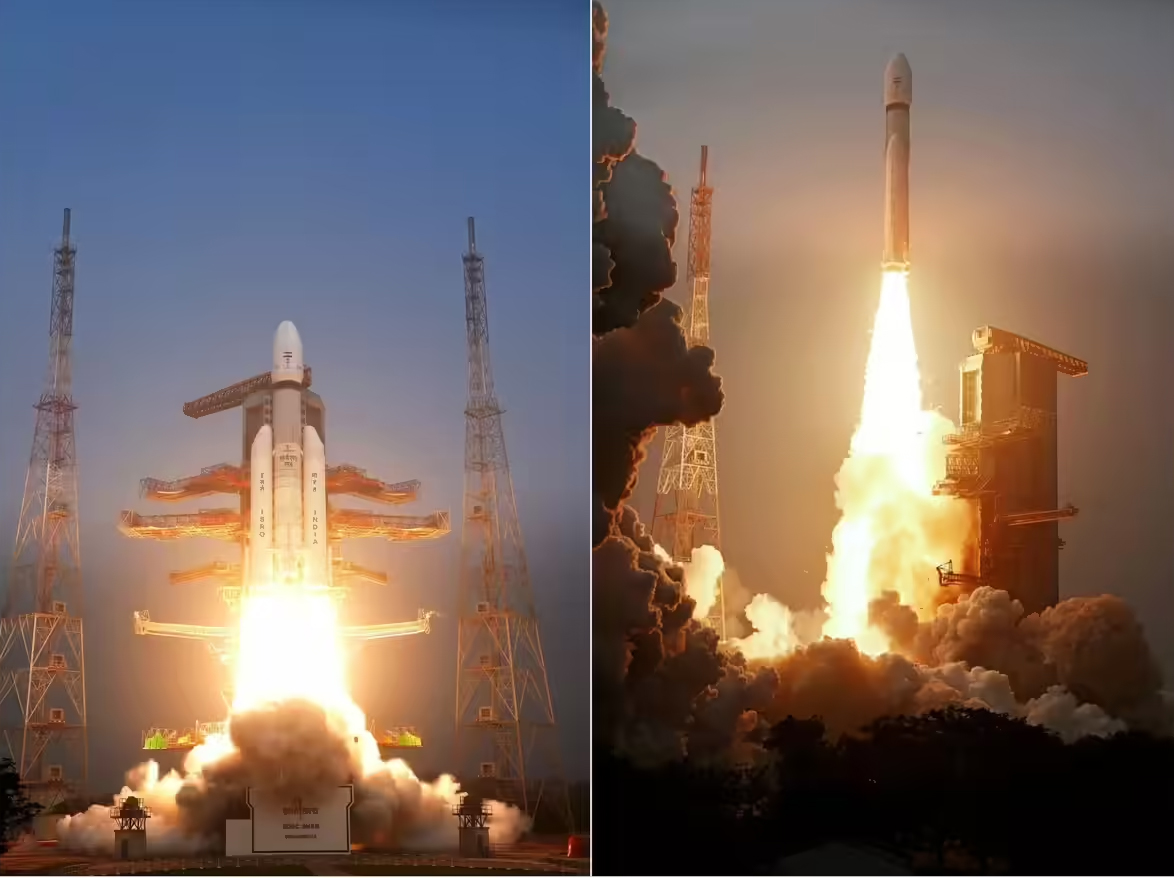
India’s space programme has long been admired for its scientific excellence and cost efficiency. The recent successful launch of the BlueBird Block-2 (BlueBird-6) communication satellite on 24 December 2025 marks a decisive shift in the nature of India’s engagement with outer space. It reflects India’s transition from a predominantly state-led scientific endeavour towards a commercially competitive and geopolitically consequential space economy. Executed by the Indian Space Research Organisation (ISRO) using the LVM3-M6 rocket from Sriharikota, the mission represents far more than a routine satellite launch.
-
-
- It signals India’s arrival on the global stage as a credible player in the domain of heavy commercial satellite launches and next-generation space-based connectivity. What distinguishes the BlueBird-6 mission is not merely its technical success, but the ecosystem it represents—one in which public capability, private enterprise, international cooperation, and strategic ambition are converging.
- It signals India’s arrival on the global stage as a credible player in the domain of heavy commercial satellite launches and next-generation space-based connectivity. What distinguishes the BlueBird-6 mission is not merely its technical success, but the ecosystem it represents—one in which public capability, private enterprise, international cooperation, and strategic ambition are converging.
-
About BlueBird Block-2 Satellite:
-
-
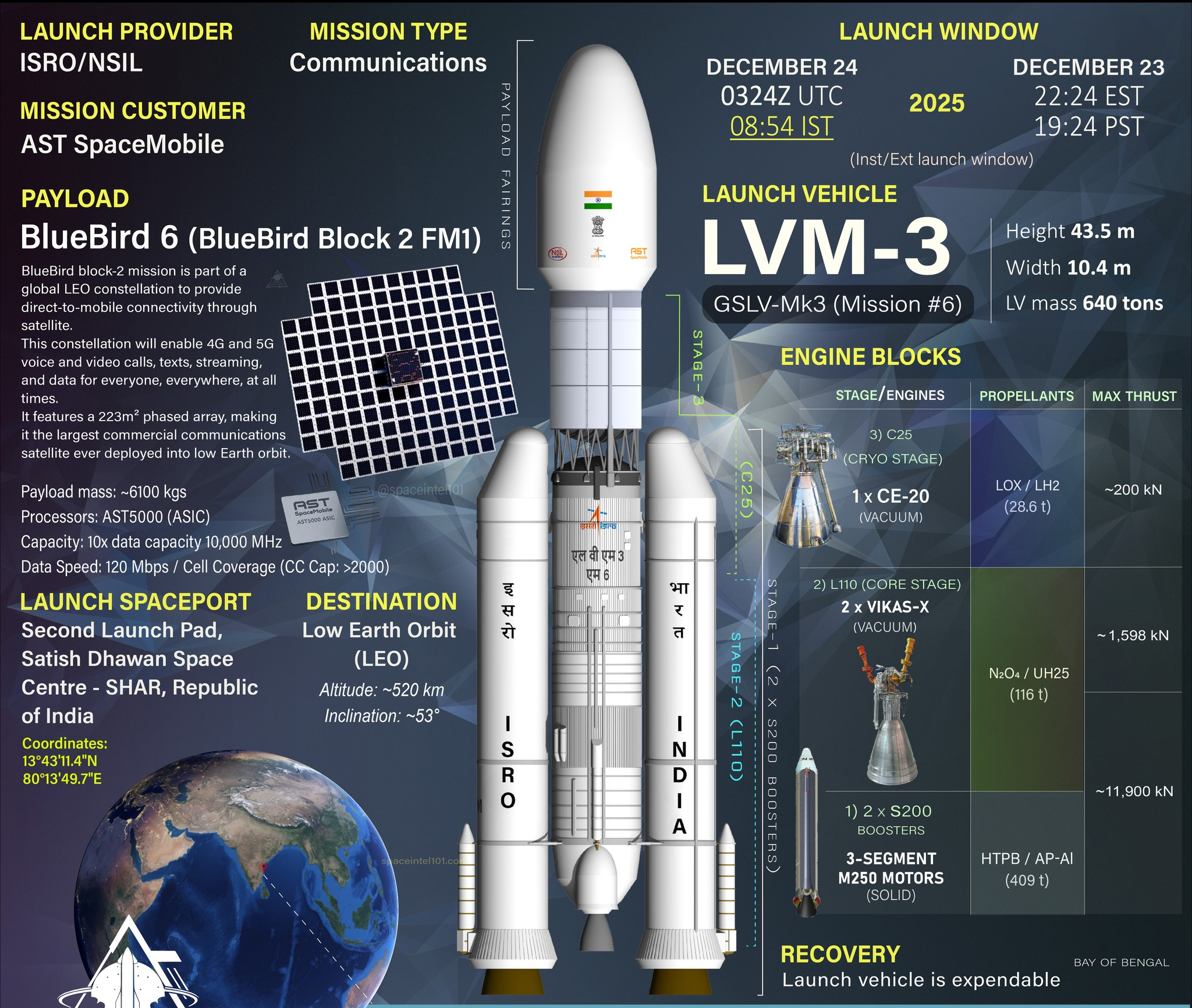
- The BlueBird Block-2 satellite, developed by AST SpaceMobile Inc., is part of a next-generation constellation designed to revolutionize global communications. Weighing approximately 6,500 kilograms, BlueBird-6 stands among the heaviest commercial satellites ever launched by ISRO, highlighting the maturity and robustness of India’s launch systems. The satellite is engineered to provide space-based cellular broadband connectivity directly to standard smartphones, eliminating the need for specialized ground terminals or infrastructure.
- A key feature of the BlueBird-6 satellite is its massive phased-array antenna system, covering nearly 2,400 square feet. These advanced antennas enable continuous, high-speed connectivity across vast geographical areas, particularly in remote, rural, and underserved regions where terrestrial networks are weak or non-existent. By enabling direct-to-device communication from space, the BlueBird constellation aims to bridge the global digital divide, supporting essential services such as emergency communications, education, healthcare access, and disaster response.
- The BlueBird Block-2 satellite, developed by AST SpaceMobile Inc., is part of a next-generation constellation designed to revolutionize global communications. Weighing approximately 6,500 kilograms, BlueBird-6 stands among the heaviest commercial satellites ever launched by ISRO, highlighting the maturity and robustness of India’s launch systems. The satellite is engineered to provide space-based cellular broadband connectivity directly to standard smartphones, eliminating the need for specialized ground terminals or infrastructure.
-
About LVM3 Rocket: Backbone of India’s Heavy-Lift Capability:
-
-
- The successful deployment of the BlueBird Block-2 satellite was made possible by ISRO’s most powerful operational launch vehicle, the LVM3, formerly known as GSLV Mk-III. The LVM3 is a three-stage, all-weather rocket incorporating solid, liquid, and cryogenic propulsion systems. It is capable of carrying payloads of up to 8,000 kilograms to Low Earth Orbit (LEO) and approximately 4,000 kilograms to Geosynchronous Transfer Orbit (GTO), making it central to India’s heavy-lift launch requirements.
- The LVM3 has already proven its reliability through several high-profile missions, including Chandrayaan-2, Chandrayaan-3, and multiple batches of OneWeb satellites. It also serves as the designated launch vehicle for India’s ambitious human spaceflight program, Gaganyaan. The successful launch of a complex and heavy commercial payload like BlueBird-6 further reinforces the LVM3’s credibility as a globally competitive launch platform.
- The successful deployment of the BlueBird Block-2 satellite was made possible by ISRO’s most powerful operational launch vehicle, the LVM3, formerly known as GSLV Mk-III. The LVM3 is a three-stage, all-weather rocket incorporating solid, liquid, and cryogenic propulsion systems. It is capable of carrying payloads of up to 8,000 kilograms to Low Earth Orbit (LEO) and approximately 4,000 kilograms to Geosynchronous Transfer Orbit (GTO), making it central to India’s heavy-lift launch requirements.
-
Commercial Arms of ISRO: Antrix and NSIL:
-
-
- India’s expanding presence in the global space market is driven by two key commercial entities under ISRO. The first is Antrix Corporation Limited (ACL), established in 1992 as ISRO’s original commercial and marketing arm. Antrix focuses on promoting ISRO’s existing capabilities worldwide, including launch services, satellite transponders, remote sensing data, and technology transfers.
- The second and more recent entity is NewSpace India Limited (NSIL), established in 2019 as part of India’s space sector reforms. NSIL plays a more comprehensive role by managing end-to-end commercial space activities. This includes satellite manufacturing through Indian industry, launch services, and execution of international commercial contracts. NSIL is central to enabling private sector participation, expanding industrial capacity, and transforming India from a government-driven space program into a commercially competitive ecosystem.
- The BlueBird-6 mission is a prime example of NSIL’s evolving role, where India not only provides launch services but also integrates commercial, diplomatic, and industrial objectives into a single mission.
- India’s expanding presence in the global space market is driven by two key commercial entities under ISRO. The first is Antrix Corporation Limited (ACL), established in 1992 as ISRO’s original commercial and marketing arm. Antrix focuses on promoting ISRO’s existing capabilities worldwide, including launch services, satellite transponders, remote sensing data, and technology transfers.
-
Strategic Implications of the BlueBird-6 Launch:
-
-
- Strategically, the successful launch of a sophisticated U.S. commercial satellite underscores the growing Indo-US collaboration in advanced space technologies. Space cooperation has emerged as a key pillar of bilateral relations, encompassing satellite launches, navigation systems, Earth observation, and deep-space exploration. By delivering a mission of such complexity, India enhances its credibility as a reliable and trusted launch partner for international clients.
- The mission also signals India’s readiness to compete with established global launch providers by offering cost-effective, dependable, and technologically advanced launch solutions. This strengthens India’s geopolitical standing and reinforces its role as a responsible spacefaring nation.
- Strategically, the successful launch of a sophisticated U.S. commercial satellite underscores the growing Indo-US collaboration in advanced space technologies. Space cooperation has emerged as a key pillar of bilateral relations, encompassing satellite launches, navigation systems, Earth observation, and deep-space exploration. By delivering a mission of such complexity, India enhances its credibility as a reliable and trusted launch partner for international clients.
-
Economic and Commercial Significance:
-
-
- Economically, the BlueBird-6 mission represents a major boost to India’s commercial space ambitions. Through NSIL, India can attract high-value international contracts, generate foreign revenue, and expand employment and industrial participation across the space supply chain. Indian companies benefit from opportunities in manufacturing, testing, integration, and support services associated with such missions.
- Furthermore, the mission positions India to capture a larger share of the rapidly growing global space economy, particularly in Low Earth Orbit broadband constellations. As demand for satellite-based internet connectivity increases worldwide, India’s ability to launch large, advanced communication satellites places it in a strong competitive position.
- Economically, the BlueBird-6 mission represents a major boost to India’s commercial space ambitions. Through NSIL, India can attract high-value international contracts, generate foreign revenue, and expand employment and industrial participation across the space supply chain. Indian companies benefit from opportunities in manufacturing, testing, integration, and support services associated with such missions.
-
India’s Booming Space Commercialization Ecosystem:
-
-
- India’s space sector is undergoing a profound transformation—from a government-dominated model led by ISRO to a vibrant, private sector-driven economy. India’s space economy, valued at approximately $8.4 billion in 2022, is projected to grow to nearly $44 billion by 2033, aiming to capture 8–10% of the global space market. This rapid growth is driven by policy reforms, startup innovation, global investment, and expanding downstream applications.
- A key driver of this transformation is the Indian Space Policy 2023, which opened the space sector to private participation, permitted 100% Foreign Direct Investment (FDI) in several segments, and provided a clear regulatory framework for non-government entities. These reforms have unlocked private capital and fostered innovation across the space value chain.
- As a result, over 400 space technology startups are now active in India, working across launch services, satellite manufacturing, Earth observation, data analytics, and space-based applications. Companies such as Pixxel, Skyroot Aerospace, and Agnikul Cosmos exemplify India’s growing private launch and satellite capabilities. Government support institutions like IN-SPACe (Indian National Space Promotion and Authorisation Centre) and NSIL facilitate authorization, infrastructure access, and industry collaboration, while new venture capital funds and global investors are accelerating growth.
- India’s space sector is undergoing a profound transformation—from a government-dominated model led by ISRO to a vibrant, private sector-driven economy. India’s space economy, valued at approximately $8.4 billion in 2022, is projected to grow to nearly $44 billion by 2033, aiming to capture 8–10% of the global space market. This rapid growth is driven by policy reforms, startup innovation, global investment, and expanding downstream applications.
-
Key Sectors and Activities:
-
-
- India’s commercial space growth spans multiple sectors. In manufacturing, private firms are increasingly building satellites, subsystems, and launch vehicle components, with emerging manufacturing clusters in southern India. In launch services, startups are developing cost-effective solutions, including small satellite launch vehicles (SSLV), which reduce barriers to space access.
- Space-based applications form another major growth area. Satellite data supports agriculture, water resource management (such as Jal Shakti initiatives), disaster relief, urban planning, climate monitoring, and national security. India is also advancing high-end capabilities, demonstrated by missions like SpaDeX (space docking experiment) and long-term plans for a national space station, reflecting growing technological ambition.
- India’s commercial space growth spans multiple sectors. In manufacturing, private firms are increasingly building satellites, subsystems, and launch vehicle components, with emerging manufacturing clusters in southern India. In launch services, startups are developing cost-effective solutions, including small satellite launch vehicles (SSLV), which reduce barriers to space access.
-
Conclusion:
The LVM3-M6 launch of the BlueBird Block-2 (BlueBird-6) communication satellite stands as a defining achievement in India’s evolving space ecosystem. It showcases ISRO’s heavy-lift launch capabilities, NSIL’s growing commercial role, and India’s expanding international partnerships. More broadly, it reflects the success of India’s space sector reforms, the rise of private enterprise, and the country’s ambition to lead in next-generation satellite communications and space applications. As India’s space commercialization accelerates, missions like BlueBird-6 symbolize a future where scientific excellence, economic growth, and global collaboration converge, cementing India’s place as a key driver of the global space economy.
| UPSC/PCS Mains Exam Question: The launch of the Bluebird Block-2 (Bluebird-6) communication satellite marks a qualitative shift in India's space program. In the light of this statement, analyse the commercialisation of India's space sector, the growing role of the private sector and its strategic and geopolitical implications. |



