
Context:
The Biological Weapons Convention (BWC) is regarded as a significant achievement in the global effort to prohibit biological weapons. The year 2025 marks the 50th anniversary of the Biological Weapons Convention (BWC), which comes at a time when rapid advances in science and technology are accompanied by increasingly complex security challenges. It is a historic international treaty aimed at the complete elimination of biological weapons. To mark this occasion, a recent high-level event held in New Delhi witnessed India’s External Affairs Minister highlighting a serious concern that the world remains inadequately prepared to address bioterrorism, and that the threat posed by non-state actors continues to grow.
-
-
- Rapid progress in modern biotechnology, synthetic biology, and dual-use research has transformed the nature of biological weapons threats, thereby necessitating stronger, coordinated global biosecurity frameworks and proactive international cooperation.
- Rapid progress in modern biotechnology, synthetic biology, and dual-use research has transformed the nature of biological weapons threats, thereby necessitating stronger, coordinated global biosecurity frameworks and proactive international cooperation.
-
Bioterrorism: The Emerging Threat:
INTERPOL defines bioterrorism as the deliberate release of biological agents or toxins to cause disease, fear, or political pressure. It poses unique challenges:
-
-
- High Casualty Potential: Rapid transmission can overwhelm public health systems.
- Detection and Attribution Difficulties: Biological attacks often resemble natural outbreaks.
- Dual-Use Research Risks: Advances in gene editing and synthetic biology heighten misuse potential.
- Low-Cost, High-Impact Nature: Biological weapons are cheaper than nuclear or chemical alternatives.
- Psychological and Economic Disruption: Panic and misinformation can destabilise societies and economies.
- High Casualty Potential: Rapid transmission can overwhelm public health systems.
-
The COVID-19 pandemic exposed global vulnerabilities in outbreak detection, response, and coordination, underscoring the challenges of managing highly contagious pathogens.

About the Biological Weapons Convention (BWC):
-
-
- The BWC, formally titled “The Convention on the Prohibition of the Development, Production and Stockpiling of Bacteriological (Biological) and Toxin Weapons and on their Destruction”, is a comprehensive international treaty that prohibits the development, production, acquisition, transfer, stockpiling, and use of biological and toxin weapons.
- A defining feature of the Convention is the General Purpose Criterion under Article I, which bans all biological agents, toxins, and related materials that lack legitimate peaceful, protective, or prophylactic purposes, rather than listing specific agents or technologies. This flexible and technology-neutral approach ensures the treaty’s continued relevance amid rapid scientific advancement.
- The BWC was opened for signature in 1972 and entered into force in 1975, with India ratifying it in 1974. Review Conferences are held every five years to align the treaty with evolving scientific, technological, and security developments. Importantly, the BWC supplements the 1925 Geneva Protocol, which prohibited only the use of biological weapons but did not address their development or stockpiling.
- By establishing a comprehensive prohibition regime, the BWC became the first multilateral treaty to eliminate an entire category of weapons of mass destruction.
- The BWC, formally titled “The Convention on the Prohibition of the Development, Production and Stockpiling of Bacteriological (Biological) and Toxin Weapons and on their Destruction”, is a comprehensive international treaty that prohibits the development, production, acquisition, transfer, stockpiling, and use of biological and toxin weapons.
-
Key Features of the BWC:
-
-
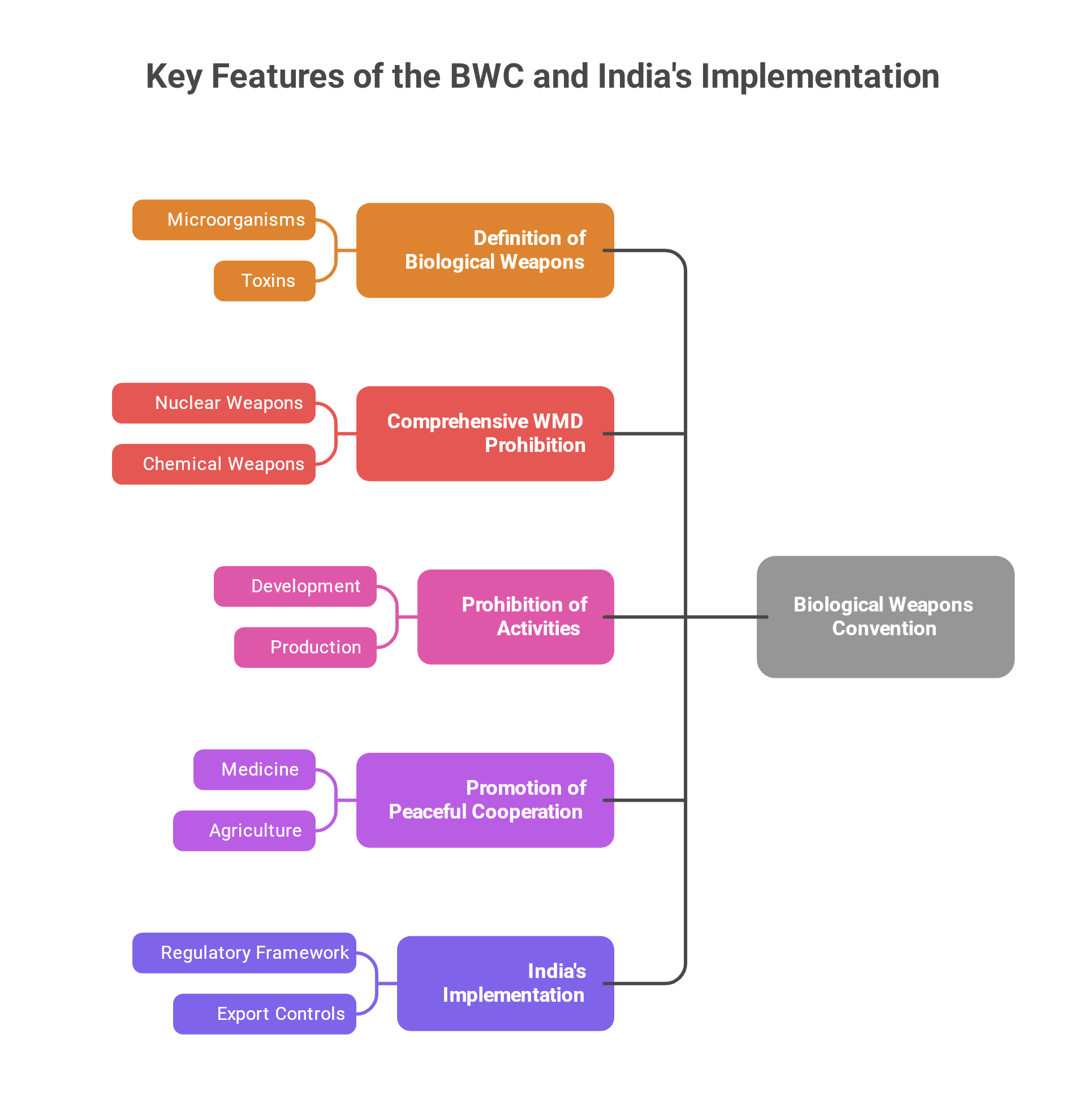
- Definition of Biological and Toxin Weapons: Biological weapons are defined as microorganisms (including viruses, bacteria, and fungi) or toxins deliberately used to cause disease or death in humans, animals, or plants.
- Comprehensive Weapons of mass destruction (WMD) Prohibition: The BWC is the first treaty to ban an entire category of weapons of mass destruction, setting a precedent for future arms control regimes. Weapons of mass destruction (WMD) are weapons that have the capacity to cause mass casualties and destruction, and include nuclear, chemical, and biological weapons.
- Prohibition of Activities: It prohibits the development, production, acquisition, stockpiling, transfer, and use of biological weapons.
- Promotion of Peaceful Cooperation: The Convention encourages international cooperation in medicine, agriculture, public health, and scientific research, reinforcing the principle that biology must be used for life, not destruction.
- Definition of Biological and Toxin Weapons: Biological weapons are defined as microorganisms (including viruses, bacteria, and fungi) or toxins deliberately used to cause disease or death in humans, animals, or plants.
-
Through these provisions, the BWC establishes a strong normative framework against the misuse of biological science.
India and the BWC:
-
-
- India has taken proactive steps to implement the BWC domestically, demonstrating its commitment to global biosecurity. Key elements of India’s regulatory framework include:
- Manufacture, Use, Import, Export and Storage of Hazardous Micro-organisms, Genetically Engineered Organisms or Cells Rules, 1989
- Weapons of Mass Destruction and their Delivery Systems (Prohibition of Unlawful Activities) Act, 2005
- Export controls under the Special Chemicals, Organisms, Materials, Equipment and Technologies (SCOMET) list
- Manufacture, Use, Import, Export and Storage of Hazardous Micro-organisms, Genetically Engineered Organisms or Cells Rules, 1989
- These measures ensure treaty compliance, regulate dual-use research, and strengthen national biosecurity preparedness. India has also been an active participant in BWC forums, consistently advocating modernisation of treaty mechanisms to address challenges arising from synthetic biology and emerging biotechnologies.
- India has taken proactive steps to implement the BWC domestically, demonstrating its commitment to global biosecurity. Key elements of India’s regulatory framework include:
-
Gaps and Limitations in the BWC:
Despite its pioneering role, the BWC suffers from several structural limitations:
-
-
- Absence of a Verification Mechanism: Unlike the Chemical Weapons Convention (CWC), enforced through the Organisation for the Prohibition of Chemical Weapons (OPCW), the BWC lacks an independent verification and inspection regime.
- Limited Mandate of the ISU: The Implementation Support Unit (ISU) performs primarily administrative functions and has no enforcement authority.
- Inadequate Oversight of Emerging Science:
Rapid advances in biotechnology, genetic engineering, and synthetic biology are not systematically monitored under the treaty. - Vulnerability to Non-State Actors: The relative accessibility, low cost, and high impact of biological weapons increase the risk of exploitation by terrorist groups.
- Absence of a Verification Mechanism: Unlike the Chemical Weapons Convention (CWC), enforced through the Organisation for the Prohibition of Chemical Weapons (OPCW), the BWC lacks an independent verification and inspection regime.
-
Measures to Strengthen Global Biosecurity:
A multi-dimensional approach is required to reinforce the BWC and global biosecurity:
-
-
- Robust National Implementation: Oversight of dual-use research, mandatory pathogen reporting, and structured incident response systems.
- Bio-Forensics and Attribution: Scientific capabilities to trace outbreaks and support investigations.
- Focus on the Global South: Equitable access to vaccines, medicines, and technologies to strengthen global resilience.
- Dual-Use Research Governance: Ethical review and regulatory frameworks to prevent misuse.
- Article VII Assistance Mechanism: The India–France proposal for a global support database to assist states facing biological threats.
- Enhanced International Cooperation: Collaboration in surveillance, information sharing, and capacity building.
- Confidence-Building Measures (CBMs): Data sharing, facility declarations, and legislative transparency.
- Supporting Agreements: Instruments such as the Cartagena Protocol on Biosafety (2000) promote safe handling of genetically modified organisms.
- Robust National Implementation: Oversight of dual-use research, mandatory pathogen reporting, and structured incident response systems.
-
Effective implementation of these measures would ensure the BWC remains relevant in an era of rapid technological change.
India’s Perspective:
-
-
- While the BWC has been instrumental in establishing a global norm against biological weapons, the contemporary threat landscape demands a more adaptive and proactive approach. The dual-use nature of biotechnology implies that traditional verification mechanisms alone may be insufficient. Moreover, the nature of threats has evolved, with non-state actors now possessing access to tools and information that were unimaginable at the time the treaty was negotiated.
- India’s advocacy for stronger compliance mechanisms, ethical oversight, and greater inclusion of Global South nations is not merely normative but also strategic. Vulnerable countries are likely to face disproportionate impacts from biological threats, making their integration into global biosecurity planning essential. In this context, enhanced international cooperation, scientific capacity-building, and rapid response mechanisms are critical for mitigating both natural outbreaks and deliberate biological misuse.
- While the BWC has been instrumental in establishing a global norm against biological weapons, the contemporary threat landscape demands a more adaptive and proactive approach. The dual-use nature of biotechnology implies that traditional verification mechanisms alone may be insufficient. Moreover, the nature of threats has evolved, with non-state actors now possessing access to tools and information that were unimaginable at the time the treaty was negotiated.
-
Conclusion:
The 50th anniversary of the Biological Weapons Convention is an opportunity to acknowledge its achievements while confronting persistent and emerging vulnerabilities. Although the BWC has played a crucial role in delegitimising biological weapons, the growing risks of bioterrorism, dual-use biotechnology, and non-state actor threats highlight the need for reform. Strengthening verification mechanisms, oversight of emerging science, rapid response capacity, and international cooperation, particularly with an emphasis on the Global South is essential to building a resilient, equitable, and effective global biosecurity architecture.
| UPSC/PCS Mains Practice Question: Bioterrorism is an emerging threat to India's internal security. In this context, evaluate the relevance of the Biological Weapons Convention (BWC) and discuss the measures required for India, highlighting its limitations. |



