
Context:
Recently, a case related to the copyright registration of an artwork created by Artificial Intelligence (AI) in India has raised the important question of whether an AI system can be considered the legal author of a work. This case highlights the need to clarify the relationship between AI, human creativity, and Intellectual Property Rights.
What is Copyright?
-
-
- Copyright is an Intellectual Property Right that grants creators of original literary, dramatic, musical, and artistic works, among other protected works, exclusive legal rights over the use of their creations.
- In India, the principal law related to copyright is the Copyright Act, 1957.
- Copyright is an Intellectual Property Right that grants creators of original literary, dramatic, musical, and artistic works, among other protected works, exclusive legal rights over the use of their creations.
-
Key features of Copyright:
-
-
- It provides legal protection to original works.
- It protects the original expression of ideas rather than the ideas themselves.
- It grants creators rights related to reproduction, distribution, and other uses of their works.
- It provides creators with opportunities for economic benefits and control over their creations.
- It provides legal protection to original works.
-
What is the DABUS Case?
-
-
- DABUS is an Artificial Intelligence system developed by American AI researcher Stephen Thaler. Thaler attempted to register the artwork ‘A Recent Entrance to Paradise’, created by DABUS, for copyright protection. In this case, the AI system was identified as the author of the work.
- This raised the following question: Can an AI system be granted the status of a legal author in the same manner as a human?
- In the context of the Indian copyright framework, the key point is that there is no explicit provision recognising AI itself as a legal author. For copyright protection of an AI-generated work, human creative contribution and the legal identification of the author become important.
- DABUS is an Artificial Intelligence system developed by American AI researcher Stephen Thaler. Thaler attempted to register the artwork ‘A Recent Entrance to Paradise’, created by DABUS, for copyright protection. In this case, the AI system was identified as the author of the work.
-
Legal Framework of Copyright in India:
-
-
- Copyright Act, 1957: This is the principal law governing copyright protection in India. Its objective is to protect the rights of creators and promote creative works.
- Section 2(d): Definition of Author: This section contains provisions related to the identification of the author of different types of works. It is particularly important in the context of computer-generated works.
- Section 13: Works in Which Copyright Subsists: This section deals with original literary, dramatic, musical, and artistic works, along with other works that may qualify for copyright protection.
- Section 17: First Owner of Copyright: Generally, the author is considered the first owner of copyright. However, exceptions may arise in circumstances involving employment, contracts, and other legal conditions.
- Copyright Act, 1957: This is the principal law governing copyright protection in India. Its objective is to protect the rights of creators and promote creative works.
-
Difference Between AI-Generated and AI-Assisted Works:
-
-
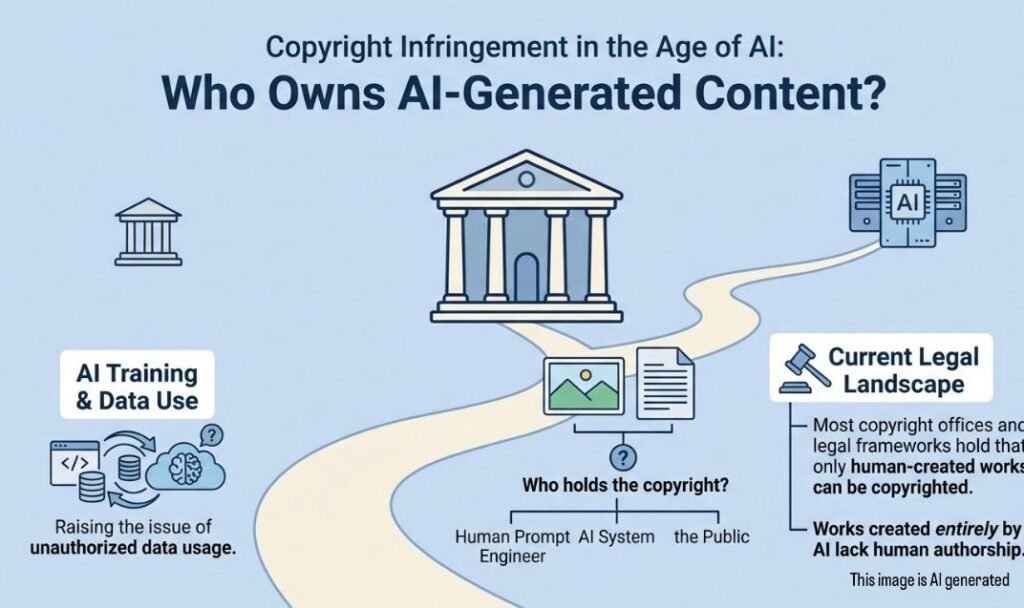
- AI-Generated Work:
- A work that is created largely independently by an AI system, where the direct creative contribution of a human may be limited.
- Key Question: Does the work contain sufficient human creative contribution?
- A work that is created largely independently by an AI system, where the direct creative contribution of a human may be limited.
- AI-Assisted Work
- A work in which a human plays a significant role in determining the subject, ideas, instructions, structure, selection, editing, and final creative decisions.
- The question now is: How significant is the human’s original contribution to the work? Therefore, merely using AI does not automatically exclude a human-created work from copyright protection. An assessment of the actual human creative contribution is necessary.
- A work in which a human plays a significant role in determining the subject, ideas, instructions, structure, selection, editing, and final creative decisions.
- AI-Generated Work:
-
Key Issues Related to AI and Copyright:
-
-
- Identification of the Author: Who will be the legal author of a work created by AI? Will it be the person who provided instructions to the AI, or the person who edited and developed the AI’s output?
- Determination of Originality: How will the originality of an AI-generated work be determined? Can merely providing an instruction be considered sufficient creative contribution?
- Use of Training Data: The legality of using books, images, music, news reports, and other copyright-protected materials to train AI models is an important issue.
- Liability for Copyright Infringement: If AI-generated content copies an existing work, who among the AI developer, user, or other concerned parties will be held responsible?
- Economic Interests of Creators: AI has made it possible to produce large amounts of content. This may affect the employment, remuneration, and rights of artists, writers, musicians, and other creators.
- Identification of the Author: Who will be the legal author of a work created by AI? Will it be the person who provided instructions to the AI, or the person who edited and developed the AI’s output?
-
Global Perspective:
-
-
- United States: The US copyright framework places central importance on human creativity. Content created solely by AI generally faces difficulty in obtaining copyright protection if it does not contain sufficient human creative contribution.
- United Kingdom: The UK’s Copyright, Designs and Patents Act, 1988, contains specific provisions relating to computer-generated works. In such cases, the person who undertook the necessary arrangements for the creation of the work may be considered the author.
- European Union: Along with the regulation of AI, the European Union is also focusing on the use of copyright-protected materials, transparency, and the interests of rights holders.
- United States: The US copyright framework places central importance on human creativity. Content created solely by AI generally faces difficulty in obtaining copyright protection if it does not contain sufficient human creative contribution.
-
Significance for India:
-
-
- Promotion of innovation and productivity in creative industries.
- New opportunities in the fields of Indian languages, education, design, films, and publishing.
- Low-cost content creation opportunities for small creators.
- Promotion of the development of the digital economy and AI-based industries.
- Promotion of innovation and productivity in creative industries.
-
Major Challenges:
-
-
- Protection of the economic interests and remuneration of creators.
- Unauthorised use of training data.
- Lack of accountability and transparency in AI-generated content.
- Need for clear criteria to assess original human creativity.
- Establishing a balance between AI technology and existing Intellectual Property Rights laws.
- Protection of the economic interests and remuneration of creators.
-
Way Forward:
-
-
- Legal Clarity: Clear guidelines should be developed under copyright law regarding AI-generated and AI-assisted works.
- Protection of Human Creativity: Original human creative contribution should be made a key basis for determining copyright protection.
- Transparent AI Framework: A system should be developed for appropriate disclosure regarding the training data, sources of content, and use of AI models.
- Stakeholder Dialogue: Extensive consultation among artists, writers, technology companies, publishers, and policymakers is necessary.
- International Cooperation: India should play an active role in developing common principles related to AI and Intellectual Property Rights on international platforms such as the World Intellectual Property Organization (WIPO).
- Legal Clarity: Clear guidelines should be developed under copyright law regarding AI-generated and AI-assisted works.
-
Conclusion:
-
-
- The DABUS case makes it clear that the originality of a work and the legal recognition of its author are two distinct questions. AI is transforming the creative process, but under the existing copyright framework, it is important to link authorship rights to a human or a legally recognised entity.
- India must establish a balance between promoting technological innovation and protecting the rights of creators. For this, a legal framework is required that can adapt to the development of AI and ensure effective protection of human creativity, economic interests, and Intellectual Property Rights.
- The DABUS case makes it clear that the originality of a work and the legal recognition of its author are two distinct questions. AI is transforming the creative process, but under the existing copyright framework, it is important to link authorship rights to a human or a legally recognised entity.
-
|
UPSC Mains Practice Question Question: “In the context of works created by Artificial Intelligence, the concepts of human authorship rights and copyright protection are giving rise to new legal challenges.” Discuss in the context of India. (150 words) |



