
Why in news?
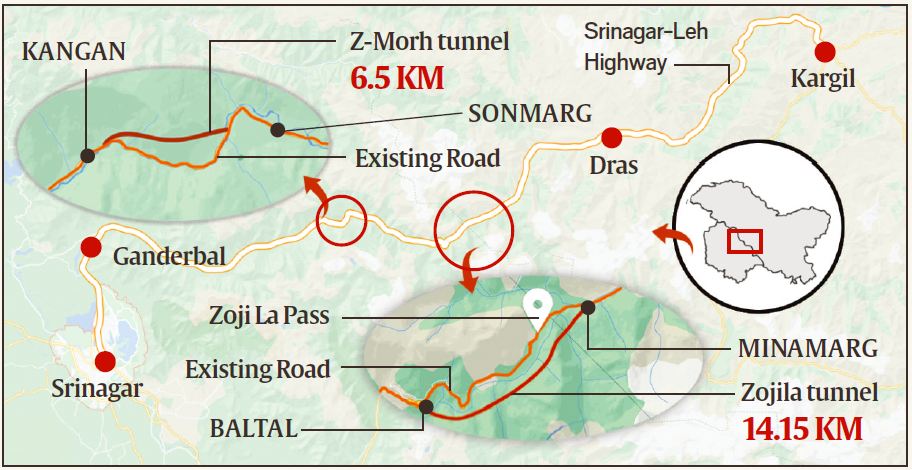
Recently, the final breakthrough of the strategically important 13.15-km-long Zojila Tunnel, which connects Kashmir with Ladakh, has been successfully completed.
Key Features and Geographic Location:
-
-
- The Zojila Tunnel will be Asia’s longest bi-directional single-tube road tunnel. It is located at an altitude of 11,578 feet in the Himalayas. The tunnel connects Ganderbal (Baltal) in Jammu & Kashmir with Dras (Minamarg) in Ladakh along National Highway-1 (NH-1), a crucial route linking the region.
- It is being constructed by Megha Engineering and Infrastructure Limited (MEIL) using the New Austrian Tunneling Method (NATM), a modern engineering technique suited for complex mountain geology. The project is expected to become fully operational by February 2028.
- The Zojila Tunnel will be Asia’s longest bi-directional single-tube road tunnel. It is located at an altitude of 11,578 feet in the Himalayas. The tunnel connects Ganderbal (Baltal) in Jammu & Kashmir with Dras (Minamarg) in Ladakh along National Highway-1 (NH-1), a crucial route linking the region.
-
Strategic Importance:
-
-
- The tunnel will provide all-weather connectivity between Kashmir and Ladakh. At present, the Zojila Pass remains closed for 3–4 months during winter due to heavy snowfall and avalanches, cutting off Ladakh from the rest of India. Once completed, the tunnel will ensure uninterrupted 365-day connectivity.
- It will significantly reduce travel time across the Zojila route from about 3.5 hours to just 15 minutes. This will also help reduce fuel consumption, emissions, and overall transportation costs.
- From a national security perspective, the tunnel is highly significant as it lies close to the Line of Control (LoC) and the Line of Actual Control (LAC). It will greatly improve India’s defence preparedness by enabling the continuous movement of troops, military equipment, tanks, and essential supplies even during harsh winter conditions.
- The tunnel will provide all-weather connectivity between Kashmir and Ladakh. At present, the Zojila Pass remains closed for 3–4 months during winter due to heavy snowfall and avalanches, cutting off Ladakh from the rest of India. Once completed, the tunnel will ensure uninterrupted 365-day connectivity.
-
Regional Economy and Tourism Development:
-
-
- The tunnel is expected to boost the regional economy of Ladakh, which often faces winter isolation and high prices of essential goods due to disrupted supply chains. Improved connectivity will lower transport costs and support smoother movement of goods and services.
- It will also promote tourism throughout the year, especially winter tourism, thereby generating new employment opportunities and supporting local livelihoods in the region.
- The tunnel is expected to boost the regional economy of Ladakh, which often faces winter isolation and high prices of essential goods due to disrupted supply chains. Improved connectivity will lower transport costs and support smoother movement of goods and services.
-
Conclusion:
The Zojila Tunnel is not only an engineering marvel but also a key pillar of inclusive development in the Himalayan region. It is expected to be a game-changer in securing India’s sovereignty and territorial integrity amid twin-front challenges with China and Pakistan.



