
WHO Declares Ebola Emergency in Congo and Uganda
Context:
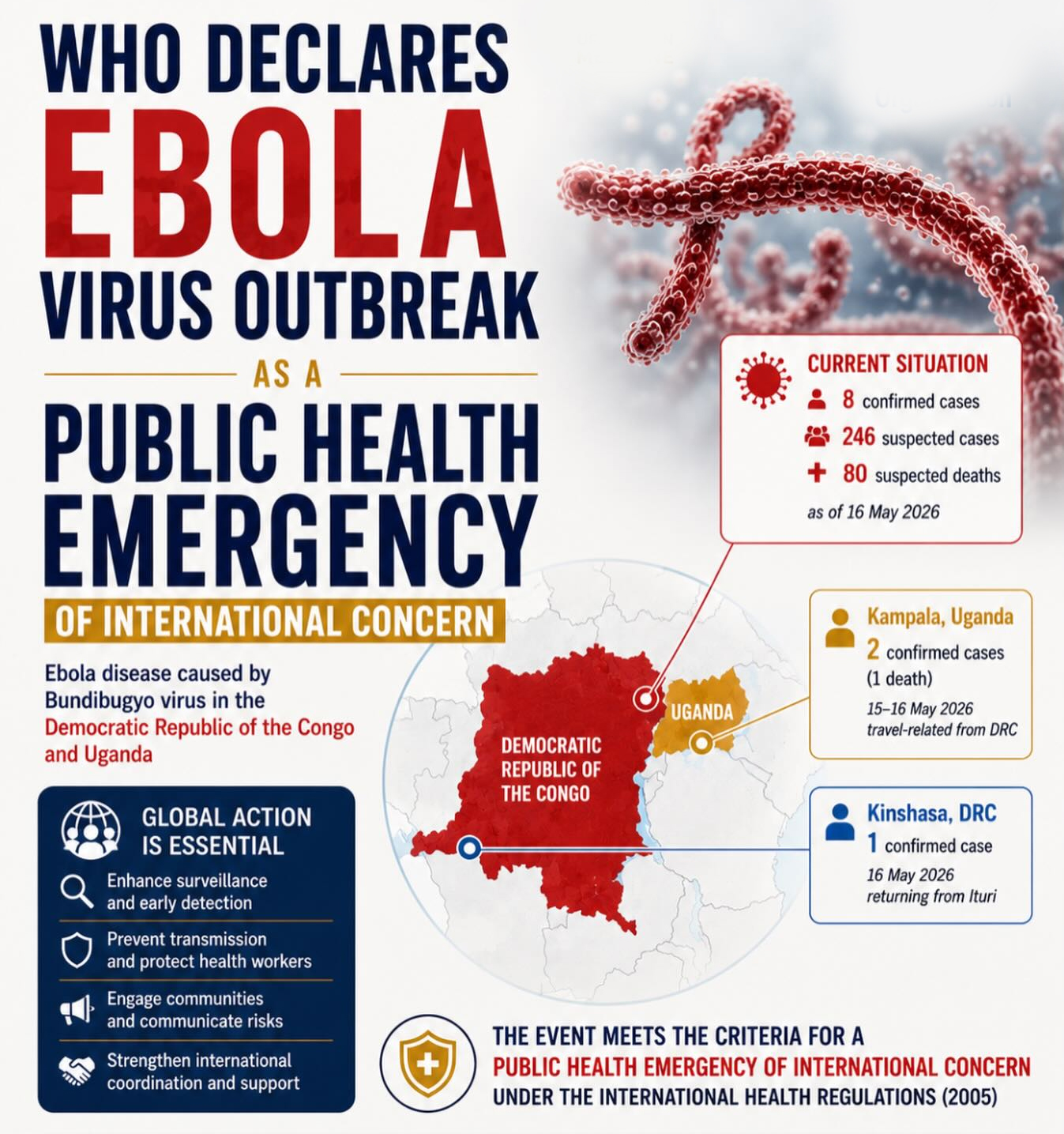
Recently, the World Health Organization declared the Ebola outbreak in the Democratic Republic of the Congo and Uganda a Public Health Emergency of International Concern (PHEIC).
About Current Situation of the Outbreak:
-
-
-
- According to WHO reports, eight laboratory-confirmed Ebola cases and 246 suspected cases have been identified in Ituri Province of the Democratic Republic of the Congo. Around 80 suspected deaths have also been reported. Uganda confirmed two Ebola cases in Kampala. The infected individuals had travelled from the Democratic Republic of the Congo, raising concerns about cross-border transmission.
- WHO clarified that although the outbreak is severe and requires coordinated international action, it does not currently qualify as a pandemic emergency like COVID-19. The organization also advised countries against imposing international travel or border restrictions, as such actions may disrupt humanitarian assistance and trade.
- According to WHO reports, eight laboratory-confirmed Ebola cases and 246 suspected cases have been identified in Ituri Province of the Democratic Republic of the Congo. Around 80 suspected deaths have also been reported. Uganda confirmed two Ebola cases in Kampala. The infected individuals had travelled from the Democratic Republic of the Congo, raising concerns about cross-border transmission.
-
-
What is Ebola Virus Disease?
-
-
-
- Ebola Virus Disease (EVD) is a severe and often fatal infectious disease caused by viruses belonging to the genus Orthoebolavirus. It is a zoonotic disease, meaning it spreads from animals to humans. The disease causes haemorrhagic fever and has an average fatality rate of nearly 50%.
- The present outbreak is caused by the Bundibugyo strain, a rare type of Ebola virus for which no approved vaccines or therapeutics currently exist. Although Congo and Uganda have faced Ebola outbreaks earlier, this is only the third outbreak linked to the Bundibugyo strain.
- Ebola Virus Disease (EVD) is a severe and often fatal infectious disease caused by viruses belonging to the genus Orthoebolavirus. It is a zoonotic disease, meaning it spreads from animals to humans. The disease causes haemorrhagic fever and has an average fatality rate of nearly 50%.
-
-
Transmission of Ebola Virus:
The Ebola virus mainly originates in wild animals such as fruit bats and spreads to humans through direct contact with infected animals or bodily fluids.
Diagnostic Tests and Treatment:
-
-
-
- Laboratory testing is essential for confirming Ebola infection. Major diagnostic methods include RT-PCR tests, Antibody-Capture ELISA tests, antigen detection tests, and virus isolation by cell culture.
- WHO recommends treatments such as mAb114 (Ansuvimab) and REGN-EB3 (Inmazeb). Key containment measures include isolation of patients, contact tracing, safe burial practices, improved sanitation, use of protective equipment, and public awareness campaigns.
- Laboratory testing is essential for confirming Ebola infection. Major diagnostic methods include RT-PCR tests, Antibody-Capture ELISA tests, antigen detection tests, and virus isolation by cell culture.
-
-
About the World Health Organization (WHO):
-
-
-
- The WHO is the United Nations’ specialized agency for international public health. Established in 1948 and headquartered in Geneva, Switzerland, it coordinates global efforts to combat diseases, strengthen healthcare systems, and respond to health emergencies.
- WHO currently works with 194 member states and operates through regional and country offices worldwide, including India.
- The WHO is the United Nations’ specialized agency for international public health. Established in 1948 and headquartered in Geneva, Switzerland, it coordinates global efforts to combat diseases, strengthen healthcare systems, and respond to health emergencies.
-
-
Conclusion:
The Ebola outbreak in Congo and Uganda demonstrates the continuing threat posed by infectious diseases. WHO’s declaration emphasizes the importance of global cooperation, disease surveillance and rapid public health response mechanisms to prevent international spread and protect global health security.



