
VB-G RAM G Act, 2025
Context:
Recently, the Government of India notified commencement of the Viksit Bharat – Guarantee for Rozgar and Ajeevika Mission (Gramin) Act, 2025 (VB-G RAM G Act) across rural India with effect from 1 July 2026.
About the Act:
-
-
- The VB-G RAM G Act, 2025 is a rural employment law designed to modernise India’s wage employment system. It aims to strengthen livelihood security, create durable rural infrastructure, enhance transparency through digital governance, and promote climate-resilient development.
- The Act replaces the Mahatma Gandhi National Rural Employment Guarantee Act and represents a major restructuring of rural employment policy, shifting emphasis from welfare-based job provision to productivity, asset creation, and sustainable rural development aligned with long-term national goals.
- The Act aligns rural employment with the vision of Viksit Bharat @2047, integrating job provision with productive asset creation. Guided by “Rozgar Bhi, Samman Bhi”, it emphasises dignity in work, decentralised planning, and long-term socio-economic transformation of rural areas.
- The VB-G RAM G Act, 2025 is a rural employment law designed to modernise India’s wage employment system. It aims to strengthen livelihood security, create durable rural infrastructure, enhance transparency through digital governance, and promote climate-resilient development.
-
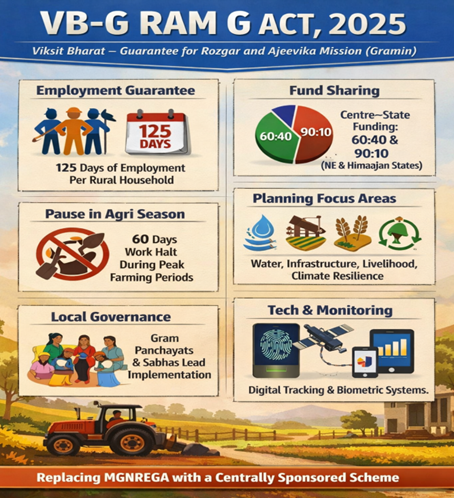
Key Features of the VB-G RAM G Act, 2025:
-
-
- Enhanced Employment Guarantee: Increased from 100 to 125 days per rural household annually.
- Thematic Works: Focus on water security, rural infrastructure, livelihood assets, and climate resilience.
- Digital Governance: Biometric authentication, geo-tagging, NMMS attendance, GIS planning, real-time dashboards, and DBT-based wage payments.
- Decentralised Planning: Gram Panchayats prepare Viksit Gram Panchayat Plans (VGPPs) through Gram Sabhas.
- Timely Wages: Payment within 15 days with 0.05% daily compensation for delays.
- Worker Welfare: Provision of drinking water, shade, first aid, and childcare facilities at worksites.
- Transparency Measures: Mandatory social audits and mobile-based monitoring systems.
- Seasonal Flexibility: States may allow up to 60 days pause during peak agricultural seasons.
- Enhanced Employment Guarantee: Increased from 100 to 125 days per rural household annually.
-
Benefits of the Act:
The Act improves livelihood security through extended employment days and strengthens rural infrastructure such as irrigation and connectivity. It boosts climate resilience through conservation and disaster mitigation works. Digital governance reduces corruption and delays, ensuring transparency and efficiency. Women’s participation is encouraged through childcare support and improved workplace facilities. Decentralised planning empowers local governance and ensures community-driven development.
Conclusion:
The VB-G RAM G Act, 2025 marks a shift toward a productivity-oriented rural development model integrating employment, infrastructure, and sustainability. Its success will depend on efficient implementation, digital inclusion, and timely fund flow to ensure inclusive and equitable rural transformation under Viksit Bharat @2047.



