
Context:
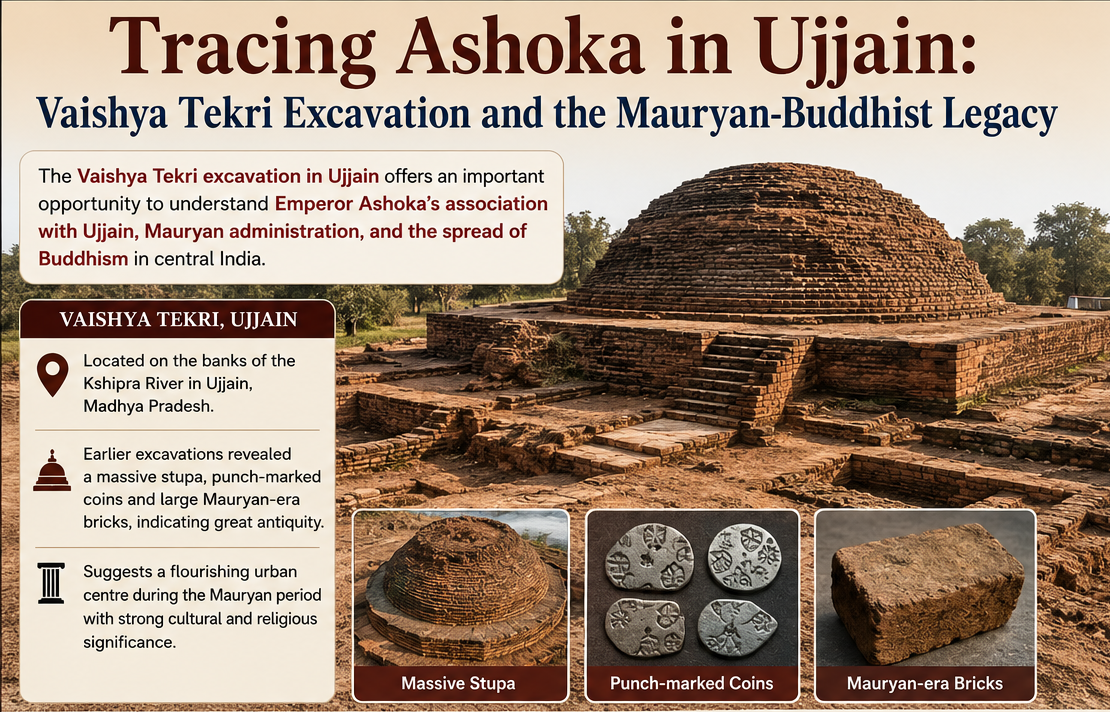
Recently, the Archaeological Survey of India (ASI) and the Madhya Pradesh government have been considering the re-excavation and conservation of the Vaishya Tekri site in Ujjain, Madhya Pradesh. The mound is believed to contain the remains of a massive Buddhist stupa, possibly dating back to the Mauryan period. Nearly 90 years after its first excavation, Vaishya Tekri has once again emerged as a major archaeological focus in Ujjain.
Excavation of Vaishya Tekri:
-
-
- The first systematic excavation of Vaishya Tekri was carried out in 1938-39 by the Archaeology Department of the erstwhile Gwalior State. The excavation report described a structure approximately 350 feet in diameter and at least 100 feet high. For comparison, the Great Stupa at Sanchi, in its present form, is approximately 54 feet high.
- The mound contained an extremely massive and compact core made of locally available murram, over which brick masonry had been constructed. The discovery of large-sized bricks and coins during the excavation was regarded as evidence suggesting a Mauryan-period association.
- The first systematic excavation of Vaishya Tekri was carried out in 1938-39 by the Archaeology Department of the erstwhile Gwalior State. The excavation report described a structure approximately 350 feet in diameter and at least 100 feet high. For comparison, the Great Stupa at Sanchi, in its present form, is approximately 54 feet high.
-
Possible Association with Ashoka:
-
-
- Ujjain was an important centre of the Mauryan Empire and has traditionally been associated with the early life of Emperor Ashoka. This has led to the theory that Vaishya Tekri could be one of the stupas constructed under Ashoka’s patronage and promotion of Buddhism.
- However, no definitive inscription has yet been discovered to establish that the monument was commissioned by Ashoka. Therefore, identifying it as an Ashokan-period stupa remains a plausible but unproven conclusion.
- Ujjain was an important centre of the Mauryan Empire and has traditionally been associated with the early life of Emperor Ashoka. This has led to the theory that Vaishya Tekri could be one of the stupas constructed under Ashoka’s patronage and promotion of Buddhism.
-
Why is the Re-Excavation Important?
-
-
- Fresh excavation at Vaishya Tekri could help establish its precise chronology, original architectural plan, and different phases of construction. Archaeologists may also uncover evidence of monasteries, smaller stupas, and other remains associated with Buddhist activities in and around ancient Ujjain.
- If the dimensions recorded in the earlier excavation reports and the proposed Mauryan-period dating are confirmed, the site could make an important contribution to our understanding of Buddhism in central India, Mauryan patronage, and large-scale monumental architecture.
- Fresh excavation at Vaishya Tekri could help establish its precise chronology, original architectural plan, and different phases of construction. Archaeologists may also uncover evidence of monasteries, smaller stupas, and other remains associated with Buddhist activities in and around ancient Ujjain.
-
Ashokan-Period Stupas:
-
-
- Ashokan-period stupas played an important role in the development of Buddhist architecture in India. In the 3rd century BCE, Emperor Ashoka promoted Buddhism and the propagation of Dhamma across his empire. Stupas became important centres for preserving sacred relics and promoting Buddhist traditions.
- Early stupas were generally hemispherical structures made of brick and plaster. Their principal architectural elements included the anda, or dome; harmika; yashti; chhatra; and a pradakshina patha for ritual circumambulation.
- Ashokan-period stupas played an important role in the development of Buddhist architecture in India. In the 3rd century BCE, Emperor Ashoka promoted Buddhism and the propagation of Dhamma across his empire. Stupas became important centres for preserving sacred relics and promoting Buddhist traditions.
-
Conclusion:
Vaishya Tekri has considerable potential to emerge as an important Buddhist archaeological site. Its reported monumental dimensions make its comparison with the Sanchi Stupa particularly significant. A fresh investigation and excavation nearly nine decades after the original excavation could provide valuable insights into the role of Ujjain in the early history and spread of Buddhism in India.



