
Context:
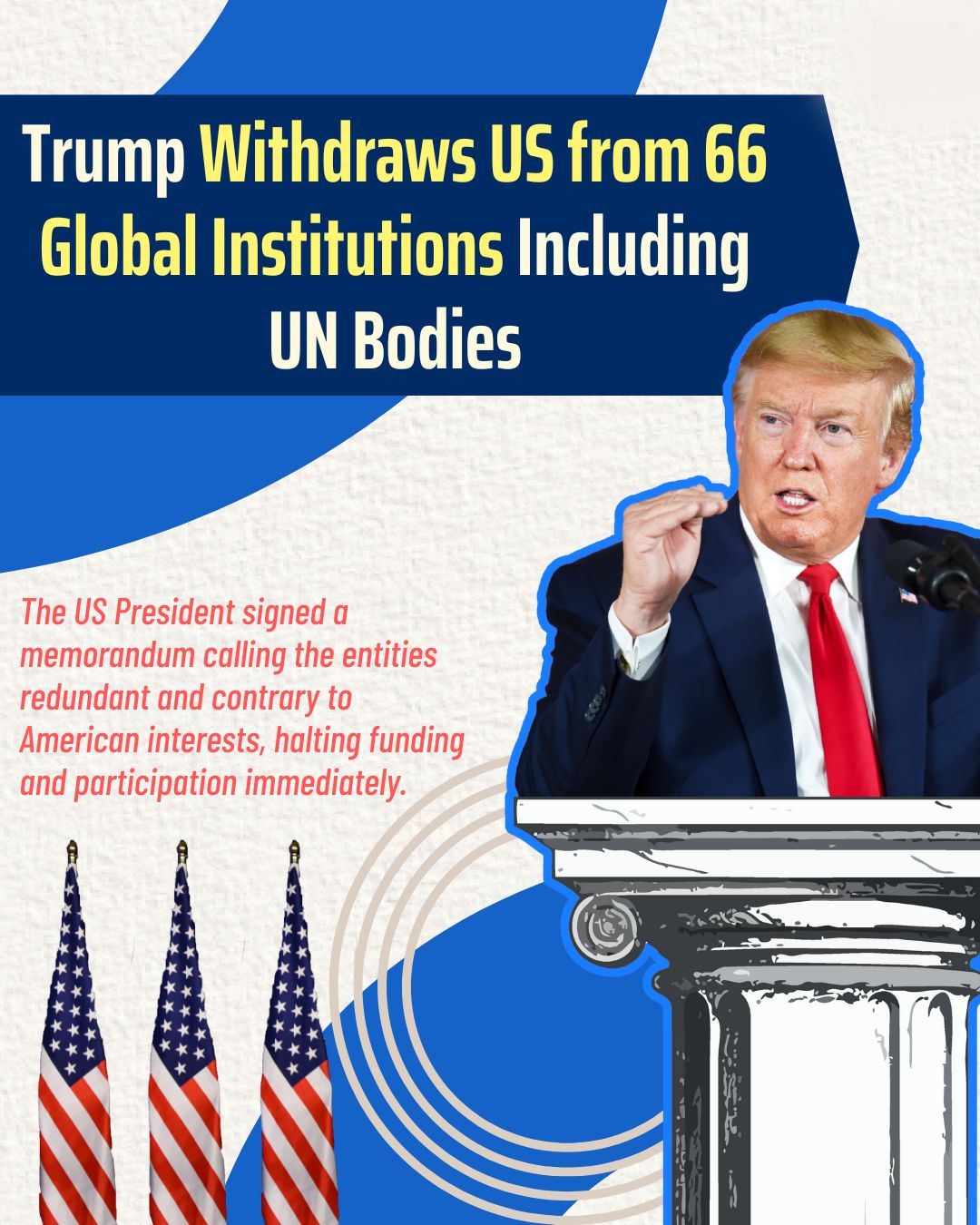
Recently, the United States announced its withdrawal from 66 international organisations, including 31 UN-linked bodies and 35 non-UN organisations such as the International Solar Alliance (ISA), the Intergovernmental Panel on Climate Change (IPCC) and the United Nations Framework Convention on Climate Change (UNFCCC). The White House framed this decision as a measure to protect national sovereignty and reduce engagement with institutions perceived as inefficient or inconsistent with US interests.
Rationale Behind the Move:
The decision reflects the “America First” doctrine, which emphasises that multilateral commitments should align with domestic priorities and taxpayer interests. US officials argued that participation in global bodies often constrains national policymaking and does not always yield measurable benefits. Supporters of the move view it as a reassertion of sovereignty and autonomy in international affairs.
Global and Strategic Implications:
-
-
- Multilateralism at Risk: The withdrawal weakens institutions addressing climate change, public health, and development, potentially leading to fragmentation in global governance.
- Climate Diplomacy and ISA: Exiting climate platforms undermines US influence in global climate negotiations. Withdrawal from the ISA disrupts collaborative renewable energy initiatives and may create space for other powers, such as China, to expand their influence.
- Power Dynamics: Reduced US engagement creates a leadership vacuum in multilateral institutions, allowing the EU, China, and emerging economies to shape norms and standards, potentially altering global decision-making frameworks.
- Multilateralism at Risk: The withdrawal weakens institutions addressing climate change, public health, and development, potentially leading to fragmentation in global governance.
-
Challenges and Criticisms:
-
-
- Critics argue that the move undermines international cooperation, weakens responses to shared global crises, and may erode US credibility. The claim of organisational inefficiency is viewed as subjective, overlooking the long-term benefits of collaboration such as data sharing, standard-setting, and conflict resolution.
- Humanitarian and development-focused agencies may face funding and capacity constraints, adversely affecting low-income countries dependent on international support.
-
Indian and Regional Perspective:
For India, the US withdrawal from the ISA and climate-related bodies is a diplomatic setback but also presents an opportunity to strengthen South–South cooperation. India’s leadership in renewable energy and climate coalitions remains intact, although the country may need to recalibrate partnerships with other major stakeholders.
Conclusion:
The US exit highlights the tension between sovereignty-driven foreign policy and global responsibility. While the move reinforces domestic priorities, it risks weakening multilateral frameworks essential for addressing transnational challenges. For India and the wider international community, it underscores the importance of strategic autonomy, sustained multilateral engagement, and adaptive diplomacy in an evolving geopolitical landscape.



