
Context:
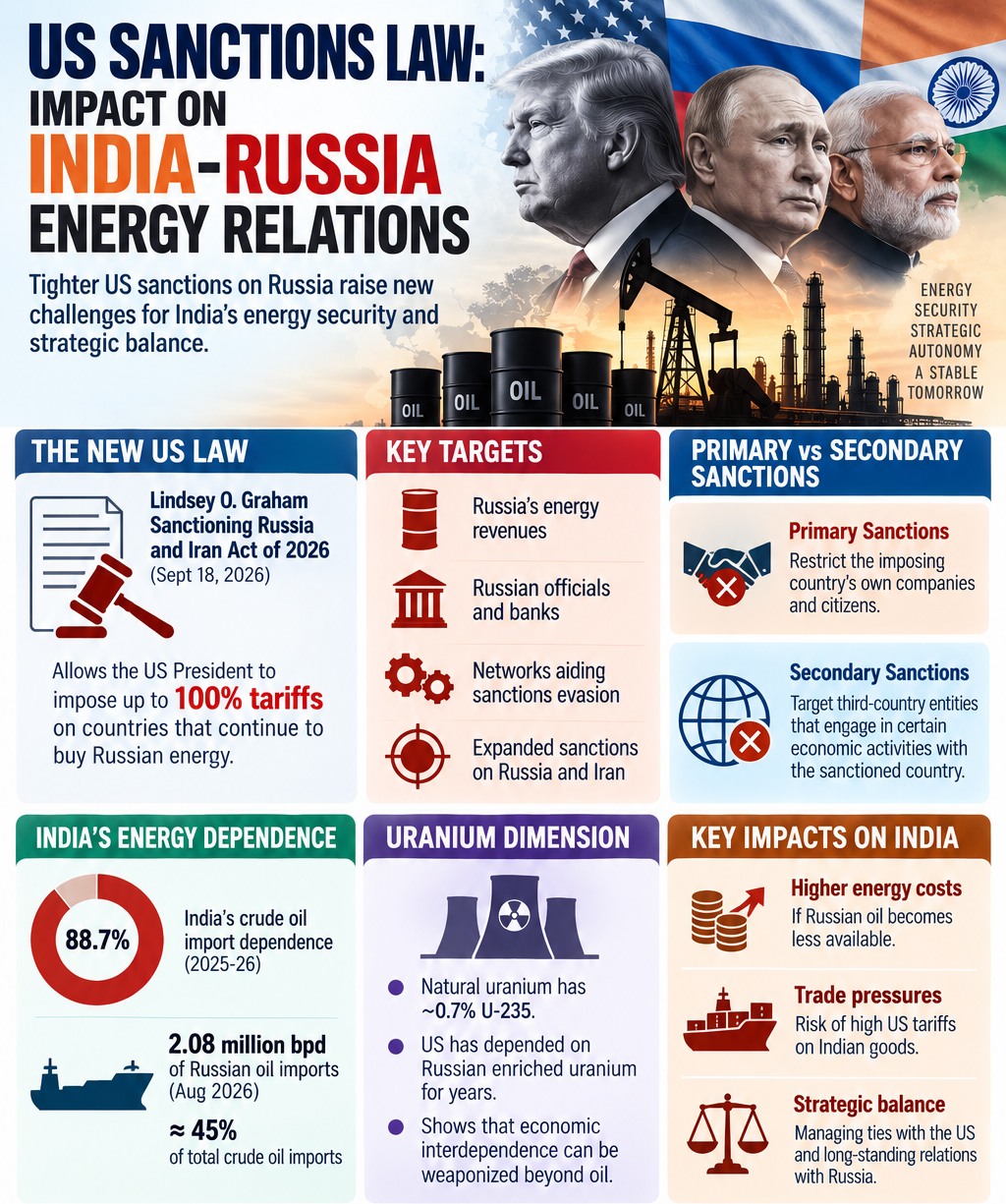
On September 18, 2026, USA President Donald Trump signed the Lindsey O. Graham Sanctioning Russia and Iran Act of 2026 into law. This legislation strengthens sanctions and tariff provisions on Russia and authorizes the US President to impose additional tariffs of up to 100% on certain countries that continue to purchase Russian energy. India and China are among the key countries affected by this provision.
Key Features of the Law:
-
-
- The primary purpose of this legislation is to impact Russia's energy and defense revenues and increase economic pressure on Russia in the context of the Ukraine war. It provides for action against Russian officials, banks, energy interests, and networks that facilitate sanctions evasion. It also expands existing sanctions related to Russia and Iran.
- Importantly, the 100% tariff does not automatically apply to India. The legislation authorizes the US President to impose additional tariffs on goods from countries that purchase large quantities of Russian oil or natural gas under certain circumstances. The final targets and tariff rates will depend on the US administration's decision.
- The primary purpose of this legislation is to impact Russia's energy and defense revenues and increase economic pressure on Russia in the context of the Ukraine war. It provides for action against Russian officials, banks, energy interests, and networks that facilitate sanctions evasion. It also expands existing sanctions related to Russia and Iran.
-
Economic Sanctions and Secondary Sanctions:
-
-
- Economic sanctions are a means of restricting trade, finance, investment, or asset-related activities to exert economic pressure on a country, entity, or individual.
- Primary sanctions: The imposing country prohibits its companies and citizens from conducting certain transactions with the targeted country.
- Secondary sanctions: Action may also be taken against companies or entities in a third country if they engage in certain economic activities with the sanctioned country.
- Primary sanctions: The imposing country prohibits its companies and citizens from conducting certain transactions with the targeted country.
- Thus, secondary sanctions can have economic impacts beyond a country's borders.
- Economic sanctions are a means of restricting trade, finance, investment, or asset-related activities to exert economic pressure on a country, entity, or individual.
-
The Question of Energy Security for India:
-
-
- India imports a significant portion of its crude oil needs. In 2025-26, India's crude oil import dependence reached 88.7%.
- India increased its purchases of Russian crude oil amid sanctions and price-capping on Russian oil by Western countries following the Russia-Ukraine war. In August 2026, India imported approximately 2.08 million barrels per day of Russian oil, representing about 45% of its total crude oil imports. However, in July, this share was approximately 55.9%.
- This is due not only to political relations, but also to price, availability, refining capacity, and supply reliability. Therefore, a complete switch to Russian oil could be challenging for India.
- India imports a significant portion of its crude oil needs. In 2025-26, India's crude oil import dependence reached 88.7%.
-
Uranium and US Dependence:
-
-
- This issue is also important in the context of uranium. Natural uranium contains approximately 0.7% U-235. For use as fuel in light-water reactors, it must be enriched to a higher U-235 concentration.
- The US has long been dependent on Russian enriched uranium. US laws have attempted to limit the import of Russian low-enriched uranium (LEU), but the transition has been a complex process due to energy security concerns and limitations on domestic enrichment capacity. The USITC has also noted the important role of Russian enriched uranium in the US market.
- This example shows that the weaponization of economic interdependence is not limited to oil and gas. Trade, finance, technology, critical minerals, and nuclear fuel can also become instruments of geopolitical pressure.
- This issue is also important in the context of uranium. Natural uranium contains approximately 0.7% U-235. For use as fuel in light-water reactors, it must be enriched to a higher U-235 concentration.
-
Impact on India-Russia Relations:
-
-
- The new US law poses three major challenges for India:
- Energy costs: Decreased availability of Russian oil may force India to increase imports from more expensive sources.
- Trade pressures: If high US tariffs are imposed on India, India-US trade may face additional pressure.
- Strategic balance: India must maintain a balance between its growing strategic partnership with the US and its long-standing defense and energy ties with Russia.
- Energy costs: Decreased availability of Russian oil may force India to increase imports from more expensive sources.
- For India, the answer lies not in purchasing oil from a single source, but in diversifying import sources, strengthening domestic production, strategic petroleum reserves, renewable energy, and energy efficiency.
- The new US law poses three major challenges for India:
-
Conclusion:
The new phase of US sanctions on Russia reflects the increasing role of geoeconomics in the global economy. The challenge for India is not a simple choice between maintaining or severing energy ties with Russia, but rather a balancing of energy security, economic interests, strategic autonomy, and relations with major powers. The current situation underlines the need for India to develop a more diversified and resilient energy system in the long term.



