
Context:
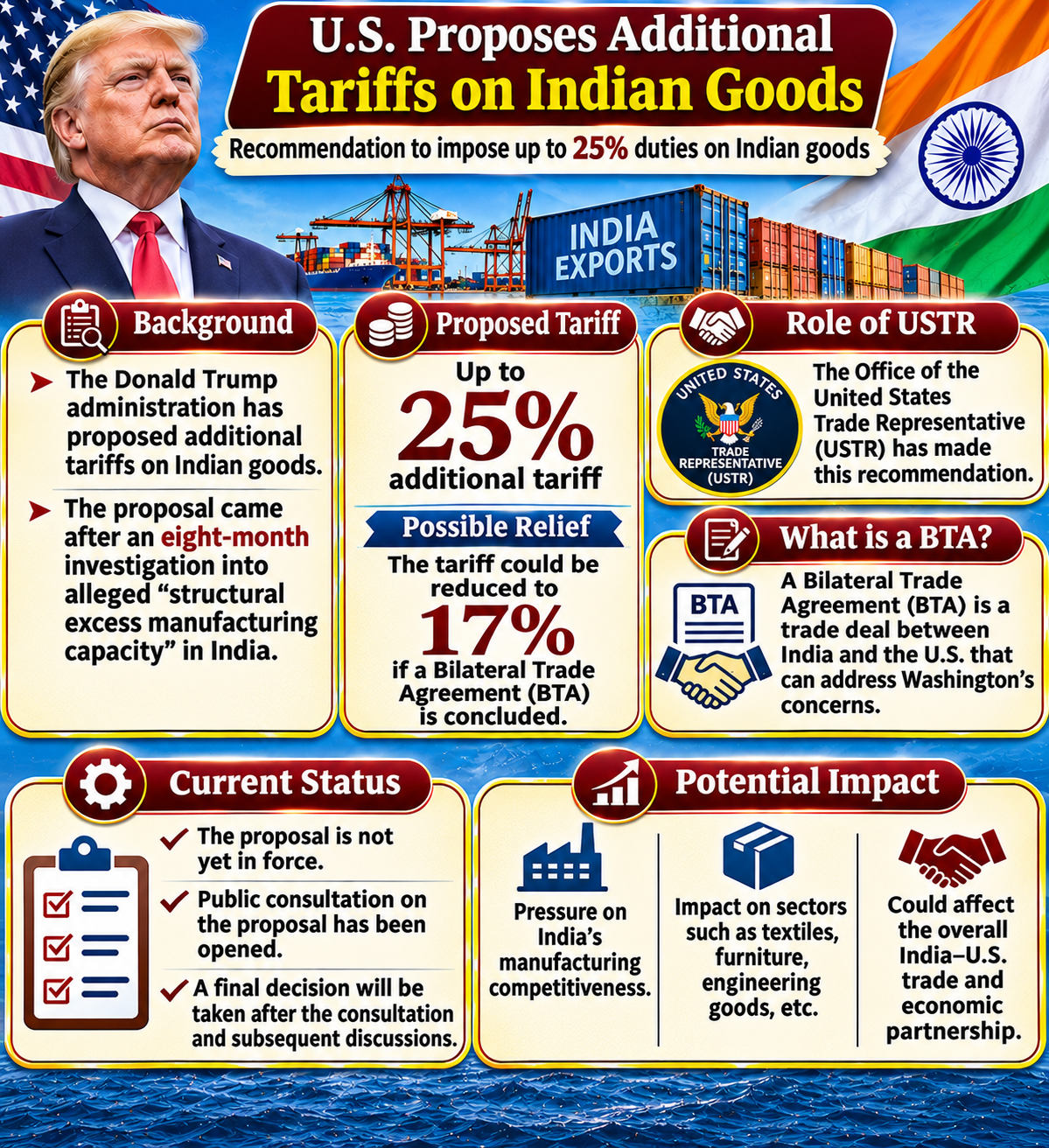
Recently, The Donald Trump administration has proposed additional tariffs of up to 25% on Indian goods following an eight-month investigation into alleged structural excess manufacturing capacity. According to the Office of the United States Trade Representative (USTR), the tariff could be reduced to 17% if India and the US conclude a Bilateral Trade Agreement (BTA) addressing Washington's concerns. The proposal is not yet in force and is open to public consultation.
About India–US Trade Relations:
-
-
- The US is among India's largest trading partners, with bilateral trade covering merchandise, services, pharmaceuticals, textiles, engineering goods and information technology.
- Both countries initiated negotiations for a Bilateral Trade Agreement in February 2025 to expand market access and strengthen economic cooperation. However, differences over agricultural access, import duties, industrial policies and regulatory barriers have complicated negotiations.
- The US is among India's largest trading partners, with bilateral trade covering merchandise, services, pharmaceuticals, textiles, engineering goods and information technology.
-
Why Has the US Proposed New Tariffs?
-
-
- The USTR launched an investigation in March 2026 under Section 301 of the Trade Act, 1974. It alleged that manufacturing policies in India and other economies create structural excess capacity, resulting in overproduction and unfair competition for American industries.
- The investigation identified concerns involving pharmaceuticals, medical devices, steel, solar products and information and communications technology (ICT). It also examined industrial initiatives such as Make in India and Production-Linked Incentive (PLI) schemes.
- The USTR launched an investigation in March 2026 under Section 301 of the Trade Act, 1974. It alleged that manufacturing policies in India and other economies create structural excess capacity, resulting in overproduction and unfair competition for American industries.
-
Proposed Tariff Rates:
The investigation covered 16 economies, of which the USTR announced determinations against 14 on November 25, 2026. It proposed the following rates:
|
Country/region |
Proposed tariff |
|
India |
Up to 25% |
|
China |
Up to 20% under this proposal |
|
Vietnam |
Up to 35% |
|
Bangladesh |
Up to 18% |
|
Indonesia |
Up to 18% |
|
Malaysia |
Up to 18% |
|
European Union |
15% |
What is Section 301 of the US Trade Act, 1974?
-
-
- Section 301 empowers the USTR to investigate foreign government policies and practices that allegedly burden or restrict US commerce. It allows the US administration to impose trade measures, including additional tariffs, against practices determined to be unfair or discriminatory.
- The latest proposal also follows the US Supreme Court's invalidation of the earlier IEEPA-based reciprocal tariff regime, prompting the administration to pursue alternative legal mechanisms.
- Section 301 empowers the USTR to investigate foreign government policies and practices that allegedly burden or restrict US commerce. It allows the US administration to impose trade measures, including additional tariffs, against practices determined to be unfair or discriminatory.
-
Implications for India:
-
-
- Higher tariffs could reduce the price competitiveness of Indian exports in the US market, affecting textiles, pharmaceuticals, engineering goods, steel and MSMEs.
- They may also squeeze exporters' profit margins, affect employment and discourage fresh manufacturing investments.
- At the strategic level, trade tensions could complicate cooperation in critical technologies and supply-chain diversification.
- Higher tariffs could reduce the price competitiveness of Indian exports in the US market, affecting textiles, pharmaceuticals, engineering goods, steel and MSMEs.
-
Way Forward:
India should pursue diplomatic negotiations, diversify export destinations towards the EU, ASEAN and Africa, improve domestic manufacturing competitiveness and strengthen MSME export capabilities. It should also explore appropriate WTO mechanisms and negotiate mutually beneficial trade arrangements while safeguarding sensitive domestic sectors.
Conclusion:
The proposed US tariffs highlight the growing challenge of protectionism and unilateral trade measures in the global economy. India must balance export competitiveness, strategic autonomy and domestic manufacturing priorities while maintaining constructive relations with the United States.