
Context:
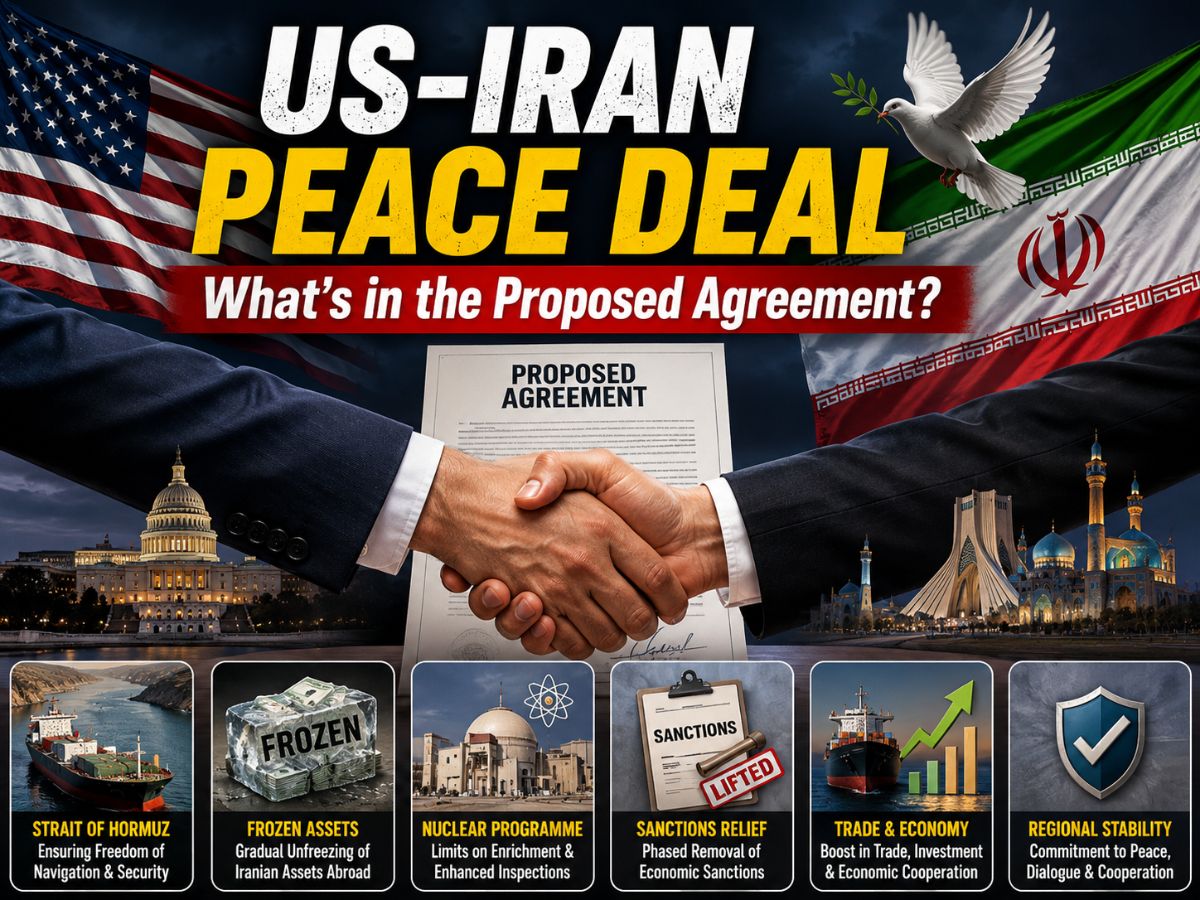
Recently, a new US–Iran Memorandum of Understanding (MoU) has been signed to extend a ceasefire and initiate a broader peace framework between the two countries following recent conflict involving Iran and United States, alongside tensions involving regional actors in the Middle East.
Key Highlights of the Agreement:
End to Hostilities
-
-
- Immediate and “permanent” cessation of military operations on all fronts
- Includes commitment to avoid escalation in Lebanon and surrounding regions
- Immediate and “permanent” cessation of military operations on all fronts
-
Respect for Sovereignty
-
-
- Mutual pledge by the US and Iran to respect:
- Territorial integrity
- Internal political affairs
- Territorial integrity
- Designed to reduce interference in domestic governance structures
- Mutual pledge by the US and Iran to respect:
-
60-Day Negotiation Timeline
-
-
- A maximum 60-day window set for negotiating a final peace deal
- Timeline may be extended with mutual consent
- Countdown begins from signing of the MoU
- A maximum 60-day window set for negotiating a final peace deal
-
Maritime and Blockade Adjustments
-
-
- US to begin lifting naval restrictions and easing maritime constraints
- Full rollback of blockade-related measures within 30 days
- Gradual normalization of shipping in Iranian ports
- US to begin lifting naval restrictions and easing maritime constraints
-
Strait of Hormuz: Free Navigation
-
-
- Iran to ensure safe and uninterrupted passage through the Strait of Hormuz
- No transit charges for commercial vessels
- Restoration of global energy and trade flows through the waterway
- Joint future framework planned with Gulf states
- Iran to ensure safe and uninterrupted passage through the Strait of Hormuz
-
Economic Reconstruction Fund
-
-
- Proposed $300 billion reconstruction and development fund for Iran
- Fund to be developed by US and regional partners
- US not required to directly contribute financially
- Focus on infrastructure and economic recovery
- Proposed $300 billion reconstruction and development fund for Iran
-
Sanctions Framework
-
-
- Commitment to eventually lift US economic sanctions on Iran
- Includes both unilateral US sanctions and UN-linked measures
- Timeline linked to Iran’s compliance with nuclear obligations
- Commitment to eventually lift US economic sanctions on Iran
-
Nuclear Non-Proliferation Commitment
-
-
- Iran agrees not to develop or acquire nuclear weapons
- Existing enriched uranium stockpiles to be managed under supervision of the International Atomic Energy Agency (IAEA)
- Mechanism for disposal or dilution to be decided in follow-up negotiations
- Iran agrees not to develop or acquire nuclear weapons
-
Interim Nuclear Status Quo
-
-
- Temporary freeze on major changes to Iran’s nuclear programme
- No new sanctions during negotiation period
- Limited waivers for oil and financial transactions
- Temporary freeze on major changes to Iran’s nuclear programme
-
Frozen Assets Release
-
-
- US to release part of Iran’s frozen funds
- Disbursement linked to compliance milestones
- US to release part of Iran’s frozen funds
-
Monitoring and Implementation
-
-
- Creation of a joint monitoring mechanism
- Supervision of compliance and implementation of the MoU
- Final agreement to be endorsed through a UN Security Council resolution
- Creation of a joint monitoring mechanism
-
Strategic Significance:
Energy Security
-
-
- Reopening of the Strait of Hormuz stabilizes global oil supply chains
- Reduces volatility in international crude oil prices
- Reopening of the Strait of Hormuz stabilizes global oil supply chains
-
Geopolitical De-escalation
-
-
- Reduces risk of direct US–Iran military confrontation
- Impacts regional dynamics involving West Asian conflicts
- Reduces risk of direct US–Iran military confrontation
-
Nuclear Diplomacy
-
-
- Reinforces non-proliferation framework under IAEA oversight
- Attempts to limit Iran’s nuclear breakout capacity
- Reinforces non-proliferation framework under IAEA oversight
-
Economic Re-engagement
-
-
- Potential reintegration of Iran into global financial systems
- Large-scale reconstruction funding signals economic normalization
- Potential reintegration of Iran into global financial systems
-
Challenges and Concerns:
-
- Verification Issues: Monitoring Iran’s nuclear compliance remains complex
- Regional Reaction: Uncertainty over response from allies like Israel and Gulf states
- Implementation Gap: Many provisions depend on future negotiations
- Political Risks: Domestic opposition in both countries may affect durability
- Verification Issues: Monitoring Iran’s nuclear compliance remains complex
Conclusion:
The US–Iran MoU represents a significant diplomatic attempt to stabilize one of the world’s most volatile geopolitical regions. However, its success depends on sustained compliance, effective verification mechanisms, and political will on both sides to transition from a ceasefire framework to a durable peace agreement.



