
Context:
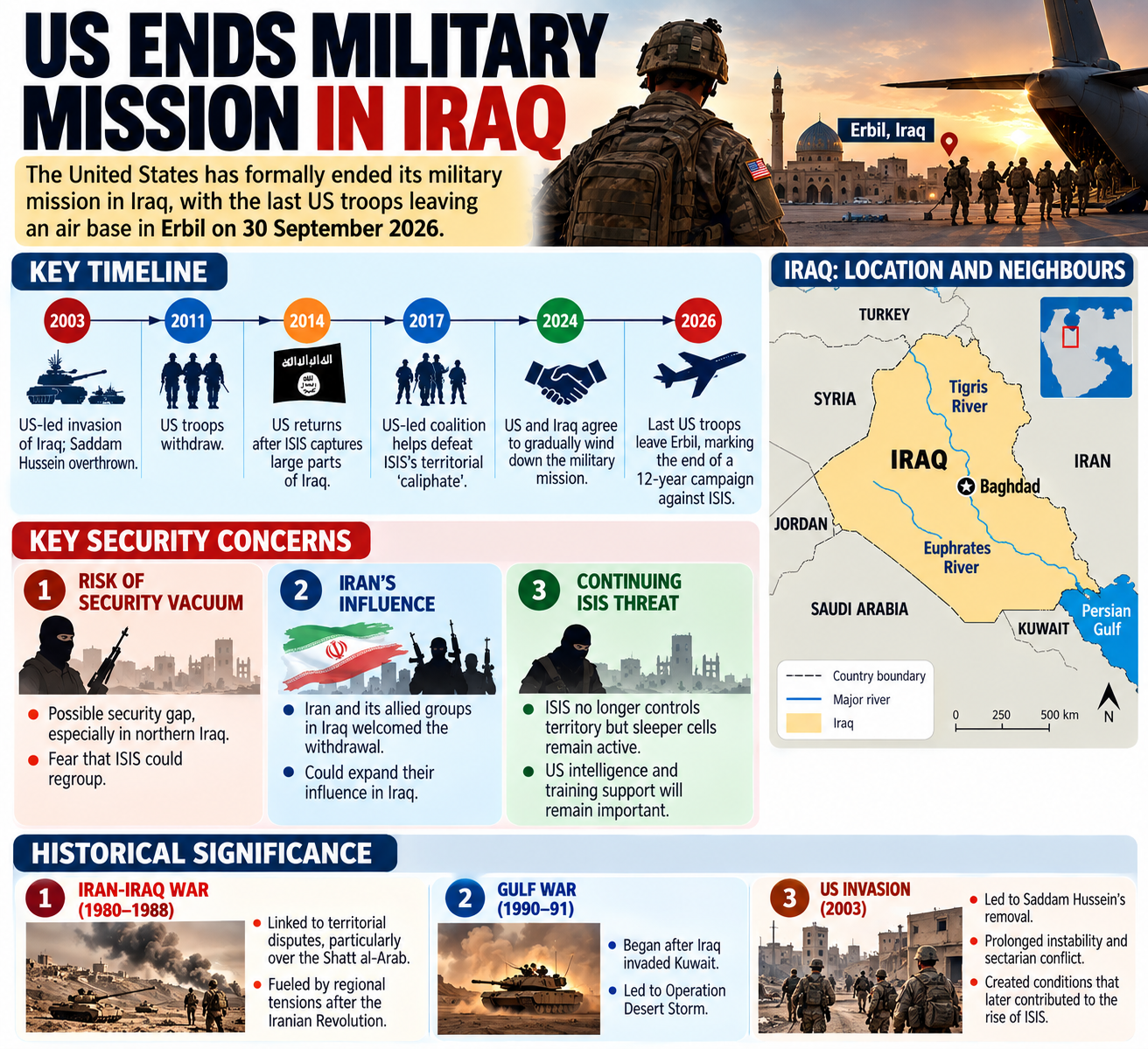
Recently, The United States has formally ended its military mission in Iraq, with the Pentagon announcing on 30 September 2026 that the last US troops and equipment had left an air base in Erbil, in Iraq’s semi-autonomous Kurdish region. The Pentagon described the withdrawal as an “orderly departure”, marking the end of a 12-year campaign against the Islamic State (ISIS).
Background:
-
-
- The US-led invasion of Iraq began in 2003, resulting in the overthrow of Saddam Hussein. US troops initially withdrew in 2011 but returned in 2014 after ISIS captured large parts of Iraq.
- The US-led coalition helped Iraqi forces defeat ISIS's territorial “caliphate” by 2017. Since then, ISIS has largely operated through scattered sleeper cells.
- In 2024, Washington and Baghdad agreed to gradually wind down the US-led military mission. Most US troops had already left Iraqi bases, with only a few hundred remaining in the Kurdish north.
- The US-led invasion of Iraq began in 2003, resulting in the overthrow of Saddam Hussein. US troops initially withdrew in 2011 but returned in 2014 after ISIS captured large parts of Iraq.
-
Security Concerns:
-
-
- Risk of Security Vacuum: The withdrawal has raised concerns about a possible security gap, particularly in northern Iraq. There are fears that ISIS could regroup and Iran-backed militias could expand their influence.
- Iran’s Influence: Iran and armed groups it supports in Iraq welcomed the US withdrawal. The development is particularly significant because the US is currently at war with Iran, while Iran-backed militias in Iraq have attacked US forces.
- Continuing ISIS Threat: Although ISIS no longer controls territory, its sleeper cells remain a security concern. Continued US intelligence and training assistance will therefore remain important.
- Risk of Security Vacuum: The withdrawal has raised concerns about a possible security gap, particularly in northern Iraq. There are fears that ISIS could regroup and Iran-backed militias could expand their influence.
-
Significance for India:
India has major interests in a stable West Asia due to:
-
-
- Energy security and crude oil imports.
- Safety of the Indian diaspora.
- Trade and investment with the region.
- Counter-terrorism cooperation.
- Regional connectivity initiatives such as IMEC.
- Instability in Iraq could affect oil prices, shipping routes, diaspora security and India's economic interests.
- Energy security and crude oil imports.
-
Geography of Iraq:
-
-
- Iraq is strategically located in West Asia, with Baghdad situated on the Tigris River. It borders Turkey, Iran, Syria, Jordan, Saudi Arabia and Kuwait and has a short coastline on the Persian Gulf.
- The Tigris and Euphrates are its major rivers and merge to form the Shatt al-Arab, making the region important for water resources and geopolitics.
- Iraq is strategically located in West Asia, with Baghdad situated on the Tigris River. It borders Turkey, Iran, Syria, Jordan, Saudi Arabia and Kuwait and has a short coastline on the Persian Gulf.
-
Historical Significance:
-
-
- Iran-Iraq War (1980–1988): Linked to territorial disputes, particularly over the Shatt al-Arab, and regional tensions following the Iranian Revolution.
- Gulf War (1990–91): Began after Iraq invaded Kuwait and led to Operation Desert Storm.
- US Invasion (2003): Led to Saddam Hussein's removal, prolonged instability and sectarian conflict, creating conditions that later contributed to the rise of ISIS.
- Iran-Iraq War (1980–1988): Linked to territorial disputes, particularly over the Shatt al-Arab, and regional tensions following the Iranian Revolution.
-
Conclusion:
The US withdrawal marks a shift from a coalition-led military mission to Iraqi-led security. Its success will depend on Iraq's ability to prevent an ISIS resurgence, manage armed militias and maintain a balance among competing regional powers.



