
Context:
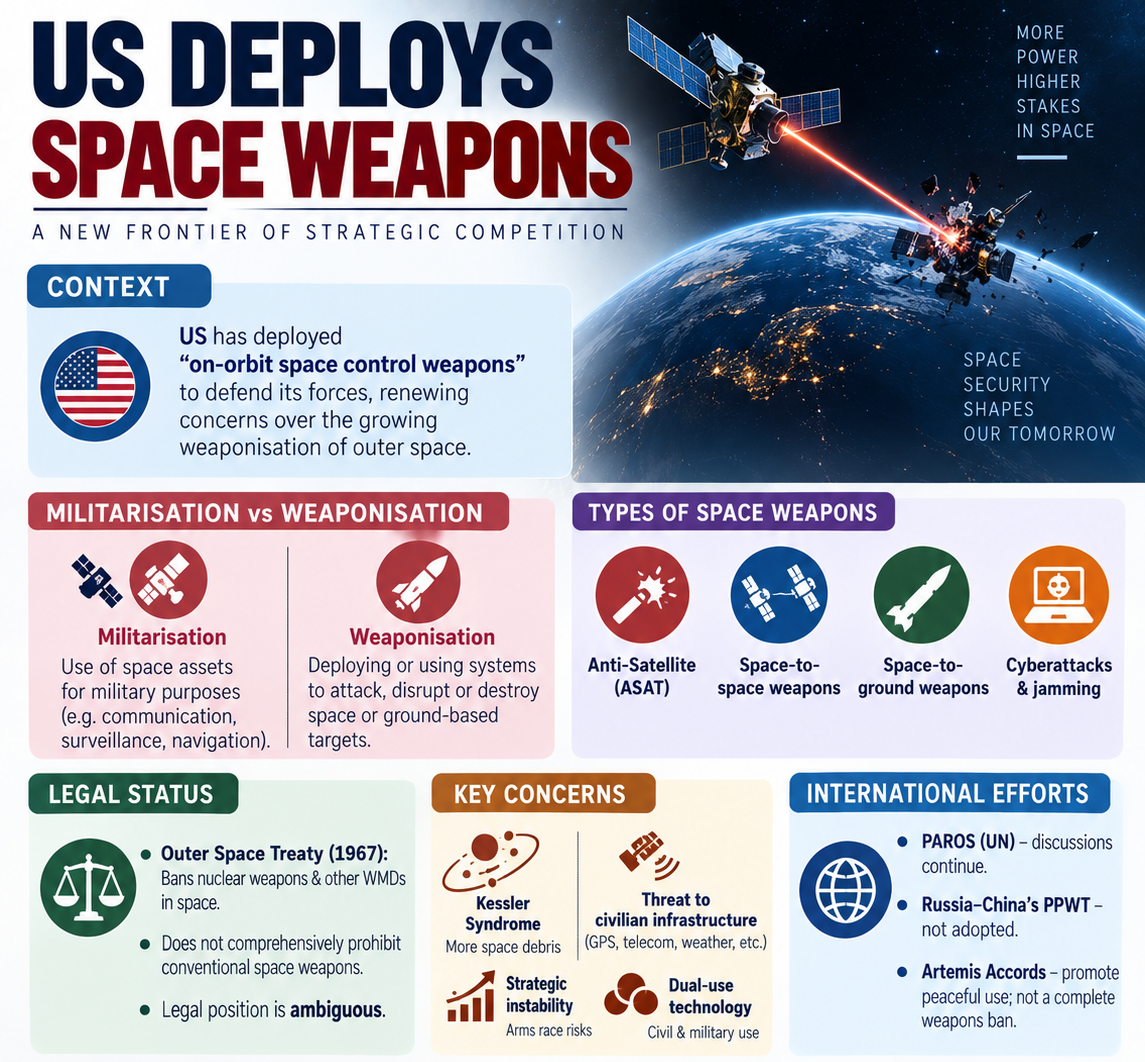
Recently, the United States publicly acknowledged that it has deployed “on-orbit space control weapons” capable of defending its forces against hostile actions. The announcement has renewed concerns about the growing weaponisation of outer space.
About Militarisation vs Weaponisation of space:
-
-
- Militarisation of space refers to the use of satellites and other space assets for military purposes such as communication, navigation, surveillance and reconnaissance.
- Weaponisation, in contrast, involves deploying or using systems designed to attack, disrupt or destroy space or ground-based targets.
- These may include:
- Anti-Satellite (ASAT) weapons
- Space-to-space weapons
- Space-to-ground weapons
- Cyberattacks and electronic jamming
- Directed-energy systems
- Anti-Satellite (ASAT) weapons
- The US, Russia, China and India have demonstrated ASAT capabilities.
- Militarisation of space refers to the use of satellites and other space assets for military purposes such as communication, navigation, surveillance and reconnaissance.
-
Is Weaponisation Legal?
The legal position is ambiguous rather than an outright ban.
-
-
- The principal international instrument is the Outer Space Treaty (1967). It prohibits placing nuclear weapons and other weapons of mass destruction in orbit or stationing them in outer space. It also restricts military activities on celestial bodies.
- However, the treaty does not comprehensively prohibit conventional weapons, many counter-space capabilities, or all Earth-to-space weapons. Therefore, not every space weapon is automatically illegal under existing international law.
- The principal international instrument is the Outer Space Treaty (1967). It prohibits placing nuclear weapons and other weapons of mass destruction in orbit or stationing them in outer space. It also restricts military activities on celestial bodies.
-
International Efforts:
-
-
- The Prevention of an Arms Race in Outer Space (PAROS) discussions at the UN Conference on Disarmament have sought stronger regulation but have not produced a comprehensive binding treaty.
- Russia and China also proposed the Prevention of the Placement of Weapons in Outer Space (PPWT). However, it did not become an international treaty and did not comprehensively address Earth-to-space weapons.
- The Artemis Accords, supported by NASA and the US, promote peaceful and responsible space exploration. India is also a signatory, but the Accords do not constitute a comprehensive weapons ban.
- The Prevention of an Arms Race in Outer Space (PAROS) discussions at the UN Conference on Disarmament have sought stronger regulation but have not produced a comprehensive binding treaty.
-
Major Concerns:
-
-
- Kessler Syndrome: ASAT attacks can create large amounts of orbital debris, potentially triggering cascading collisions and making space increasingly difficult to use.
- Threat to Civilian Infrastructure: Satellites support GPS, telecommunications, weather forecasting, internet services and disaster management. Attacks could therefore affect civilian life and the global economy.
- Strategic Instability: The development of counter-space capabilities can encourage rival states to develop similar systems, creating an arms race and escalation risks.
- Dual-Use Technology: The same satellites and technologies can serve both civilian and military purposes, making peaceful and military activities difficult to distinguish.
- Kessler Syndrome: ASAT attacks can create large amounts of orbital debris, potentially triggering cascading collisions and making space increasingly difficult to use.
-
Way Forward:
The emerging space-security environment requires updated international rules, greater transparency, confidence-building measures, responsible behaviour, debris mitigation and stronger multilateral mechanisms.
Conclusion:
The existing legal framework restricts WMDs in space but does not comprehensively prohibit conventional space weapons. The challenge for the international community is therefore to bridge these legal gaps while ensuring that outer space remains secure, sustainable and accessible for peaceful purposes.



