
Context:
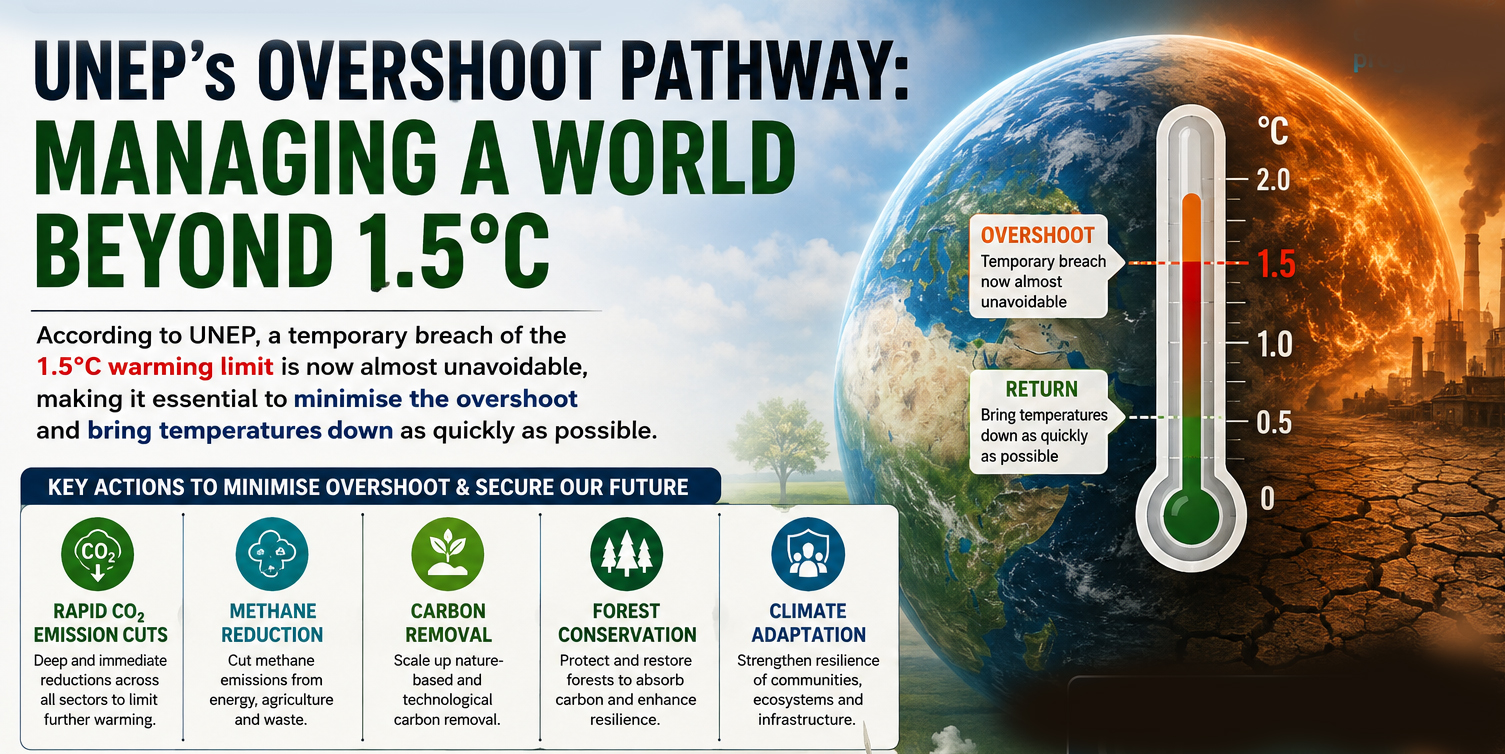
The United Nations Environment Programme (UNEP) has released its report Limiting Overshoot – Navigating Exceedance of 1.5°C and Pathways Towards Return, warning that temporary overshoot of the 1.5°C global warming threshold is now widely assessed as unavoidable. Even under an optimistic scenario involving full implementation of existing climate plans and net-zero pledges, global temperatures could peak at around 1.8°C.
What is the 1.5°C Global Warming Threshold?
The 1.5°C global warming threshold is a key climate target under the 2015 Paris Agreement, aimed at limiting the long-term rise in global average temperature to 1.5°C above pre-industrial levels.
For scientific assessment, the 1850–1900 average is generally used as the pre-industrial baseline. The threshold represents a long-term warming level.
Significance of the 1.5°C Target:
-
-
- The Paris Agreement (2015) seeks to hold global warming well below 2°C and pursue efforts to limit it to 1.5°C. The lower threshold is significant because climate risks increase with every additional fraction of warming. Compared with 2°C, 1.5°C reduces risks related to extreme heat, drought, water stress, sea-level rise and ecosystem damage.
- However, 1.5°C is not a completely “safe” limit; it represents a goal to minimise climate risks.
- The Paris Agreement (2015) seeks to hold global warming well below 2°C and pursue efforts to limit it to 1.5°C. The lower threshold is significant because climate risks increase with every additional fraction of warming. Compared with 2°C, 1.5°C reduces risks related to extreme heat, drought, water stress, sea-level rise and ecosystem damage.
-
What is Climate Overshoot?
Overshoot refers to temporarily exceeding a temperature threshold before potentially bringing temperatures down later. Importantly, crossing 1.5°C for a single year does not automatically mean that the Paris Agreement has failed, as its temperature goal concerns long-term warming trends.
Implications of Overshoot:
-
-
- A higher and prolonged overshoot can intensify:
- Extreme heat and wildfires
- Glacier and ice-sheet loss
- Sea-level rise
- Coral-reef degradation
- Amazon rainforest dieback
- Permafrost thaw
- Risks to major ocean systems such as AMOC
- Extreme heat and wildfires
- Some impacts may be irreversible, even if global temperatures subsequently decline.
- A higher and prolonged overshoot can intensify:
-
Required Climate Action:
-
-
- First, countries must accelerate mitigation through rapid emissions reductions and particularly methane reduction, which can provide near-term climate benefits.
- Second, adaptation must be strengthened through climate-resilient agriculture, infrastructure, water management and early-warning systems.
- Third, achieving temperature decline after overshoot would require net-negative CO₂ emissions, making carbon dioxide removal technologies and ecosystem restoration increasingly important. However, carbon removal cannot replace immediate emissions reduction.
- First, countries must accelerate mitigation through rapid emissions reductions and particularly methane reduction, which can provide near-term climate benefits.
-
Climate Justice and India:
-
-
- Overshoot will disproportionately affect developing countries that have contributed relatively less to historical emissions but face greater vulnerability. Hence, climate finance, technology transfer and the principle of CBDR-RC remain crucial.
- For India, priorities include renewable energy expansion, energy efficiency, climate-resilient agriculture, heat-action plans, water security and coastal resilience.
- Overshoot will disproportionately affect developing countries that have contributed relatively less to historical emissions but face greater vulnerability. Hence, climate finance, technology transfer and the principle of CBDR-RC remain crucial.
-
Conclusion:
The likely overshoot of 1.5°C should not become an excuse to abandon climate ambition. Instead, the focus must shift towards minimising the magnitude and duration of overshoot through faster mitigation, stronger adaptation, climate finance and, eventually, responsible carbon removal. Every fraction of a degree of warming avoided can reduce future climate damage.



