
UN Global Forest Goals Report 2026
Context:
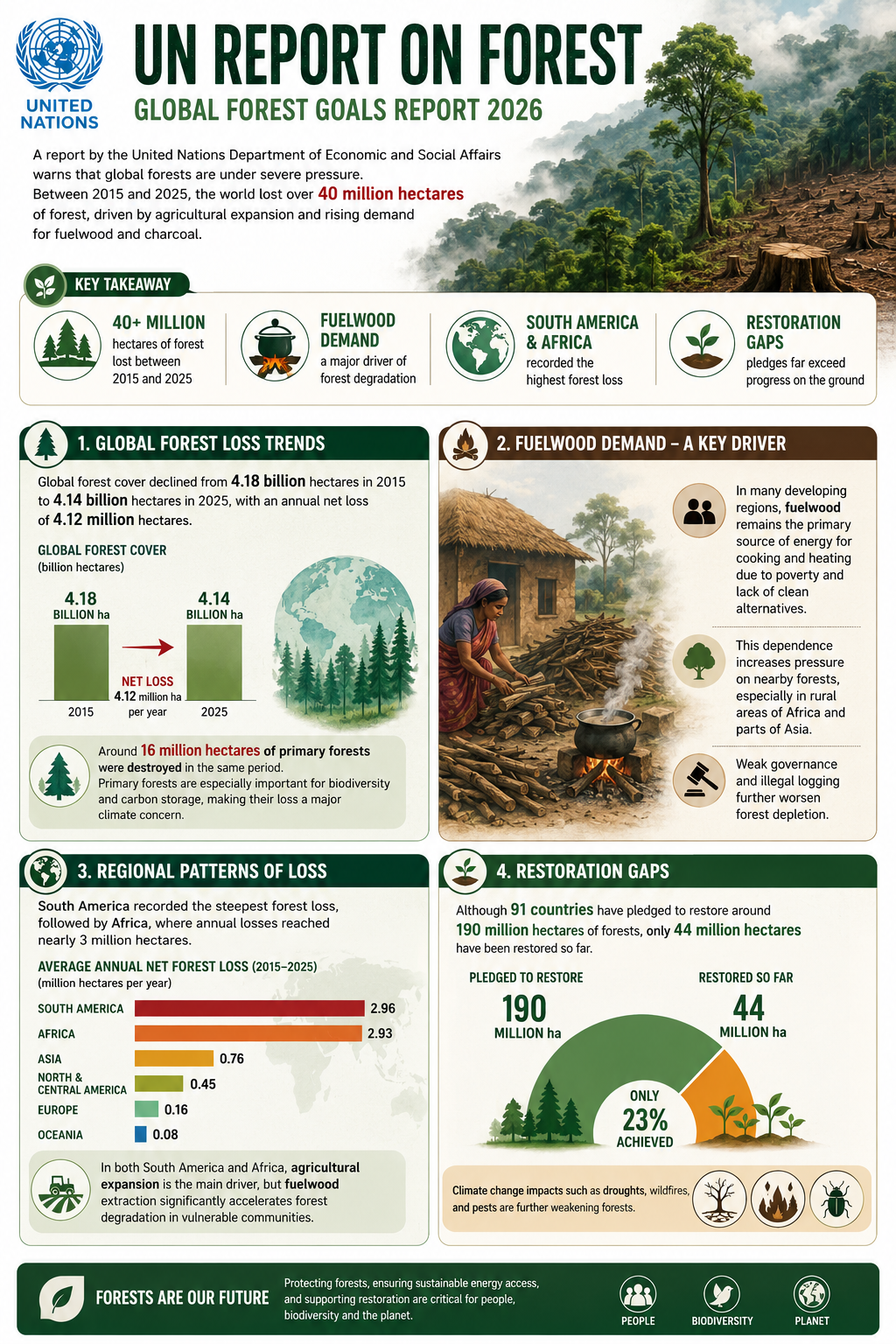
Recently, A report titled the Global Forest Goals Report 2026, released by the United Nations Department of Economic and Social Affairs, warns that global forests are under severe pressure. Between 2015 and 2025, the world lost over 40 million hectares of forest, driven by agricultural expansion and rising demand for fuelwood and charcoal.
Key findings of the report:
-
-
- Global Forest Loss Trends: Global forest cover declined from 4.18 billion hectares in 2015 to 4.14 billion hectares in 2025, with an annual net loss of 4.12 million hectares. South America and Africa recorded the highest losses, while around 16 million hectares of primary forests were destroyed in the same period. Primary forests are especially important for biodiversity and carbon storage, making their loss a major climate concern.
- Fuelwood Demand as a Key Driver: A major finding of the report is the rising role of fuelwood and charcoal demand in driving forest degradation. In many developing regions, fuelwood remains the primary source of energy for cooking and heating due to poverty and lack of clean alternatives. This dependence increases pressure on nearby forests, especially in rural areas of Africa and parts of Asia. Weak governance and illegal logging further worsen forest depletion.
- Regional Patterns of Loss: South America recorded the steepest forest loss, followed by Africa, where annual losses reached nearly 3 million hectares. In both regions, agricultural expansion is the main driver, but fuelwood extraction significantly accelerates forest degradation in vulnerable communities.
- Restoration Gaps: Although 91 countries have pledged to restore around 190 million hectares of forests, only 44 million hectares have been restored so far. Climate change impacts such as droughts, wildfires, and pests are further weakening forests.
- Global Forest Loss Trends: Global forest cover declined from 4.18 billion hectares in 2015 to 4.14 billion hectares in 2025, with an annual net loss of 4.12 million hectares. South America and Africa recorded the highest losses, while around 16 million hectares of primary forests were destroyed in the same period. Primary forests are especially important for biodiversity and carbon storage, making their loss a major climate concern.
-
India’s Forest Restoration Efforts:
-
-
- India is working to expand forest and tree cover to 33% of its geographical area. As of 2025, forest and tree cover stands at about 25.17% (827,357 sq km).
- India has pledged under the Bonn Challenge to restore 26 million hectares of degraded land by 2030.
- Key initiatives include the Green India Mission, the Aravalli Green Wall Project, and the Compensatory Afforestation Fund (CAMPA). Joint Forest Management (JFM) also involves local communities in forest protection.
- India is working to expand forest and tree cover to 33% of its geographical area. As of 2025, forest and tree cover stands at about 25.17% (827,357 sq km).
-
Conclusion:
The report concludes that stronger global cooperation, increased funding, and expanded access to clean energy are essential to reduce dependence on fuelwood and protect global forest ecosystems.



