
Context:
Recently, on 14 September 2026, the leaders of Scotland, Wales, and Northern Ireland signed a joint Memorandum of Understanding (MoU) in Cardiff, the capital of Wales. The agreement supported the right of the people of these nations to self-determination and their demand for referendums on future constitutional changes.
-
-
- The meeting was attended by John Swinney, First Minister of Scotland; Rhun ap Iorwerth, First Minister of Wales; and Michelle O’Neill, First Minister of Northern Ireland, along with Mary Lou McDonald, the opposition leader in the Republic of Ireland. However, the meeting was primarily conducted in their capacity as political party leaders, rather than as a formal inter-governmental agreement among the three governments.
- The meeting was attended by John Swinney, First Minister of Scotland; Rhun ap Iorwerth, First Minister of Wales; and Michelle O’Neill, First Minister of Northern Ireland, along with Mary Lou McDonald, the opposition leader in the Republic of Ireland. However, the meeting was primarily conducted in their capacity as political party leaders, rather than as a formal inter-governmental agreement among the three governments.
-
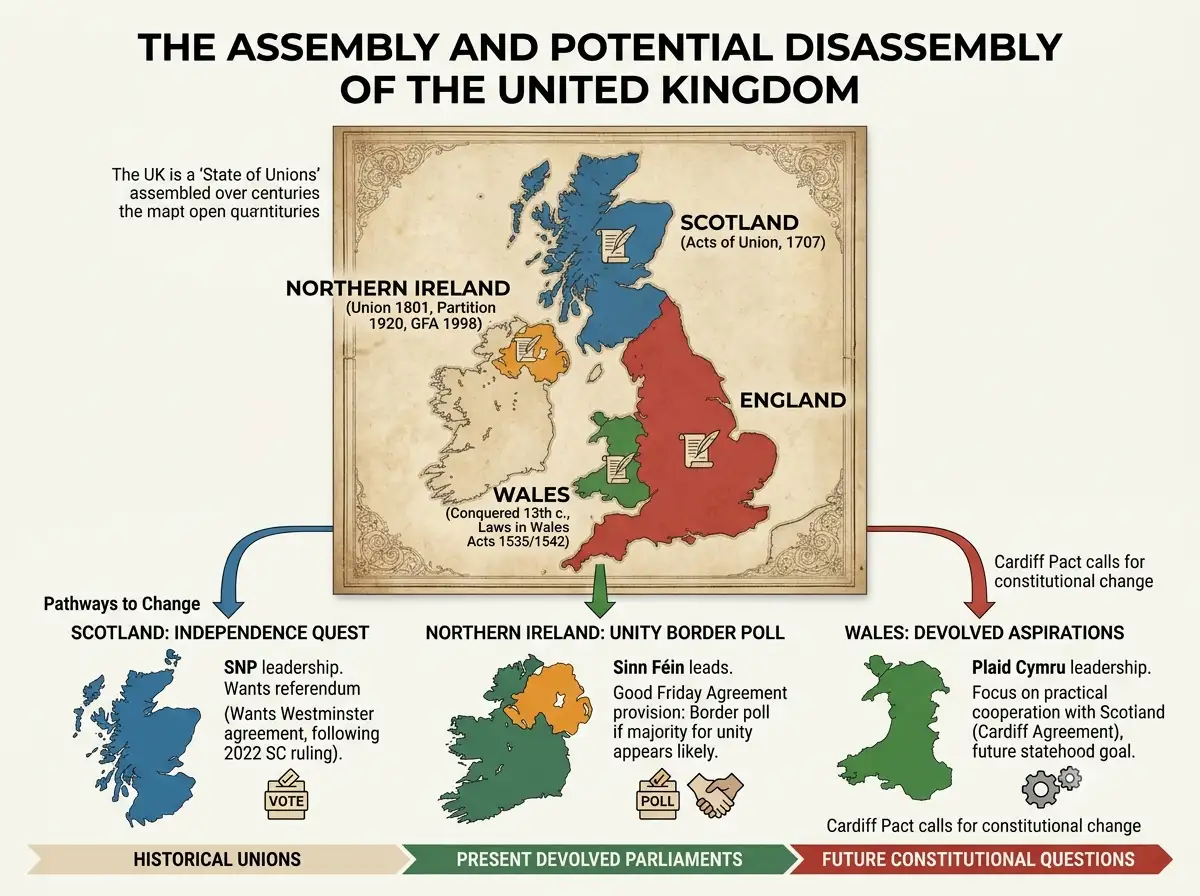
Constitutional Structure of the United Kingdom:
-
-
- The United Kingdom consists of England, Scotland, Wales, and Northern Ireland. Its system of governance is different from the federal structure of India. In the UK, devolution has granted legislative and administrative powers to Scotland, Wales, and Northern Ireland at different levels, while several important subjects, including defence and foreign affairs, remain under the authority of the Westminster Parliament.
- A key feature of the British constitutional system is Parliamentary Sovereignty. This means that the Parliament of the United Kingdom is the supreme legislative authority. Therefore, despite devolution, ultimate constitutional authority has not been completely separated from Westminster.
- The United Kingdom consists of England, Scotland, Wales, and Northern Ireland. Its system of governance is different from the federal structure of India. In the UK, devolution has granted legislative and administrative powers to Scotland, Wales, and Northern Ireland at different levels, while several important subjects, including defence and foreign affairs, remain under the authority of the Westminster Parliament.
-
Demand for Independence and Scotland:
-
-
- The demand for independence in Scotland has been part of the political discourse for a long time. On 18 September 2014, a referendum on Scottish independence was held, in which 55.3% of voters voted against independence and 44.7% voted in favour.
- After this, demands for a second referendum continued. In 2022, the UK Supreme Court clarified that the Scottish Parliament could not independently enact legislation to hold such a referendum because the matter concerns reserved powers relating to the United Kingdom and its Parliament.
- The demand for independence in Scotland has been part of the political discourse for a long time. On 18 September 2014, a referendum on Scottish independence was held, in which 55.3% of voters voted against independence and 44.7% voted in favour.
-
The Question of Northern Ireland and Wales:
-
-
- The case of Northern Ireland is different from that of Scotland. The Good Friday Agreement (1998) established a special framework regarding Northern Ireland’s constitutional status and linked the question of its integration with Ireland to a process of popular consent through a referendum.
- In Wales, too, demands for greater autonomy and the strengthening of national identity have gained importance. With Rhun ap Iorwerth becoming First Minister in 2026, constitutional issues have received renewed significance in Welsh politics.
- The case of Northern Ireland is different from that of Scotland. The Good Friday Agreement (1998) established a special framework regarding Northern Ireland’s constitutional status and linked the question of its integration with Ireland to a process of popular consent through a referendum.
-
Conclusion:
-
-
- The Cardiff Agreement has further highlighted the debate between devolution and full self-determination in the UK. At the same time, issues such as relations with Europe, the impact of Brexit, regional economic inequalities, and national identity are also closely connected with this debate. UK Prime Minister Andy Burnham stated in July 2026 that his priority was economic and social issues and that an immediate independence referendum was not on his agenda.
- Thus, the Cardiff Agreement shows that the question of the unity of the United Kingdom is not limited merely to independence versus union. It is also closely linked to balancing multi-level governance, regional autonomy, self-determination, and parliamentary sovereignty.
- The Cardiff Agreement has further highlighted the debate between devolution and full self-determination in the UK. At the same time, issues such as relations with Europe, the impact of Brexit, regional economic inequalities, and national identity are also closely connected with this debate. UK Prime Minister Andy Burnham stated in July 2026 that his priority was economic and social issues and that an immediate independence referendum was not on his agenda.
-



