
UAE Announces Exit from OPEC
Context:
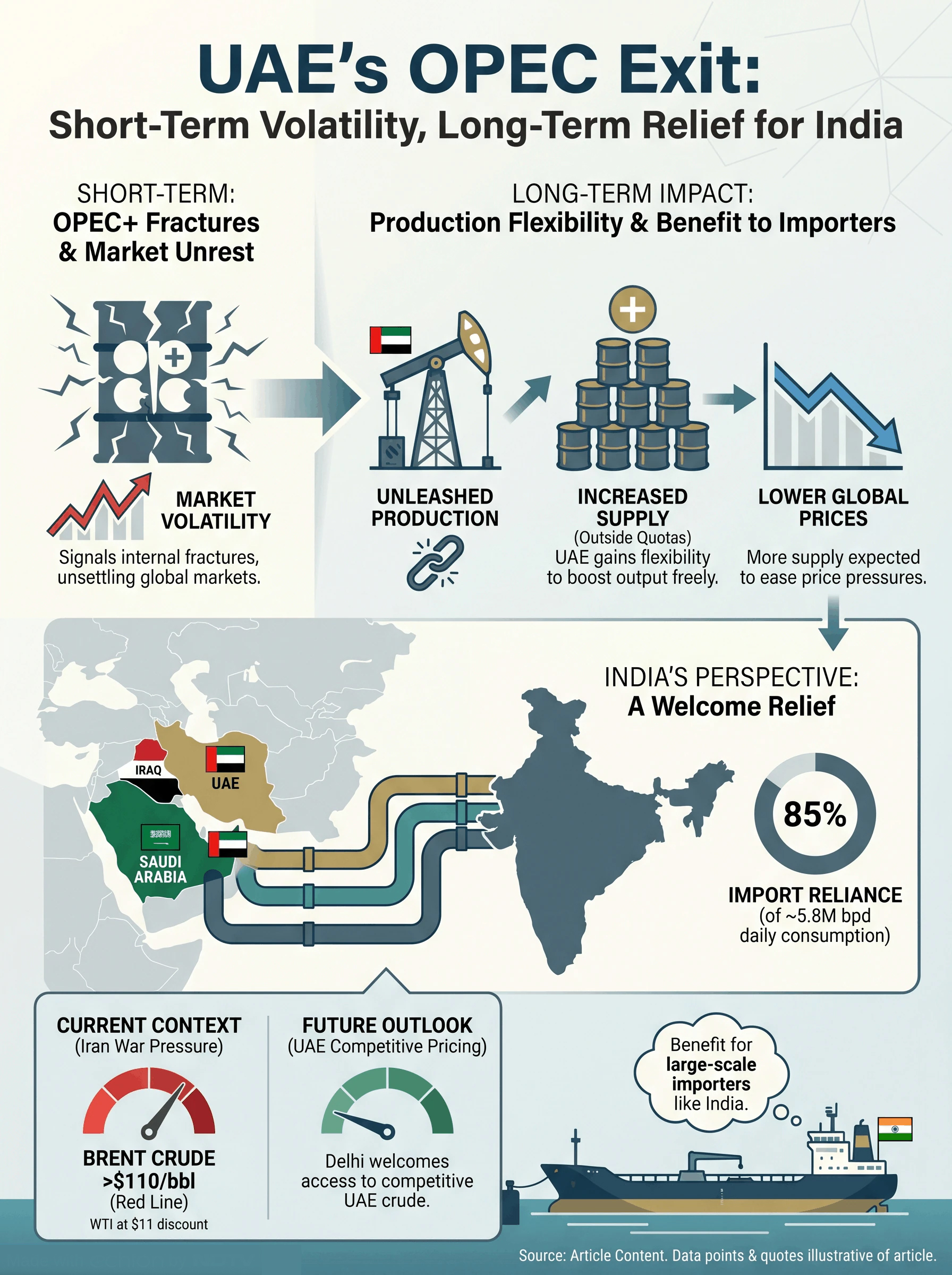
Recently, The United Arab Emirates has announced its exit from the Organization of the Petroleum Exporting Countries, effective May 1. This move removes one of the cartel’s largest producers and raises concerns about weakening OPEC’s influence over global oil supply and prices.
About OPEC:
-
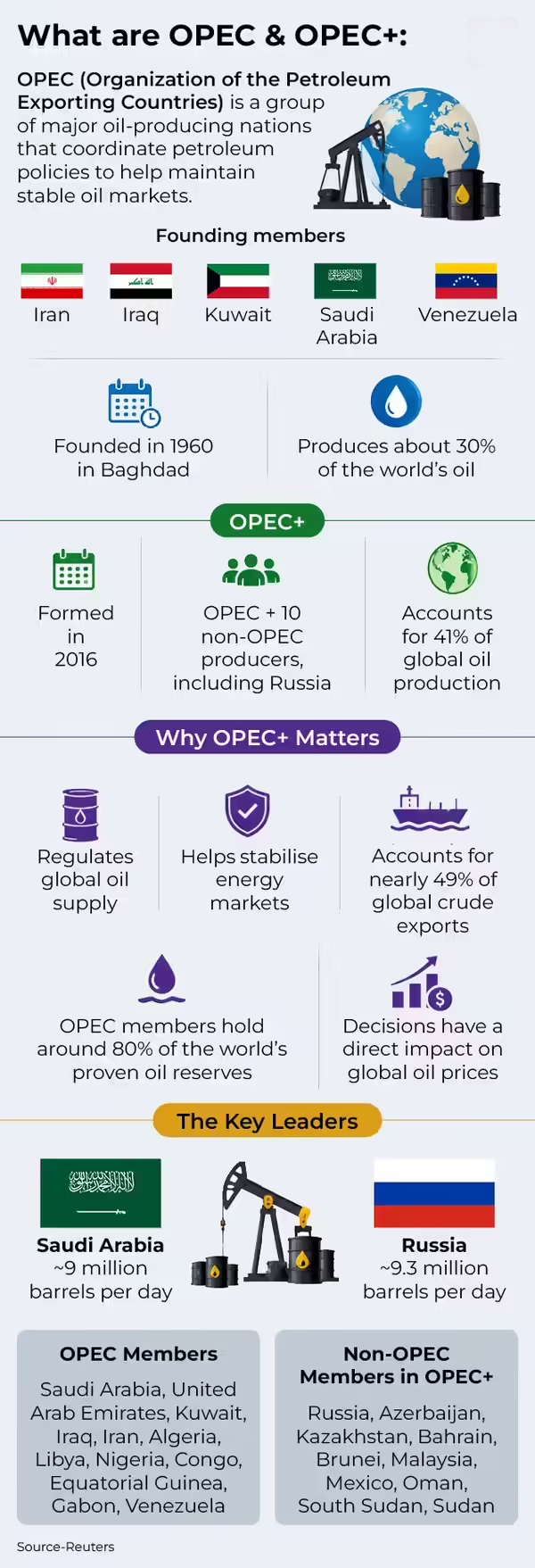
- The Organization of the Petroleum Exporting Countries (OPEC) is a permanent intergovernmental organization established in 1960 at the Baghdad Conference by five founding members—Iran, Iraq, Kuwait, Saudi Arabia, and Venezuela—to coordinate and unify petroleum policies among oil-producing nations.
- Headquartered in Vienna, OPEC currently consists of around 12 developing oil-exporting countries (subject to periodic changes due to exits), collectively accounting for roughly 30–40% of global oil output and about 80% of the world’s proven oil reserves.
- The primary objective of OPEC is to coordinate petroleum policies, stabilize global oil markets, ensure fair prices for producers, and maintain a steady supply for consumers. In 2016, the broader alliance known as OPEC+ was formed, bringing together OPEC members and major non-OPEC producers like Russia to jointly manage oil production and influence global energy markets.
- The Organization of the Petroleum Exporting Countries (OPEC) is a permanent intergovernmental organization established in 1960 at the Baghdad Conference by five founding members—Iran, Iraq, Kuwait, Saudi Arabia, and Venezuela—to coordinate and unify petroleum policies among oil-producing nations.
Reasons behind UAE’s Exit:
-
- Discontent with Production Quotas
- UAE has long opposed OPEC-imposed limits on oil output.
- Heavy investments in expanding capacity (up to ~5 million barrels/day) created pressure to produce more.
- UAE has long opposed OPEC-imposed limits on oil output.
- Strategic Economic Vision
- Shift toward maximizing revenue and leveraging expanded production capacity.
- Desire for greater autonomy in energy policy.
- Shift toward maximizing revenue and leveraging expanded production capacity.
- Changing Internal Dynamics of OPEC
- Earlier exit of Qatar in 2019 signaled weakening cohesion.
- Increasing divergence among member states.
- Earlier exit of Qatar in 2019 signaled weakening cohesion.
- Geopolitical Tensions
- Strained relations with Saudi Arabia, OPEC’s dominant player.
- Broader regional rivalries and policy differences.
- Strained relations with Saudi Arabia, OPEC’s dominant player.
- Discontent with Production Quotas
Implications of UAE’s Exit:
-
- Weakening of OPEC’s Cartel Power
- Loss of a major producer reduces OPEC’s ability to control supply.
- Less spare capacity within the group.
- Loss of a major producer reduces OPEC’s ability to control supply.
- Greater Market Volatility
- Reduced coordination may lead to price fluctuations.
- Difficulty in stabilizing global oil markets.
- Reduced coordination may lead to price fluctuations.
- Rise of Competitive Production
- Countries may prioritize national output over collective agreements.
- Increased competition among oil producers.
- Countries may prioritize national output over collective agreements.
- Impact on OPEC+
- Exit from OPEC+ weakens broader cooperation mechanisms.
- Reduces effectiveness of coordinated production cuts.
- Exit from OPEC+ weakens broader cooperation mechanisms.
- Weakening of OPEC’s Cartel Power
Implications for India:
-
- Energy Security
- India, a major oil importer, depends heavily on OPEC nations.
- Fragmentation could create supply uncertainties.
- India, a major oil importer, depends heavily on OPEC nations.
- Price Volatility
- Fluctuating crude prices may impact inflation and fiscal stability.
- Fluctuating crude prices may impact inflation and fiscal stability.
- Strategic Opportunities
- Potential for diversified sourcing and better bargaining power.
- Scope to strengthen ties with non-OPEC producers.
- Potential for diversified sourcing and better bargaining power.
- Energy Security
Conclusion:
The UAE’s exit from OPEC marks a significant shift in global energy geopolitics, reflecting weakening cartel cohesion and rising national energy priorities. This development may accelerate the transition toward a more fragmented and competitive global oil market, with far-reaching implications for energy security, pricing, and international relations.



