
Context:
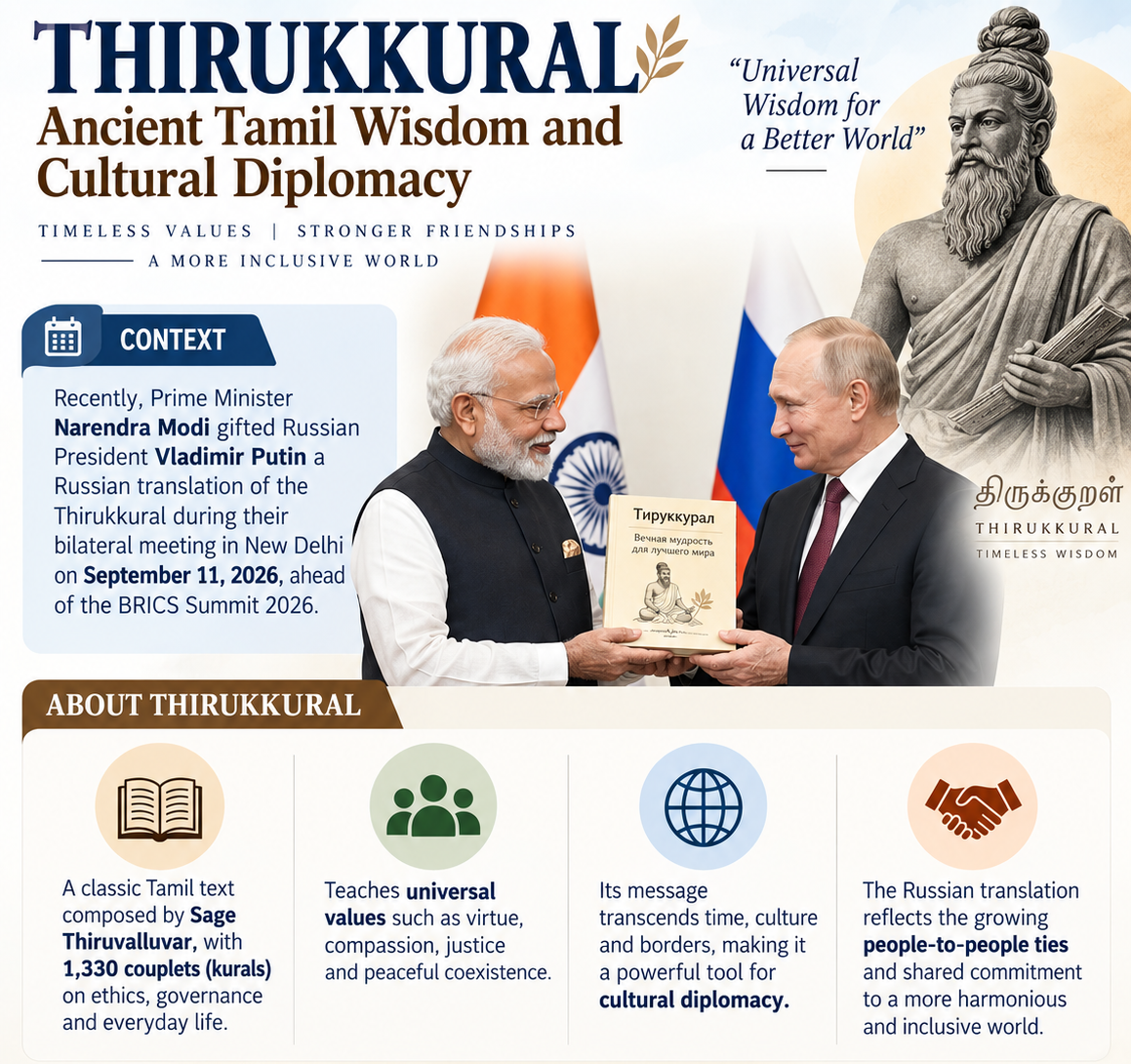
Recently, Prime Minister Narendra Modi gifted Russian President Vladimir Putin a Russian translation of the Thirukkural during their bilateral meeting in New Delhi on September 11, 2026, ahead of the BRICS Summit 2026.
What is Thirukkural?
-
-
- Thirukkural is a celebrated work of ancient Tamil literature and philosophy, authored by the poet-philosopher Thiruvalluvar (Valluvar). It contains 1,330 couplets, arranged into 133 chapters, with each chapter containing 10 couplets.
- Each kural consists of seven words and conveys ideas related to ethics, governance, social life and human relationships.
- Thirukkural is a celebrated work of ancient Tamil literature and philosophy, authored by the poet-philosopher Thiruvalluvar (Valluvar). It contains 1,330 couplets, arranged into 133 chapters, with each chapter containing 10 couplets.
-
Three Major Sections:
-
-
- Aram – Book of Virtue: It contains 38 chapters dealing with morality, individual conduct, spirituality, compassion, charity and righteous living.
- Porul – Book of Polity: It contains 70 chapters and deals with governance, leadership, economics, social responsibilities, justice and political ethics.
- Inbam – Book of Love: It contains 25 chapters and explores love, relationships and emotional life. It is further associated with Kalaviyal and Karpiyal.
- Aram – Book of Virtue: It contains 38 chapters dealing with morality, individual conduct, spirituality, compassion, charity and righteous living.
-
Key Themes and Teachings:
-
-
- Universal Humanism: Thiruvalluvar emphasised morality, kindness, wisdom and compassion rather than distinctions based on caste, religion, race or creed.
- Ethical Governance: The Porul section provides insights into good governance, leadership, justice and the responsibilities of rulers, making it relevant to modern public administration.
- Education and Wisdom: The text connects education with virtue and wisdom, suggesting that knowledge should contribute to individual character and social welfare.
- Morality and Social Well-being: Thiruvalluvar warned against greed, jealousy, anger and harshness, while promoting charity, love and righteous conduct.
- Universal Humanism: Thiruvalluvar emphasised morality, kindness, wisdom and compassion rather than distinctions based on caste, religion, race or creed.
-
Global Recognition:
Thirukkural was first published in English in 1840 and has subsequently been translated into more than 60 languages. The Russian translation gifted to Putin was translated by Naira Mkrtchyan and published in 2026 by the Central Institute of Classical Tamil.
Significance for India:
-
-
- Strengthens cultural diplomacy and soft power.
- Showcases India’s civilisational and literary heritage.
- Promotes the global relevance of Tamil culture.
- Reflects India’s tradition of pluralism and universal values.
- Provides ethical perspectives relevant to governance and public life.
- Strengthens cultural diplomacy and soft power.
-
Conclusion:
Thirukkural transcends linguistic and cultural boundaries through its timeless emphasis on virtue, justice, wisdom, governance and humanism. Its presentation to President Putin demonstrates how India’s ancient knowledge traditions can contribute to modern cultural diplomacy and global understanding.



