
Context:
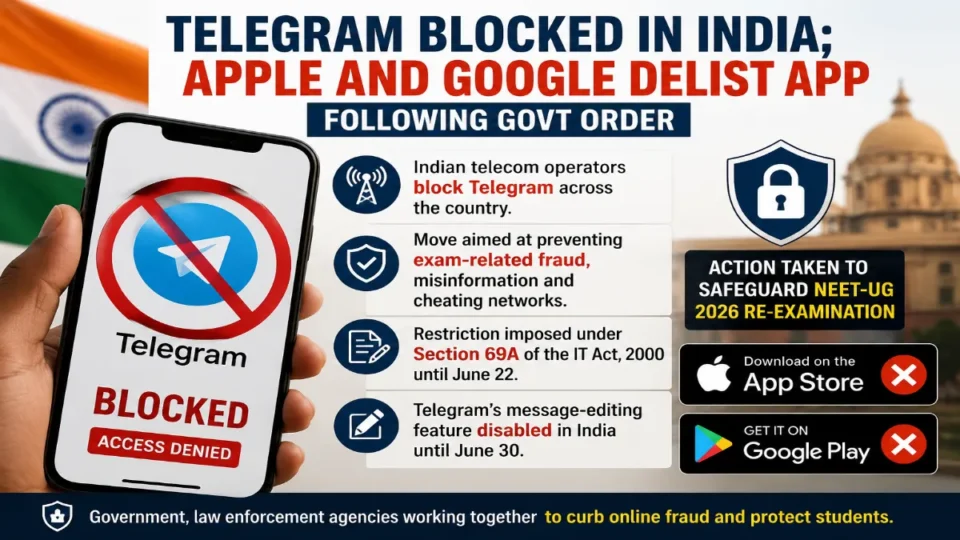
The Ministry of Electronics and Information Technology (MeitY) recently imposed a temporary ban on the messaging platform Telegram in India, following concerns raised by the National Testing Agency (NTA) over its alleged role in facilitating NEET examination-related paper leak activities. The action triggered a legal challenge before the Delhi High Court, which has upheld the government’s decision. The platform will remain unavailable on app stores until June 22, 2026, while restrictions on its message-editing feature will continue until June 30, 2026.
Background:
-
-
-
- Telegram has an estimated 150 million users in India, making it one of the country’s most widely used messaging platforms after WhatsApp.
- The government’s action was linked to concerns over NEET-UG paper leak allegations and misuse of encrypted messaging services.
- Telegram has an estimated 150 million users in India, making it one of the country’s most widely used messaging platforms after WhatsApp.
-
-
How Can the Government Block Apps in India?
-
-
-
- India regulates digital platforms through provisions under the Information Technology Act, 2000:
- The government action was taken under Section 69A of the IT Act, 2000, which empowers authorities to block online content in the interest of sovereignty, security, or public order.
- India regulates digital platforms through provisions under the Information Technology Act, 2000:
-
-
Section 69A – Content Blocking Powers
-
-
-
- Used for blocking content in cases involving:
- National security
- Public order
- Sovereignty and integrity
- National security
- Procedure:
- Identification by ministries or agencies
- Review by a designated committee
- Final approval and blocking order by MeitY
- Identification by ministries or agencies
- Used for blocking content in cases involving:
-
-
Section 79(3)(b) – Direct Blocking Mechanism
-
-
-
- Allows certain ministries to directly issue takedown or blocking orders
- Often implemented through the government’s Sahyog portal
- Faster mechanism used in urgent situations
- Allows certain ministries to directly issue takedown or blocking orders
-
-
About Regulation of Social Media in India:
Social media platforms are governed under the Information Technology (Intermediary Guidelines and Digital Media Ethics Code) Rules, 2021.
Key Compliance Requirements
-
-
-
- Appointment of:
- Grievance Officer
- Chief Compliance Officer
- Nodal Contact Person
- Grievance Officer
- Monthly compliance and transparency reporting
- Mechanisms to trace the “first originator” of messages (for messaging apps)
- Mandatory removal of unlawful content upon government direction
- Appointment of:
-
-
Failure to comply can lead to loss of “safe harbour” protection under Section 79 of the IT Act.
Section 79 – Safe Harbour Protection:
-
-
-
- Protects intermediaries from liability for user-generated content
- Conditions for protection:
- No initiation or modification of content by the platform
- Compliance with lawful government takedown orders
- No initiation or modification of content by the platform
- Non-compliance results in loss of immunity and possible legal liability
- Protects intermediaries from liability for user-generated content
-
-
Conclusion:
The Delhi High Court’s decision to uphold the temporary ban on Telegram highlights India’s evolving approach to digital governance. It reflects the growing emphasis on balancing platform accountability, exam security, and user rights, especially as encrypted messaging apps become central to both communication and cyber misuse concerns.



