
Context:
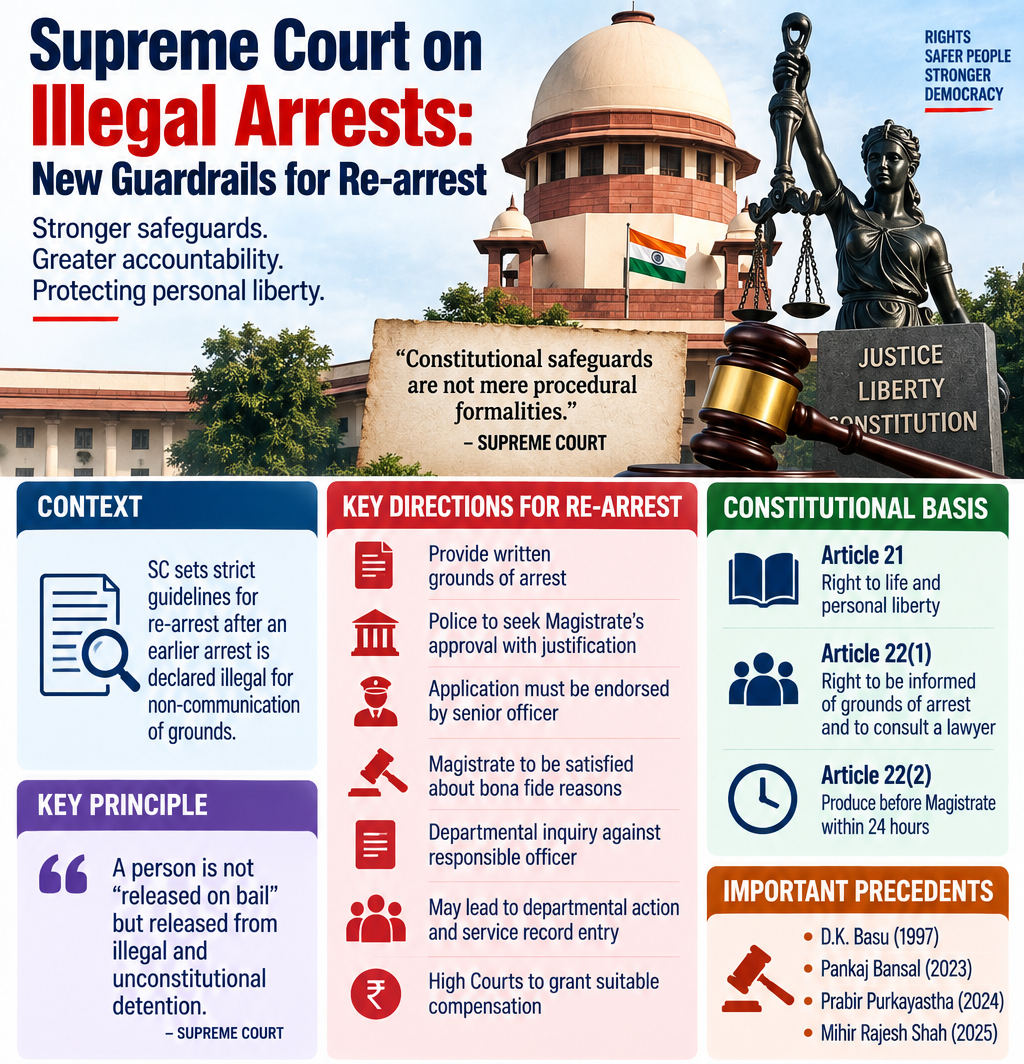
The Supreme Court recently laid down strict safeguards for re-arresting a person whose earlier arrest was declared illegal due to non-communication of the grounds of arrest. The Court held that such a person is not merely “released on bail” but is released from illegal and unconstitutional detention. It emphasised that safeguards under Article 22 of the Constitution are fundamental guarantees and cannot be treated as mere procedural formalities.
Key Directions of the Supreme Court:
The Court prescribed a judicially supervised procedure for re-arrest:
-
-
- The accused must first be provided written grounds of arrest.
- Police must approach the Magistrate with an application explaining the necessity of re-arrest and why the grounds were not supplied earlier.
- The application must carry the endorsement of the immediate superior officer.
- The Magistrate must be satisfied that the earlier failure occurred for bona fide reasons and that re-arrest is necessary.
- A departmental inquiry must be initiated against the officer responsible for the constitutional violation.
- Adverse findings may lead to departmental action and an entry in the officer’s service record.
- High Courts should grant suitable mandatory compensation where arrest safeguards have been violated.
- The accused must first be provided written grounds of arrest.
-
Constitutional Basis:
-
-
- Article 21 protects life and personal liberty.
- Article 22(1) provides the right to be informed of the grounds of arrest and the right to consult and be defended by a legal practitioner.
- Article 22(2) requires an arrested person to be produced before the nearest Magistrate within 24 hours, excluding necessary travel time.
- The judgment reinforces that these provisions operate as substantive constitutional safeguards against arbitrary deprivation of liberty.
- Article 21 protects life and personal liberty.
-
Important Judicial Precedents:
The ruling builds upon a developing jurisprudence:
-
-
- D.K. Basu v. State of West Bengal (1997): Established safeguards against arbitrary arrest and custodial abuse.
- Pankaj Bansal v. Union of India (2023): Required written grounds of arrest under PMLA.
- Prabir Purkayastha v. State (2024): Reaffirmed communication of grounds of arrest in writing.
- Mihir Rajesh Shah v. State of Maharashtra (2025): Extended the written-grounds requirement across offences and statutes.
- D.K. Basu v. State of West Bengal (1997): Established safeguards against arbitrary arrest and custodial abuse.
-
Significance:
The judgment strengthens personal liberty, judicial oversight and police accountability. It ensures that the authority responsible for an unconstitutional arrest cannot independently decide to repeat it. It also establishes that the gravity of an alleged offence cannot justify violation of constitutional safeguards.
Way Forward:
Police agencies should ensure strict compliance with constitutional arrest procedures through training, documentation, supervisory review and accountability mechanisms. At the same time, safeguards should be implemented without obstructing legitimate investigation.
Conclusion:
The judgment reinforces the principle that investigative powers of the State are subject to constitutional limitations. By combining written grounds of arrest, judicial approval, independent investigation and departmental accountability, the Supreme Court has strengthened the rule of law and protection of personal liberty.



