
Context:
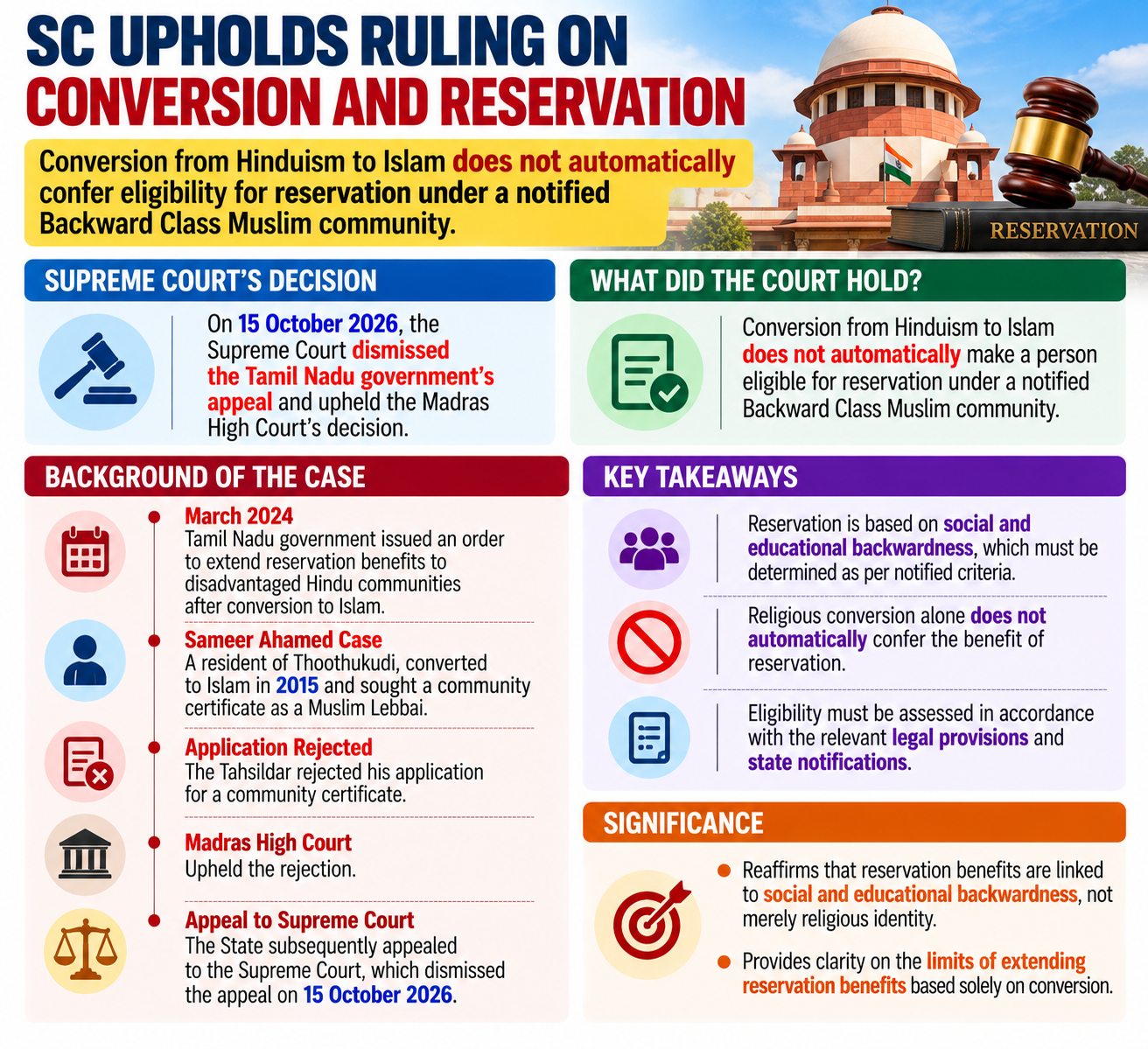
On 15 October 2026, the Supreme Court dismissed the Tamil Nadu government's appeal and upheld the Madras High Court's decision that conversion from Hinduism to Islam does not automatically confer eligibility for reservation under a notified Backward Class Muslim community.
Background of the Case:
In March 2024, the Tamil Nadu government issued an order seeking to extend reservation benefits to disadvantaged Hindu communities after conversion to Islam. The case concerned Sameer Ahamed, a resident of Thoothukudi, who converted to Islam in 2015 and subsequently sought a community certificate as a Muslim Lebbai. The Tahsildar rejected his application, and the Madras High Court upheld the decision. The State subsequently appealed to the Supreme Court.
Key Observations of the Supreme Court:
-
-
- No automatic transfer: Previous caste or community status does not automatically establish membership in a different notified Muslim Backward Class.
- Community verification: Conversion documents or certification by a religious body, such as a Jamath, cannot independently establish statutory eligibility.
- Limits on executive power: A state government order cannot bypass constitutional and statutory requirements governing reservation.
- Legal recognition: Eligibility must be established under the rules applicable to the relevant community.
- No automatic transfer: Previous caste or community status does not automatically establish membership in a different notified Muslim Backward Class.
-
Constitutional Provisions Involved:
-
-
- Article 14: Guarantees equality before the law and equal protection of laws.
- Article 15(4): Enables special provisions for the advancement of socially and educationally backward classes and SCs/STs.
- Article 16(4): Enables reservation in public employment for qualifying backward classes inadequately represented in State services.
- Article 341: Governs the specification of Scheduled Castes.
- Paragraph 3 of the Constitution (Scheduled Castes) Order, 1950, restricts SC recognition to persons professing Hinduism, Sikhism or Buddhism.
- Article 14: Guarantees equality before the law and equal protection of laws.
-
Significance of the Judgment:
-
-
- The ruling clarifies the relationship between religious conversion, community identity and affirmative action. It emphasises that reservation benefits must comply with constitutional and statutory requirements. However, it also raises questions about whether historical discrimination and social disadvantage necessarily disappear following religious conversion.
- Importantly, eligibility for Other Backward Classes (OBCs) depends on the applicable notified list and legal criteria; religion alone neither guarantees nor automatically disqualifies eligibility.
- The ruling clarifies the relationship between religious conversion, community identity and affirmative action. It emphasises that reservation benefits must comply with constitutional and statutory requirements. However, it also raises questions about whether historical discrimination and social disadvantage necessarily disappear following religious conversion.
-
Challenges and Way Forward:
The judgment highlights the need for transparent community-certification procedures, reliable data on social and educational backwardness, and constitutionally compliant reservation policies. Governments should address continuing disadvantage through legally permissible welfare and educational measures while ensuring equality and non-discrimination.
Conclusion:
The judgment reinforces the principle that affirmative action must operate within the constitutional framework. Balancing legal certainty with substantive equality requires evidence-based policymaking, transparent administration and continued commitment to social justice.



