
Successful Testing of ‘TARA’ Glide Weapon
Context:
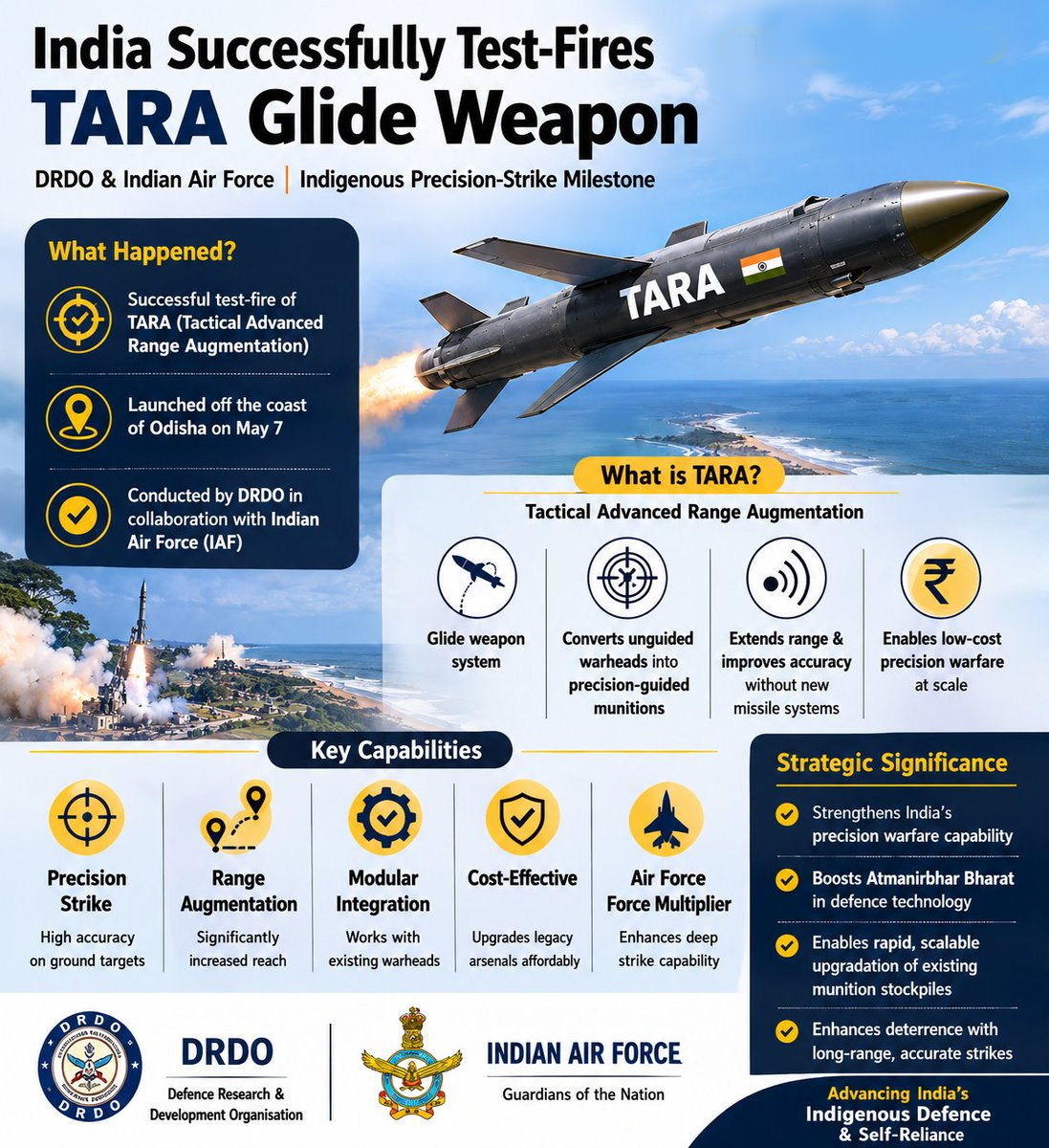
Recently, the Defence Research and Development Organisation (DRDO) and the Indian Air Force (IAF) successfully conducted the maiden flight trial of the indigenous ‘Tactical Advanced Range Augmentation (TARA)’ glide weapon system off the coast of Odisha.
About the TARA Glide Weapon:
-
-
- TARA is an indigenously developed Range Extension Kit. It is a hybrid technology that converts conventional unguided bombs into highly precise smart weapons. In simple terms, it equips existing bombs with wings and an advanced guidance system, enabling them to glide accurately toward their targets.
- The system has been developed by DRDO’s premier laboratory, the Research Centre Imarat (RCI), Hyderabad.
- TARA is an indigenously developed Range Extension Kit. It is a hybrid technology that converts conventional unguided bombs into highly precise smart weapons. In simple terms, it equips existing bombs with wings and an advanced guidance system, enabling them to glide accurately toward their targets.
-
Key Technical Features:
-
-
- Modular design: TARA can be integrated with bombs of different weights, including 250 kg, 450 kg, and 500 kg variants.
- Range: The weapon is capable of striking targets at a distance of approximately 80–100 km. This stand-off range allows aircraft to carry out strikes while remaining outside the reach of enemy air defence systems.
- Precision: It uses a GPS-aided inertial navigation system along with an electro-optical/infrared (IIR) seeker for the terminal phase. It has a circular error probable (CEP) of less than 3 metres, providing pinpoint accuracy.
- Platform compatibility: Although the initial trial was conducted using the Jaguar aircraft, it is designed for deployment on other frontline fighter aircraft such as the Sukhoi Su-30 MKI, Mirage-2000, and LCA Tejas.
- Modular design: TARA can be integrated with bombs of different weights, including 250 kg, 450 kg, and 500 kg variants.
-
Strategic and Tactical Significance:
-
-
- Atmanirbhar Bharat and cost-effectiveness: The biggest advantage of TARA is its low cost. Instead of procuring new missiles, the Air Force can upgrade its existing stock of older and larger bombs with modern technology. This strengthens the goal of self-reliance in the defence sector.
- Changing nature of air warfare: In modern warfare, stand-off capability is crucial. With TARA, pilots are not required to enter deep into enemy territory, thereby ensuring the safety of both the aircraft and the pilot.
- Surgical precision strikes: This technology enables the destruction of terrorist hideouts or military installations located in densely populated areas or near critical infrastructure without causing significant collateral damage.
- Atmanirbhar Bharat and cost-effectiveness: The biggest advantage of TARA is its low cost. Instead of procuring new missiles, the Air Force can upgrade its existing stock of older and larger bombs with modern technology. This strengthens the goal of self-reliance in the defence sector.
-
Other Glide Bombs:
-
-
- SAAW (Smart Anti-Airfield Weapon): It is a 125 kg bomb with a range of 100 km, specifically designed to destroy enemy runways and bunkers.
- GAURAV and GAUTAM: These are also long-range glide bombs, belonging to the 1,000 kg and 500 kg categories respectively.
- SAAW (Smart Anti-Airfield Weapon): It is a 125 kg bomb with a range of 100 km, specifically designed to destroy enemy runways and bunkers.
-
Conclusion:
The successful testing of TARA is not merely a technological achievement, but also a testament to India’s advanced aeronautical engineering and weapon integration capabilities. Participation of private industry through Development-cum-Production Partners (DcPP) will ensure large-scale production and faster induction of such systems into the Indian Air Force.



