
State of India’s Bats Report 2024-25
Context:
Recently, the State of India’s Bats (SoIBats) 2024-25 report was released, which is India’s first national assessment of bat diversity. It has been prepared by the Nature Conservation Foundation in collaboration with the Bat Conservation International. The report highlights major research gaps, conservation concerns, and the important role of bats in maintaining ecological balance.
About Bats:
-
-
- Bats are the only flying mammals in the world.
- They are nocturnal creatures and use echolocation for navigation.
- Two main types:
- Megabats: Fruit-eating bats (fruit bats)
- Microbats: Insect-eating bats that use echolocation
- Megabats: Fruit-eating bats (fruit bats)
- Ecological role: They help in pollination, seed dispersal, and insect control.
- Bats are the only flying mammals in the world.
-
Key Highlights of the Report:
-
-
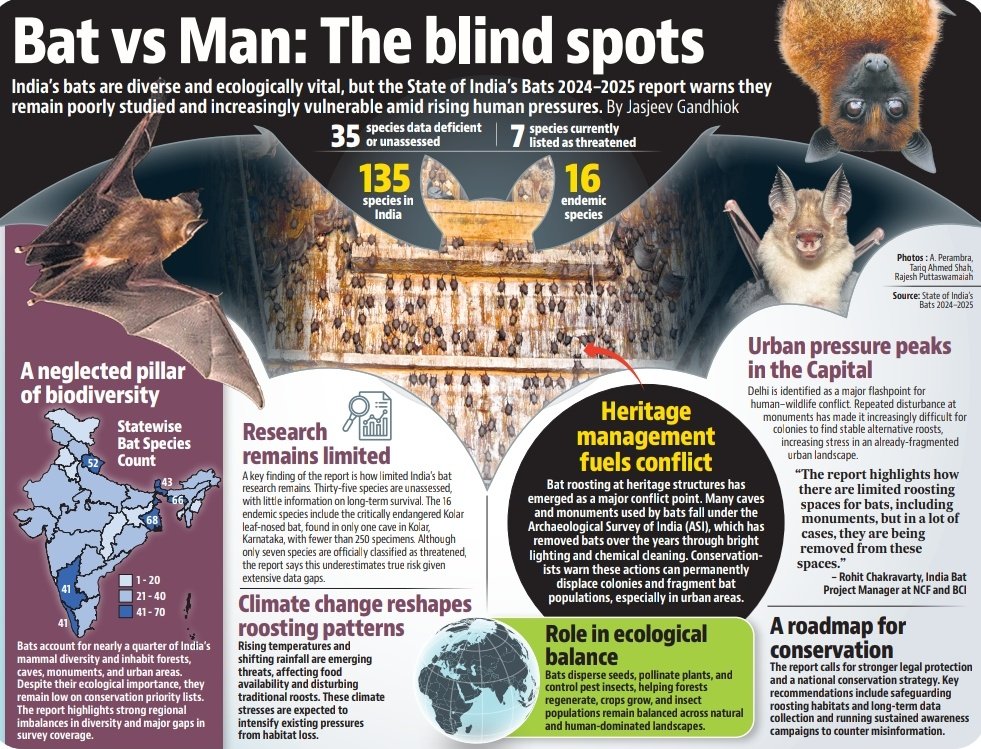
- Species Diversity: India hosts around 135 bat species, making bats the largest mammalian order in the country.
- Endemism: About 16 species are endemic (found only in India), concentrated in regions like the Western Ghats and Andaman & Nicobar Islands.
- Threatened Species: 7 species are listed under threatened categories by the International Union for Conservation of Nature (IUCN).
- Data Deficiency: Around 35 species remain unassessed or data deficient, indicating a lack of scientific research.
- Geographical Distribution: States like West Bengal and Meghalaya show high diversity, while northern plains show relatively low diversity due to habitat limitations.
- Roosting Patterns: Bats commonly roost in caves, trees, and even man-made structures such as old buildings and monuments.
- Species Diversity: India hosts around 135 bat species, making bats the largest mammalian order in the country.
-
Key issues Identified in the report:
-
-
- Lack of Dedicated Research Infrastructure: India lacks specialised bat research centres, despite bats being ecologically significant.
- Data Deficiency: A large number of species are either unassessed or poorly studied, leading to incomplete conservation status evaluation.
- Regional Bias in Studies: Most research is concentrated in biodiversity hotspots like the Western Ghats, leaving other regions understudied.
- Taxonomic and Ecological Uncertainty: Some species facing threats (e.g., due to mining or hunting) are still not properly classified in conservation frameworks.
- Lack of Dedicated Research Infrastructure: India lacks specialised bat research centres, despite bats being ecologically significant.
-
Conservation Concerns:
-
-
- Habitat Loss: Deforestation, mining, and urban expansion threaten natural roosting sites.
- Human Persecution: Myths and fear lead to hunting and destruction of bat colonies.
- Climate Change: Alters habitat suitability and food availability.
- Disturbance of Roosting Sites: Especially caves and old structures.
- Habitat Loss: Deforestation, mining, and urban expansion threaten natural roosting sites.
-
Ecological and Economic Importance:
-
-
- Bats provide critical ecosystem services:
- Pollination of plants
- Seed dispersal aiding forest regeneration
- Pest control, reducing reliance on pesticides
- Pollination of plants
- Their role in maintaining ecological balance directly supports agriculture and biodiversity.
- Bats provide critical ecosystem services:
-
Implications for Policy and Governance:
-
-
- Biodiversity Conservation: Need to include bats in mainstream conservation planning.
- Public Health Linkages: Habitat disruption may increase zoonotic disease risks, highlighting the need for a One Health approach.
- Urban Planning: Conservation strategies must account for bats in cities.
- Scientific Research: Urgent need for funding, monitoring programs, and institutional support.
- Biodiversity Conservation: Need to include bats in mainstream conservation planning.
-
Conclusion:
The State of India’s Bats Report serves as a wake-up call for policymakers and conservationists. Addressing research gaps, strengthening conservation frameworks, and promoting awareness are essential to protect these often-overlooked yet ecologically vital mammals. Integrating bat conservation into India’s broader environmental policies will be crucial for sustainable development and biodiversity protection.



