
Context:
In recent times, Spain is facing one of its biggest migration crises in recent years after 50,000–60,000 migrants crossed into the Spanish enclave of Ceuta from Morocco within 24 hours. The unprecedented influx overwhelmed local authorities and resulted in at least 41 deaths, highlighting the humanitarian and security challenges associated with irregular migration into Europe.
Background:
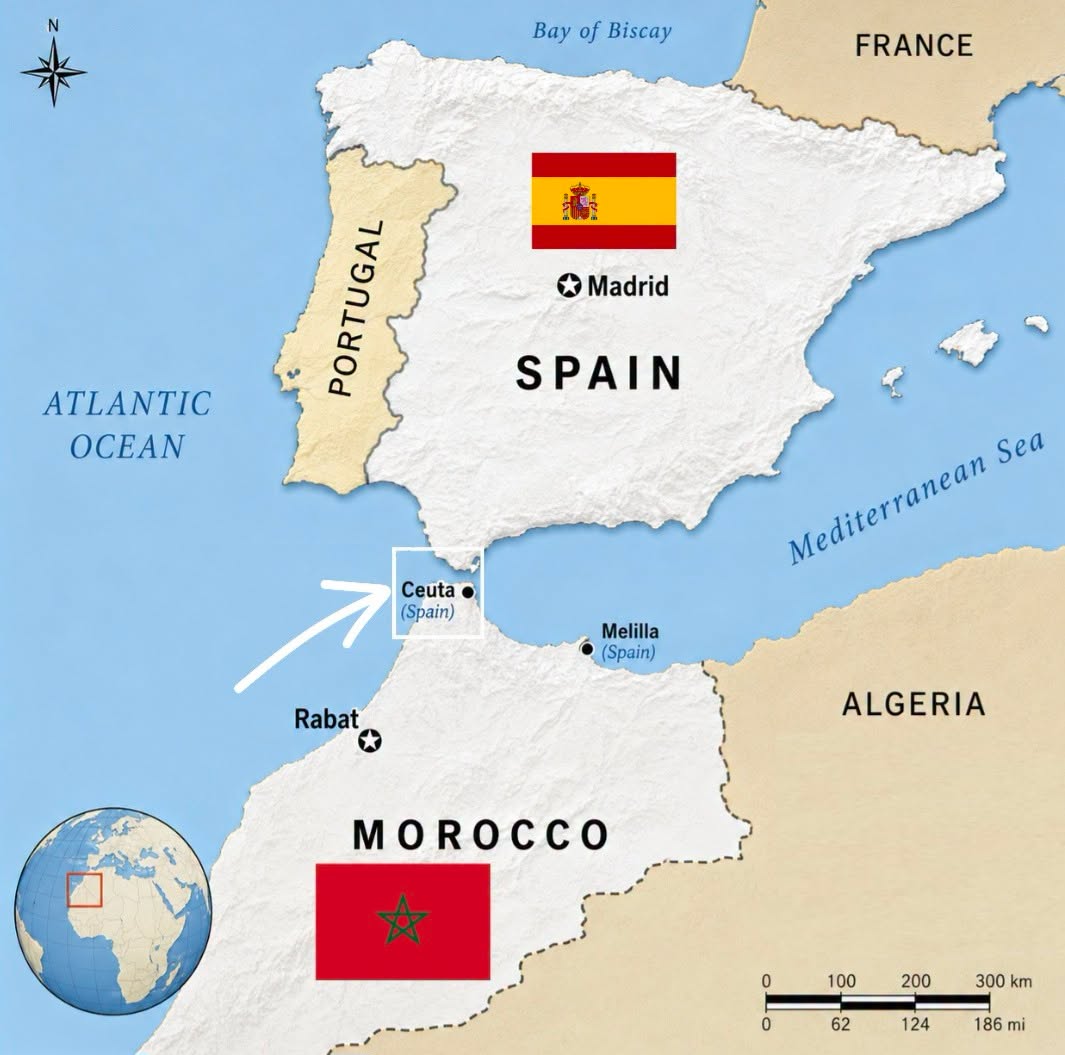
Ceuta and Melilla are two Spanish autonomous cities located on the northern coast of Africa. They constitute the European Union's only land borders with Africa, making them key entry points for migrants seeking to reach Europe. Migrants often attempt to enter Ceuta by swimming around border barriers or scaling the heavily fortified border fences.
Reasons behind the Surge:
The Spanish government attributes the sudden influx to:
-
-
- Human trafficking networks spreading misinformation about a recent Spanish Supreme Court ruling, falsely claiming that migrants arriving by sea would be allowed to remain in Spain.
- Persistent economic hardship, unemployment, and poverty in parts of North Africa.
- The geographical proximity of Ceuta and Melilla to Morocco, making them attractive entry points into the European Union.
- Human trafficking networks spreading misinformation about a recent Spanish Supreme Court ruling, falsely claiming that migrants arriving by sea would be allowed to remain in Spain.
-
However, some human rights organizations argue that structural socio-economic factors, rather than legal misinformation alone, largely explain the mass movement.
Spain's Response:
-
-
- Prime Minister Pedro Sánchez visited Ceuta and described the mass crossing as a "violation of Spain's territorial integrity."
- Additional military personnel and Civil Guard units were deployed to restore order.
- Spain coordinated with Morocco to strengthen border controls and facilitate the return of migrants.
- Authorities emphasized dismantling human trafficking and migrant smuggling networks responsible for encouraging dangerous crossings.
- Prime Minister Pedro Sánchez visited Ceuta and described the mass crossing as a "violation of Spain's territorial integrity."
-
European Response:
-
-
- European Commission President Ursula von der Leyen called for stronger action against illegal migration and migrant smuggling while stressing adherence to EU migration rules.
- Several European countries announced enhanced border monitoring, reflecting growing concerns over irregular migration within the Schengen Area.
- The crisis has revived debates on EU burden-sharing, border management, and asylum policies.
- European Commission President Ursula von der Leyen called for stronger action against illegal migration and migrant smuggling while stressing adherence to EU migration rules.
-
Challenges:
-
-
- Managing a large-scale humanitarian emergency while maintaining border security.
- Protecting the rights and safety of migrants, particularly women and children.
- Combating organized human trafficking networks.
- Balancing national security concerns with international refugee and human rights obligations.
- Strengthening cooperation between Spain, Morocco, and the European Union to prevent similar crises.
- Managing a large-scale humanitarian emergency while maintaining border security.
-
Way Forward:
The crisis underscores the need for a comprehensive migration management strategy combining stronger border cooperation, dismantling human trafficking networks, improved legal migration pathways, and addressing the root causes of migration through economic development and regional cooperation. Sustainable solutions will require close coordination between Spain, Morocco, the European Union, and international organizations to ensure both humanitarian protection and effective border governance.



