
Context:
Recently, the Defence Research and Development Organisation (DRDO) successfully conducted a flight demonstration of Solid Fuel Ducted Ramjet (SFDR) technology from the Integrated Test Range (ITR), Chandipur, off the coast of Odisha. This landmark test marks a significant stride in India’s indigenous missile propulsion capabilities and overall defence technological prowess.
What is SFDR Technology?
-
-
-
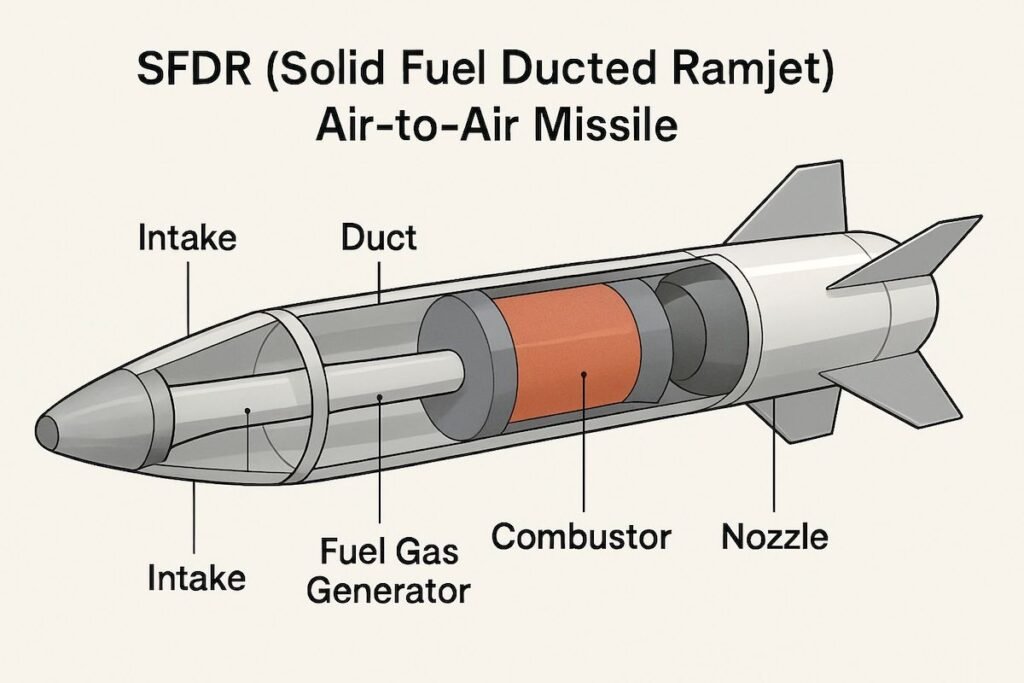
- Solid Fuel Ducted Ramjet (SFDR) is an advanced air-breathing propulsion system designed primarily for long-range air-to-air missiles. Unlike conventional solid rocket motors, which carry both fuel and oxidiser and burn out shortly after launch, SFDR uses atmospheric air as the oxidiser. This enables sustained combustion of solid fuel at supersonic speeds, resulting in longer range, higher speed, and better energy retention—critical attributes for modern aerial combat and beyond-visual-range engagements.
- The system consists of key components such as a nozzle-less booster, a solid fuel ducted ramjet motor, and a fuel flow controller. In the recent flight demonstration, all subsystems performed as expected after an initial boost to the required Mach number using a ground-based booster motor, thereby validating the technology’s readiness for future integration.
- Solid Fuel Ducted Ramjet (SFDR) is an advanced air-breathing propulsion system designed primarily for long-range air-to-air missiles. Unlike conventional solid rocket motors, which carry both fuel and oxidiser and burn out shortly after launch, SFDR uses atmospheric air as the oxidiser. This enables sustained combustion of solid fuel at supersonic speeds, resulting in longer range, higher speed, and better energy retention—critical attributes for modern aerial combat and beyond-visual-range engagements.
-
-
Strategic Significance:
-
-
-
- The successful SFDR demonstration places India among an elite group of nations possessing this complex missile propulsion technology, which has historically been limited to a few advanced defence powers. This capability significantly enhances India’s prospects for developing next-generation long-range air-to-air missiles, which are vital for ensuring air superiority and providing a tactical edge over adversaries in high-intensity conflict scenarios.
- The advanced propulsion system enables missiles to maintain sustained thrust throughout their flight, increasing the no-escape zone and improving the probability of intercept against agile, high-speed targets. This technological leap complements India’s ongoing efforts to modernise its aerial combat arsenal and reinforces self-reliance in critical defence technologies.
- The successful SFDR demonstration places India among an elite group of nations possessing this complex missile propulsion technology, which has historically been limited to a few advanced defence powers. This capability significantly enhances India’s prospects for developing next-generation long-range air-to-air missiles, which are vital for ensuring air superiority and providing a tactical edge over adversaries in high-intensity conflict scenarios.
-
-
Implications for Future Missile Programmes:
Experts suggest that SFDR technology will serve as a foundational element in the development of next-generation Beyond Visual Range Air-to-Air Missiles (BVRAAMs), such as the Astra Mk-3 (Gandiva). These missiles are expected to achieve extended engagement ranges—possibly exceeding 300 km—thereby addressing capability gaps in India’s current missile inventory and enhancing the Indian Air Force’s operational reach.
Conclusion:
The successful flight demonstration of SFDR technology by DRDO from the Chandipur test range represents a pivotal advancement in India’s defence R&D landscape. By mastering this sophisticated propulsion system, India not only strengthens its strategic deterrence profile but also expands its missile technology base for future aerospace applications. This achievement underscores India’s growing technological maturity and its commitment to building world-class defence capabilities through indigenous innovation.



