
Context:
Australia has become the first country to implement a blanket ban on social media for users under 16, effective December 9, 2025.
Rationale Behind Australia’s Ban:
1. Protection from algorithm-driven compulsive engagement, which can reinforce addictive behavior.
2. Reducing exposure to harassment, cyberbullying, and online exploitation.
3. Addressing gaps in voluntary age verification and parental controls, which are insufficient and inconsistent across platforms.
4. Establishing a clear, enforceable legal framework, instead of relying solely on self-regulation by tech companies.
Global Trends in Age-Based Digital Regulation:
Europe
-
-
-
- United Kingdom: The Online Safety Act mandates protection from harmful content but does not prescribe a minimum age.
- France: Children under 15 require parental consent to access social media.
- Germany: Teens aged 13–16 need guardian approval; younger children can sometimes bypass safeguards depending on platform design.
- United Kingdom: The Online Safety Act mandates protection from harmful content but does not prescribe a minimum age.
-
-
Asia:
-
-
-
- China: A strict “minor mode” with device-level controls, mandatory screen-time limits, and restrictions on online activities; most international platforms are blocked.
- Malaysia: Considering an under-16 ban similar to Australia’s.
- Afghanistan & Iran: Highly restrictive environments with limited or filtered social media access.
- North Korea: Citizens can access only a state-controlled intranet; the global internet is banned.
- China: A strict “minor mode” with device-level controls, mandatory screen-time limits, and restrictions on online activities; most international platforms are blocked.
-
-
United States
-
-
-
- COPPA (Children’s Online Privacy Protection Act): Regulates data collection for users under 13 but does not restrict access to social media platforms.
- COPPA (Children’s Online Privacy Protection Act): Regulates data collection for users under 13 but does not restrict access to social media platforms.
-
-
Challenges with Age-Based Restrictions:
1. Enforcement limitations: Platforms primarily rely on user-entered ages, leading to widespread evasions.
2. Technological challenges: Robust age verification is difficult to implement without compromising privacy.
3. Complex behavioral concerns: Legal measures alone cannot address deeper developmental, social, and mental health issues.
Significance for Policy and Society:
-
-
- Reflects a growing global concern around child digital safety, screen addiction, cyberbullying, and harmful content.
- Highlights the need for balanced approaches combining legislation, digital literacy, parental involvement, and technological safeguards.
- Offers context-specific lessons for India, which must protect children without restricting beneficial digital access.
- Reflects a growing global concern around child digital safety, screen addiction, cyberbullying, and harmful content.
-
Social Media Usage by Children in India:
Usage Statistics & Trends
1. High Penetration: About 43% of Indian children (8–18 years) had active social media accounts in 2021.
2. Time Spent: Many spend over 3 hours per day online; in Maharashtra, 17% spend more than 6 hours daily.
3. Platform Preferences:
o 76% of 14–15-year-olds use smartphones for social media.
o Video and OTT platforms are also widely accessed.
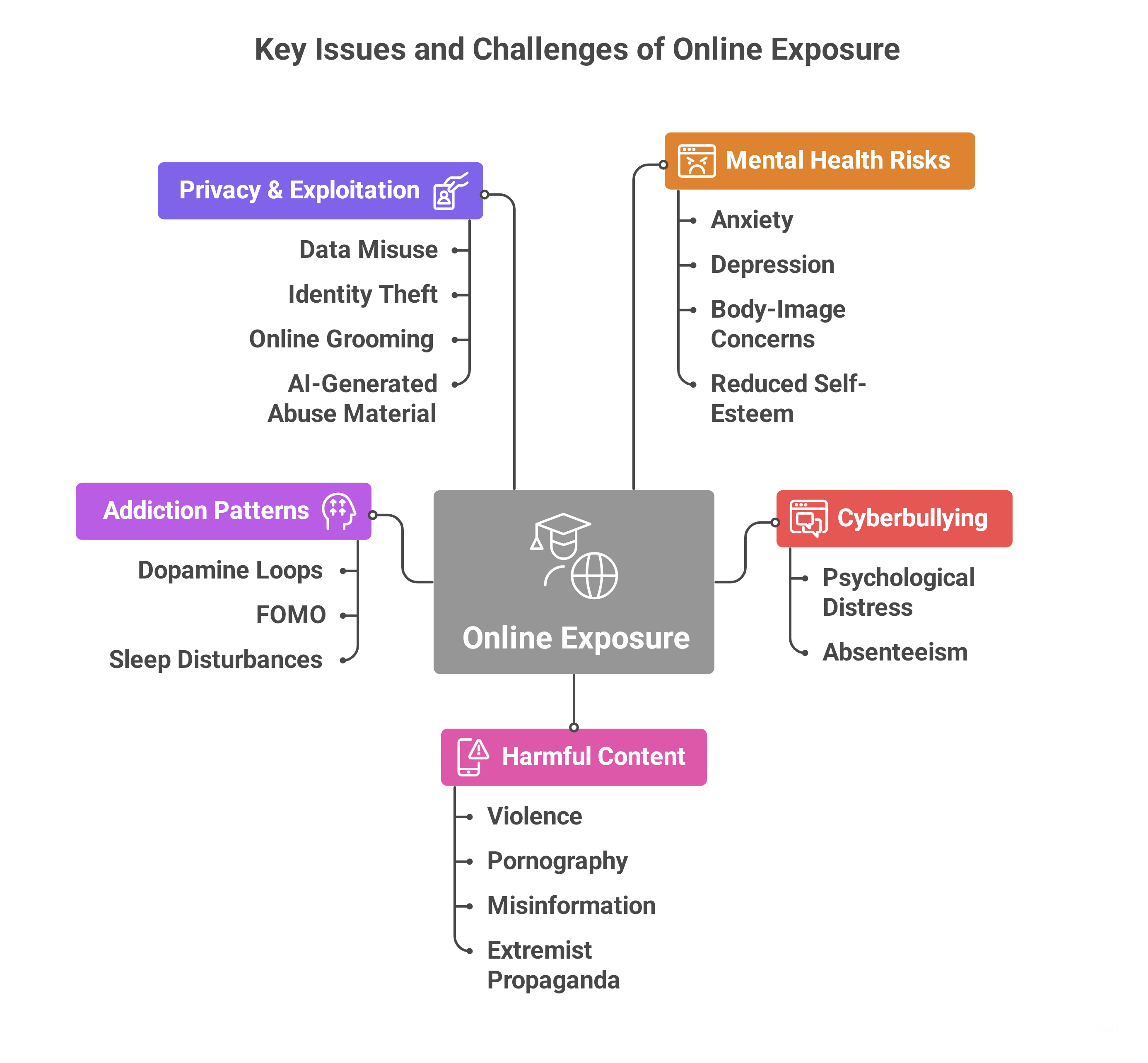
Key Issues and Challenges:
1. Mental Health Risks: Anxiety, depression, body-image concerns, and reduced self-esteem linked to online exposure.
2. Cyberbullying: 1 in 3 Indian children has faced cyberbullying (UNICEF, 2019), leading to psychological distress and absenteeism.
3. Exposure to Harmful Content: Includes violence, pornography, misinformation, and extremist propaganda.
4. Addiction Patterns: AI-driven algorithms create dopamine loops, FOMO, and sleep disturbances, affecting academic and social life.
5. Privacy & Exploitation Risks: Includes data misuse, identity theft, online grooming, and emerging threats such as AI-generated abuse material.
Regulatory and Policy Context in India:
-
-
- Digital Personal Data Protection (DPDP) Act 2023:
- Protects children’s data,
- Requires parental consent,
- Prohibits targeted advertising to children.
However, gaps remain, especially in enforcement mechanisms and platform accountability.
- Protects children’s data,
- Digital Personal Data Protection (DPDP) Act 2023:
-
Conclusion:
Australia's social media ban for children under 16 is a landmark step in digital governance. India does not have a law similar to the US's COPPA (Children's Online Privacy Protection Act), which specifically regulates children's online access, data management, and digital rights. This decision prompts governments worldwide to consider how they can strike a balance between algorithms, corporate interests, and the vulnerable minds of children.



