
Sikkim’s Natural Farming Model
Context:
Recently, Prime Minister Narendra Modi, during the 50th Statehood celebrations in Gangtok, highlighted that Sikkim adopted organic and natural farming nearly a decade ahead of the rest of the country, calling it a model for nationwide replication.
About Natural / Organic Farming:
-
-
- Natural or organic farming is an agricultural approach that avoids the use of synthetic fertilizers, pesticides, and genetically modified organisms (GMOs), relying instead on natural inputs such as compost, biofertilizers, and practices like crop rotation. It emphasizes maintaining soil health, enhancing biodiversity, and promoting ecological balance, making it a key component of sustainable agriculture and climate-resilient farming systems.
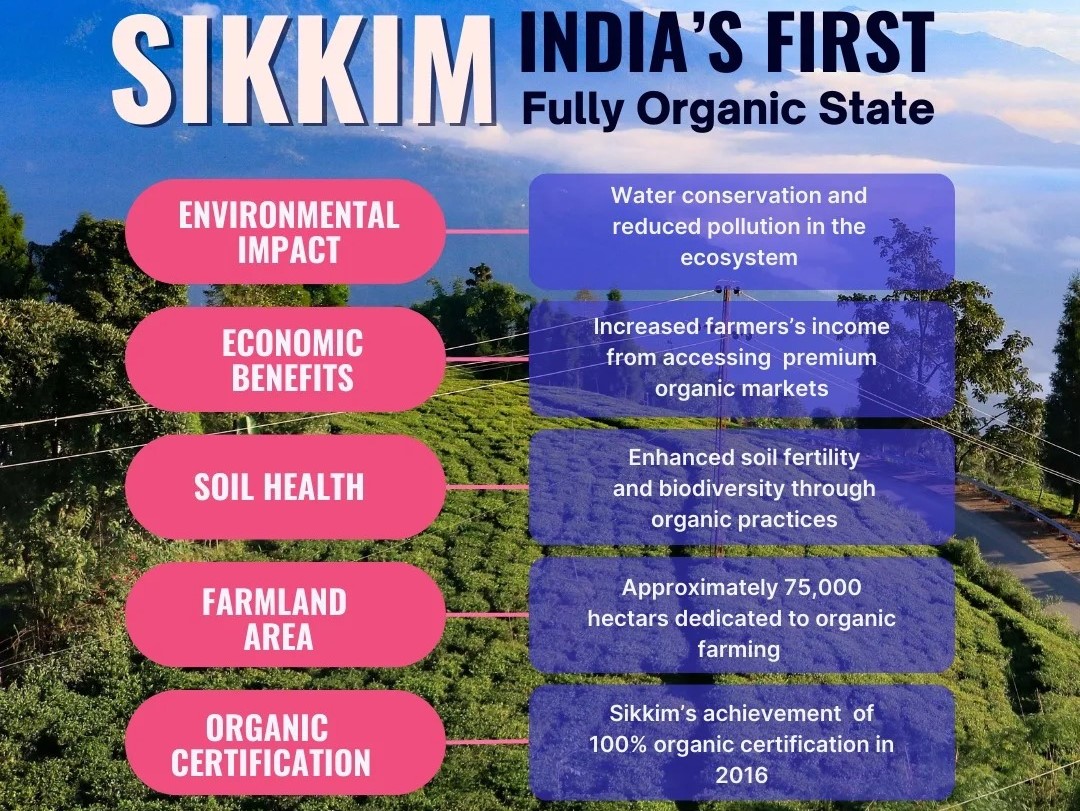
- Sikkim’s journey toward organic farming is a notable example of this approach in practice. The state began its transition in 2003 with a policy decision to adopt organic methods, achieved full organic certification by 2015, and in 2016 was officially declared India’s first 100% organic state, showcasing a successful model of environmentally sustainable agricultural transformation.
- Natural or organic farming is an agricultural approach that avoids the use of synthetic fertilizers, pesticides, and genetically modified organisms (GMOs), relying instead on natural inputs such as compost, biofertilizers, and practices like crop rotation. It emphasizes maintaining soil health, enhancing biodiversity, and promoting ecological balance, making it a key component of sustainable agriculture and climate-resilient farming systems.
-
Policy Framework:
Sikkim Organic Mission
-
-
- Gradual phasing out of chemical fertilizers and pesticides
- Capacity building and farmer training
- Promotion of vermi-composting and bio-inputs
- Gradual phasing out of chemical fertilizers and pesticides
-
Institutional Support
-
-
- Mission Organic Value Chain Development for North East Region
- Food and Agriculture Organization recognition and technical support
- Mission Organic Value Chain Development for North East Region
-
International Recognition
-
-
- Won the 2018 Future Policy Gold Award by Food and Agriculture Organization, often referred to as the “Oscar for best policies”.
- Won the 2018 Future Policy Gold Award by Food and Agriculture Organization, often referred to as the “Oscar for best policies”.
-
Key Features of Sikkim Model:
Complete Ban on Chemical Inputs
-
-
- Over 75,000 hectares brought under organic cultivation
- Over 75,000 hectares brought under organic cultivation
-
Focus on High-Value Crops
-
-
- Crops like:
- Cardamom
- Ginger
- Cardamom
- Crops like:
-
Integration with Tourism
-
-
- Branding of organic produce
- Boost to eco-tourism and agro-tourism
- Branding of organic produce
-
Rich Biodiversity
-
-
- Hosts:
- ~500 bird species
- ~700 butterfly species
- ~500 bird species
- Home to Kanchenjunga
- Hosts:
-
Advantages of the Model:
Environmental Benefits
-
-
- Improved soil fertility and health
- Reduced chemical pollution
- Conservation of biodiversity
- Improved soil fertility and health
-
Economic Gains
-
-
- Premium pricing for organic produce
- Increased farmer income (long-term)
- Tourism-driven demand
- Premium pricing for organic produce
-
Social Impact
-
-
- Health benefits for farmers and consumers
- Strengthened local livelihoods
- Health benefits for farmers and consumers
-
Challenges in Scaling Up:
-
-
- Initial drop in productivity during transition
- Lack of storage, logistics, and market linkages
- Higher cost of organic produce
- Need for certification and standardization
- Initial drop in productivity during transition
-
Relevance for India:
Alignment with National Policies
-
-
- National Mission on Natural Farming
- Paramparagat Krishi Vikas Yojana
- MOVCD-NER
- National Mission on Natural Farming
-
Contribution to SDGs
-
-
- SDG 2: Zero Hunger
- SDG 12: Responsible Consumption
- SDG 13: Climate Action
- SDG 2: Zero Hunger
-
Government’s Broader Push:
-
-
- Infrastructure projects like Sevoke–Rangpo railway to improve connectivity
- Promotion of local products and tourism
- Expansion of healthcare through Ayushman Bharat infrastructure
- Infrastructure projects like Sevoke–Rangpo railway to improve connectivity
-
Way Forward:
-
-
- Replicate Sikkim model in a phased and region-specific manner
- Strengthen market access and supply chains
- Promote farmer awareness and training
- Encourage public-private partnerships in organic value chains
- Replicate Sikkim model in a phased and region-specific manner
-
Conclusion:
Sikkim’s transition to organic farming demonstrates that sustainable agriculture is both feasible and beneficial. While challenges remain, its success offers a scalable model for achieving environmentally sustainable and economically viable agriculture in India.



