
Context:
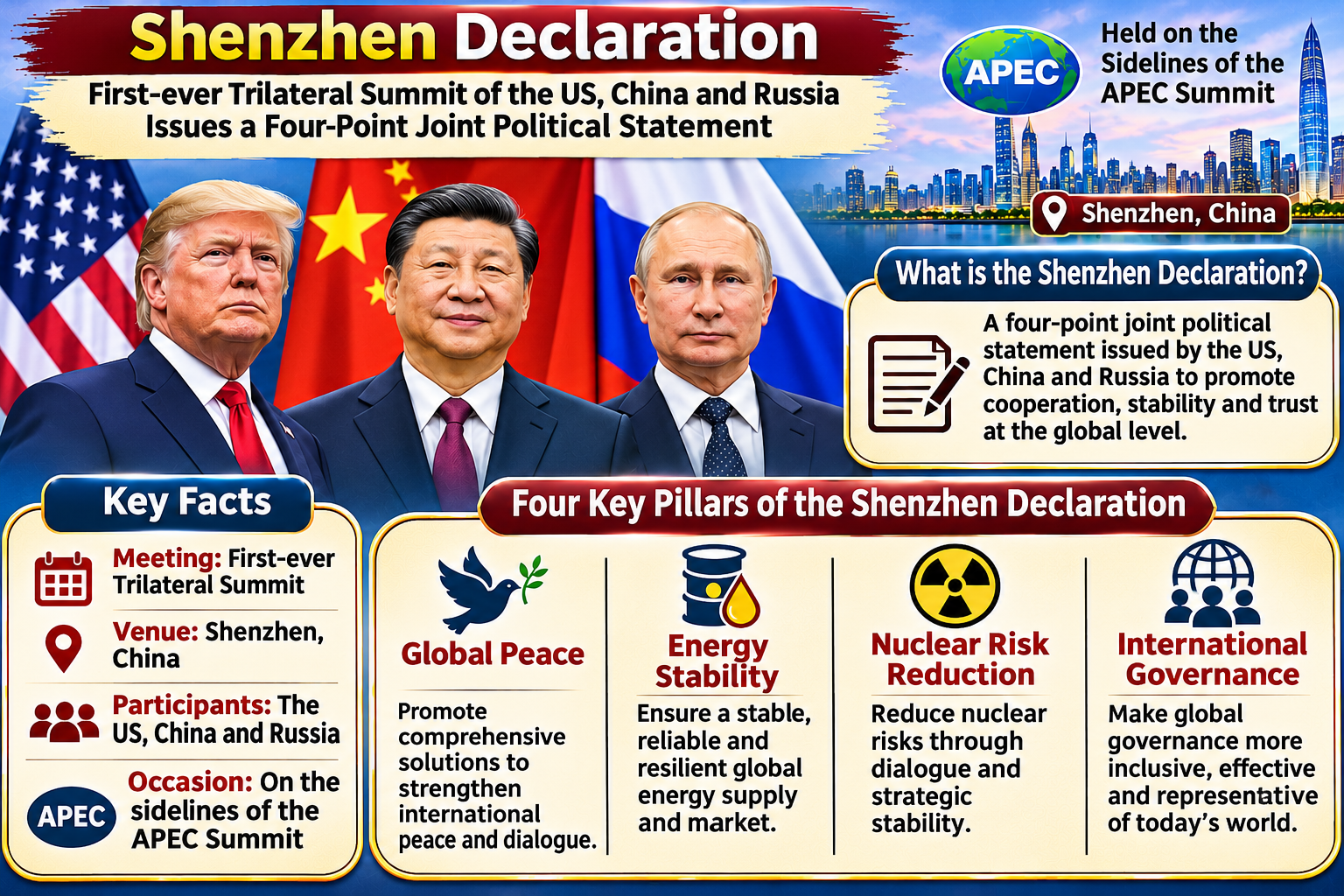
Recently, the leaders of the United States, China and Russia held their first-ever trilateral summit in Shenzhen, China, on the sidelines of the APEC Summit. The meeting resulted in a four-point joint political statement called the Shenzhen Declaration, focusing on global peace, energy stability, nuclear risk reduction and international governance.
Background:
The declaration comes amid growing geopolitical tensions, the Russia-Ukraine conflict, instability in West Asia and increasing nuclear competition. The expiry of the New START Treaty between the US and Russia on 5 February 2026 has further weakened the global arms-control framework. Meanwhile, China's expanding nuclear arsenal has increased the importance of including Beijing in nuclear-risk discussions.
Key Features of the Declaration:
-
-
- The declaration contains four major commitments. First, the three countries support reforming the United Nations to make it more effective in addressing global challenges. Second, they favour increasing refined petroleum production and maintaining stable energy supplies. Third, they emphasise state sovereignty, consent and immunity of state officials, while questioning the jurisdiction of international bodies such as the International Criminal Court (ICC). Fourth, they support dialogue on nuclear risk reduction and non-proliferation, reiterating that nuclear war cannot be won and must never be fought.
- However, it is a non-binding political declaration, not an arms-control treaty. It establishes no nuclear warhead limits, disarmament deadlines or verification mechanisms.
- The declaration contains four major commitments. First, the three countries support reforming the United Nations to make it more effective in addressing global challenges. Second, they favour increasing refined petroleum production and maintaining stable energy supplies. Third, they emphasise state sovereignty, consent and immunity of state officials, while questioning the jurisdiction of international bodies such as the International Criminal Court (ICC). Fourth, they support dialogue on nuclear risk reduction and non-proliferation, reiterating that nuclear war cannot be won and must never be fought.
-
Implications for India:
-
-
- Strategic and Security Implications: Nuclear dialogue among the US, China and Russia could reduce global tensions. However, India's exclusion from this framework limits its influence over discussions affecting its security, particularly given China's nuclear expansion and Pakistan's nuclear capabilities.
- United Nations Reforms: The declaration's general support for UN reform does not specifically endorse India's demand for permanent membership of the UN Security Council. India must continue advocating greater representation for developing countries.
- Energy Security: Increased refined petroleum supplies could help stabilise global energy markets. As a major energy importer, India may benefit from reduced price volatility and more reliable supplies.
- International Law: The declaration's position on state immunity and the ICC raises concerns about accountability for serious international crimes. India, which is not a party to the Rome Statute, must balance sovereignty concerns with the need to strengthen international accountability.
- Strategic and Security Implications: Nuclear dialogue among the US, China and Russia could reduce global tensions. However, India's exclusion from this framework limits its influence over discussions affecting its security, particularly given China's nuclear expansion and Pakistan's nuclear capabilities.
-
Way Forward:
India should pursue strategic autonomy through active engagement with major powers and multilateral platforms such as the UN, BRICS and G20. It should advocate inclusive nuclear-risk reduction, transparent arms-control mechanisms and comprehensive UN reforms. Strengthening domestic energy security and maintaining credible minimum nuclear deterrence remain essential.
Conclusion:
The Shenzhen Declaration reflects the growing influence of major powers in shaping global governance. For India, it presents both opportunities for greater energy stability and challenges relating to nuclear security and international representation. India must promote an inclusive, multipolar world order based on sovereignty, cooperation and rules-based international engagement.