
Context:
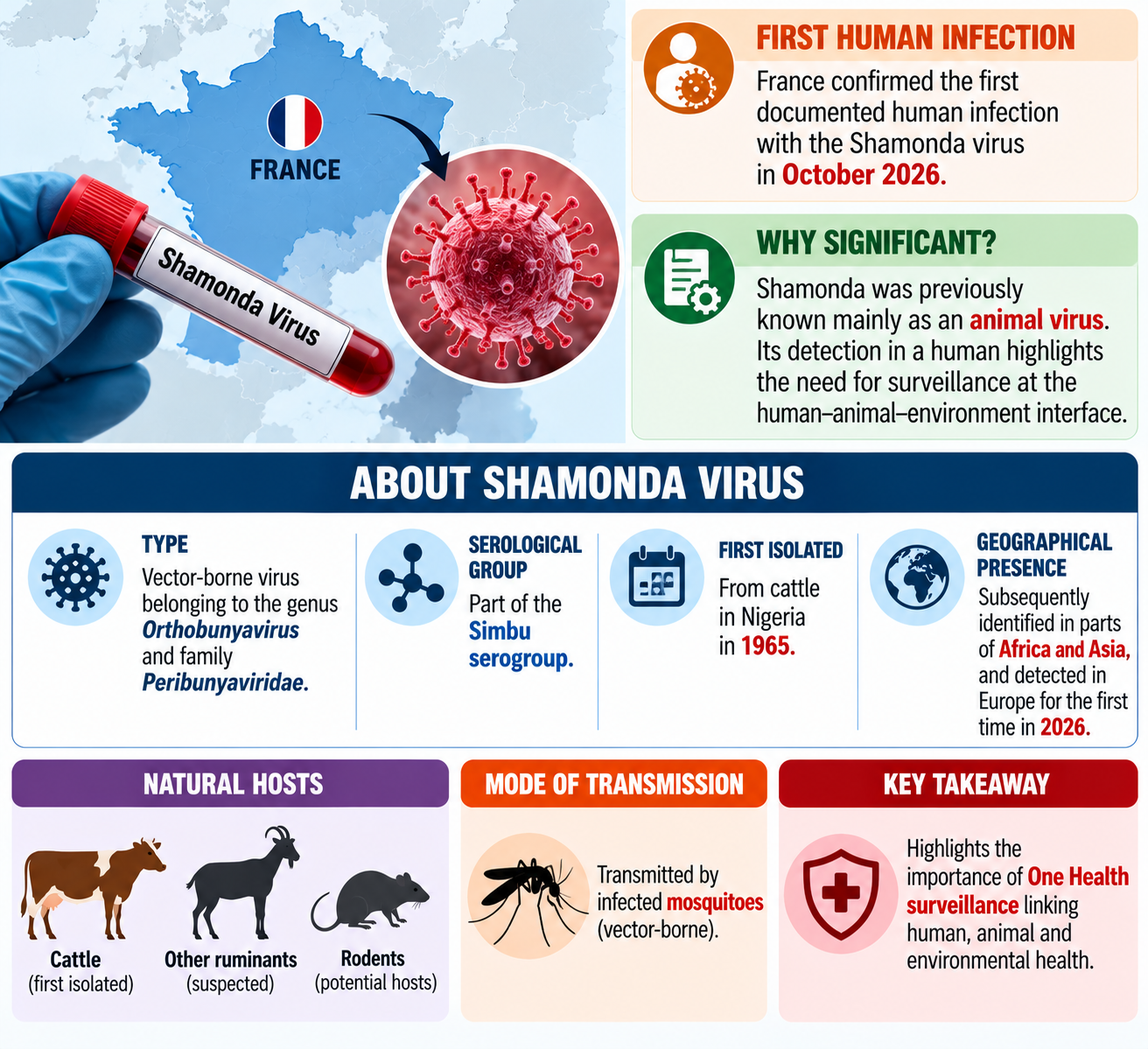
Recently, France confirmed the first documented human infection with the Shamonda virus in October 2026. The case is significant because Shamonda was previously known primarily as an animal virus. Its detection in a human highlights the importance of surveillance at the intersection of human, animal and environmental health.
What is the Shamonda Virus?
-
-
- The Shamonda virus is a vector-borne virus belonging to the genus Orthobunyavirus and family Peribunyaviridae. It is part of the Simbu serogroup and was first isolated from cattle in Nigeria in 1965. It has subsequently been identified in parts of Africa and Asia, and was detected in Europe for the first time in 2026.
- The virus primarily affects cattle, although infections have also been reported in sheep, goats, horses and alpacas. Its full epidemiological characteristics and long-term impact remain uncertain.
- The Shamonda virus is a vector-borne virus belonging to the genus Orthobunyavirus and family Peribunyaviridae. It is part of the Simbu serogroup and was first isolated from cattle in Nigeria in 1965. It has subsequently been identified in parts of Africa and Asia, and was detected in Europe for the first time in 2026.
-
How is the Virus Transmitted?
Shamonda virus is believed to spread primarily through the bites of infected Culicoides midges, which are small, biting, fly-like insects. These insects act as vectors, transmitting the virus between susceptible animals. Direct animal-to-animal transmission through ordinary contact has not been established, although transmission from an infected mother to her foetus can occur.
Zoonotic Spillover and Public Health Concerns:
-
-
- Zoonotic spillover occurs when a pathogen crosses the species barrier from animals to humans. Factors that may increase the risk include changes in pathogen characteristics, increased contact between humans and animals, ecological changes, vector distribution and the vulnerability of individuals with weakened immune systems.
- In the French case, authorities considered infection through an infected midge bite the leading hypothesis. The patient was severely immunocompromised and developed neurological complications.
- Zoonotic spillover occurs when a pathogen crosses the species barrier from animals to humans. Factors that may increase the risk include changes in pathogen characteristics, increased contact between humans and animals, ecological changes, vector distribution and the vulnerability of individuals with weakened immune systems.
-
Role of the World Organisation for Animal Health (WOAH):
WOAH supports international animal-health surveillance, scientific collaboration, laboratory diagnosis and information-sharing. In the Shamonda case, it is working with reference centres, experts and the World Health Organization to improve understanding of the virus and its potential implications for human and animal health.
Way Forward:
-
-
- The One Health approach recognises that human health, animal health and environmental health are interconnected. India should strengthen veterinary surveillance, laboratory testing, vector monitoring and information-sharing between public-health and animal-husbandry authorities.
- Early detection of unusual livestock illnesses, research into emerging pathogens and international cooperation can help identify potential threats before they become wider public-health problems.
- The One Health approach recognises that human health, animal health and environmental health are interconnected. India should strengthen veterinary surveillance, laboratory testing, vector monitoring and information-sharing between public-health and animal-husbandry authorities.
-
Conclusion:
The first documented human Shamonda virus infection in France is an important development in emerging-disease surveillance, but it does not by itself indicate an imminent public-health emergency. Continued research, transparent reporting and coordinated human, animal and environmental health surveillance are essential to assess the risk accurately.



