
Context:
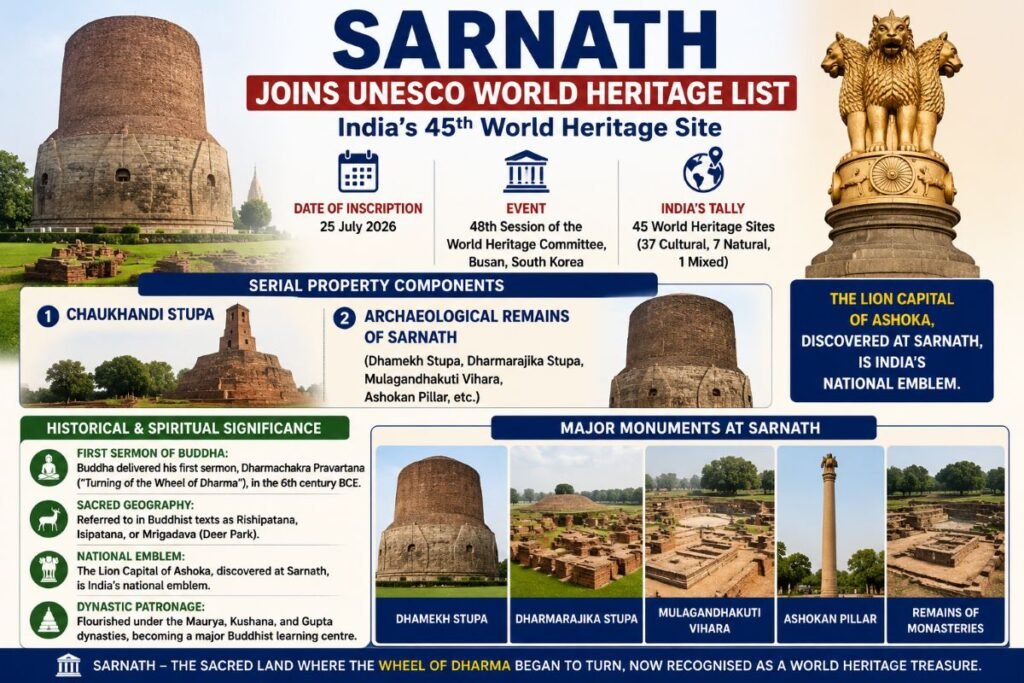
Recently, Sarnath, the sacred site where Lord Buddha delivered his first sermon after attaining enlightenment, was inscribed on the UNESCO World Heritage List during the 48th Session of the World Heritage Committee (WHC) held in Busan, South Korea. With this recognition, Sarnath has become India's 45th UNESCO World Heritage Site and the fourth World Heritage Site in Uttar Pradesh. The other three World Heritage Sites in the state are the Taj Mahal, Agra Fort, and Fatehpur Sikri.
About Sarnath:
-
-
- Sarnath is located about 10 km from Varanasi in Uttar Pradesh.
- It is one of the holiest pilgrimage sites in Buddhism.
- After attaining enlightenment at Bodh Gaya, Gautama Buddha delivered his first sermon here to his five disciples, marking the beginning of the spread of Buddhism.
- This event is known as Dharmachakrapravartana ("Turning the Wheel of Dharma").
- Sarnath is one of the four major Buddhist pilgrimage sites. The other three are:
- Lumbini (Nepal)
- Bodh Gaya (Bihar)
- Kushinagar (Uttar Pradesh)
- Lumbini (Nepal)
- Sarnath is located about 10 km from Varanasi in Uttar Pradesh.
-
Major Monuments at Sarnath:
-
-
- Dhamek Stupa
- Ashokan Pillar, whose Lion Capital is the National Emblem of India
- Ruins of ancient monasteries and temples dating from the Mauryan to Gupta periods
- Dhamek Stupa
-
What is a UNESCO World Heritage Site?
A UNESCO World Heritage Site (WHS) is a place recognized under the World Heritage Convention, 1972 for its Outstanding Universal Value (OUV) to humanity.
-
- The Convention came into force in 1975.
- India ratified the Convention in 1977.
- The Convention came into force in 1975.
Categories of World Heritage Sites:
1. Cultural Heritage – Monuments, archaeological sites, historic buildings, and cultural landscapes.
2. Natural Heritage – Natural landscapes, biodiversity hotspots, and geological formations.
3. Mixed Heritage – Sites possessing both cultural and natural significance.
Selection Process:
-
- The World Heritage Committee (WHC) consists of 21 elected Member States.
- It evaluates nominations submitted by countries and takes the final decision on inscription.
- A site must satisfy at least one of UNESCO's ten selection criteria to qualify for inscription.
- It must also meet the following requirements:
- Authenticity
- Integrity
- Legal Protection
- Effective Management
- Authenticity
- The World Heritage Committee (WHC) consists of 21 elected Member States.
Significance:
The inscription of Sarnath on the UNESCO World Heritage List:
-
- Provides global recognition to India's rich Buddhist heritage.
- Promotes heritage conservation.
- Boosts international tourism.
- Strengthens the Buddhist Circuit.
- Creates new employment opportunities through tourism.
- Enhances India's cultural diplomacy, particularly with Buddhist-majority countries in Asia.
- Encourages international cooperation for the conservation of India's archaeological and cultural heritage.
- Provides global recognition to India's rich Buddhist heritage.
Conclusion:
The inscription of Sarnath on the UNESCO World Heritage List is a significant recognition of India's rich Buddhist and cultural heritage. It will promote heritage conservation, strengthen the Buddhist Circuit, boost tourism, and enhance India's cultural diplomacy while ensuring the preservation of this historic site for future generations.



