
Context:
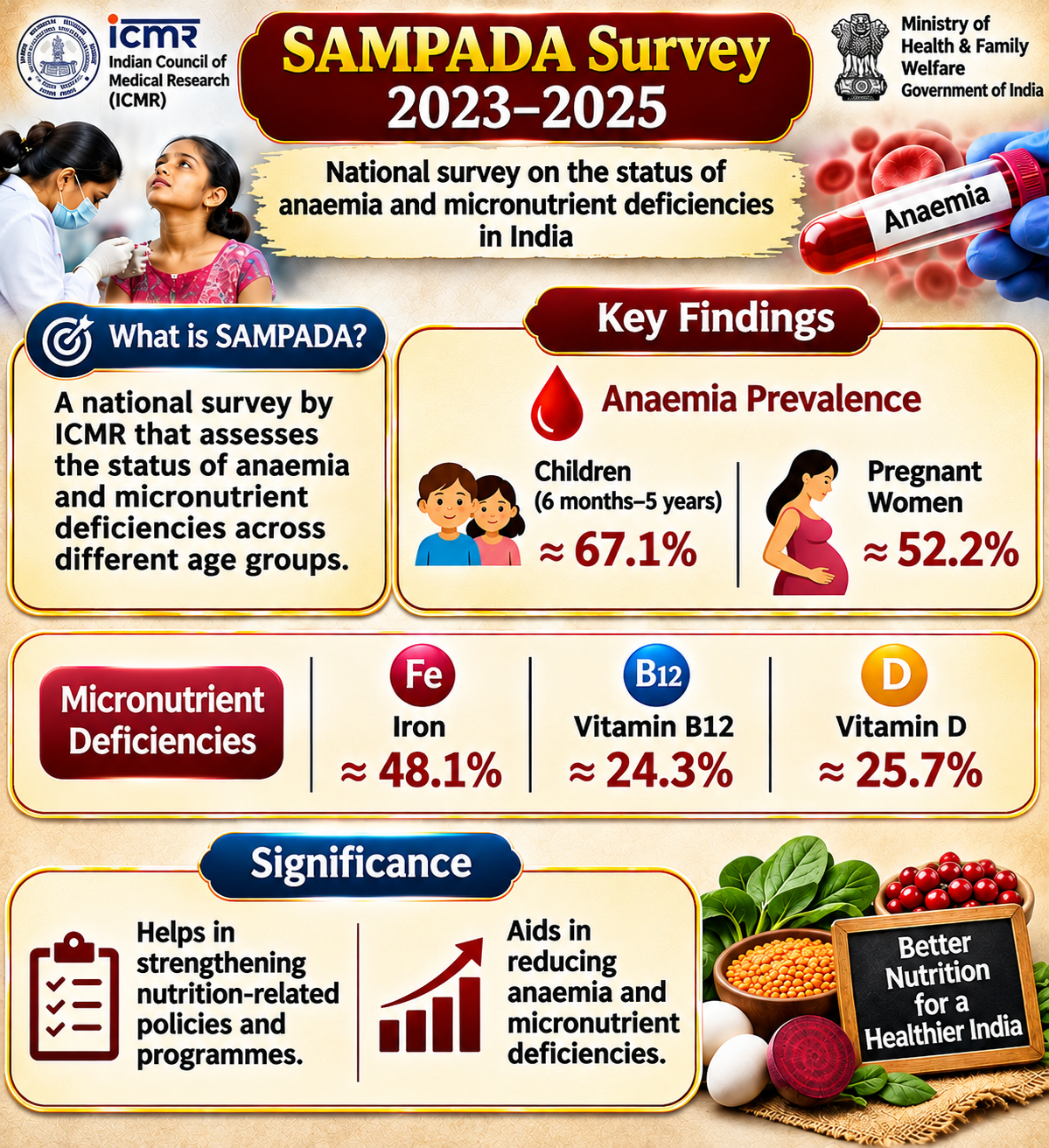
Recently, The Indian Council of Medical Research (ICMR), under the Department of Health Research, Ministry of Health and Family Welfare, has released findings of the Survey for Assessment of Markers of Population Health, Activity, Diet and Anthropometry (SAMPADA) 2023–2025. The survey provides comprehensive national-level evidence on anaemia and micronutrient deficiencies across different age groups and physiological stages.
Key Features of the Survey:
-
-
- SAMPADA covered more than 2 lakh individuals from over 81,000 households across 183 districts in 35 States and Union Territories. More than 1.7 lakh blood samples were analysed for haemoglobin estimation.
- A major strength of the survey is the use of venous blood sampling and automated analysers, ensuring greater accuracy and reliability. A subsample was also assessed for iron, folate, vitamin B12 and inflammatory biomarkers such as C-reactive protein (CRP) and alpha-1-acid glycoprotein (AGP).
- SAMPADA covered more than 2 lakh individuals from over 81,000 households across 183 districts in 35 States and Union Territories. More than 1.7 lakh blood samples were analysed for haemoglobin estimation.
-
Major Findings of SAMPADA:
-
-
- The survey indicates an encouraging decline in anaemia prevalence compared with previous national surveys.
- Anaemia prevalence was 42% among children aged 12–59 months, 46% among adolescent girls (10–19 years), 22–23% among adolescent boys and adult men, and 56% among women of reproductive age.
- It also provides nationally representative estimates for older adults, an age group for which evidence was previously limited.
- The majority of anaemia cases are mild, while severe anaemia affects less than 2% of people in most age groups.
- Iron deficiency accounts for approximately half of anaemia cases among women, adolescent girls and children. However, infections, inflammation and genetic disorders also contribute significantly.
- Vitamin B12 and folate deficiencies showed similar prevalence among anaemic and non-anaemic individuals, indicating their limited contribution to anaemia at the population level.
- The survey indicates an encouraging decline in anaemia prevalence compared with previous national surveys.
-
About Anaemia:
-
-
- Anaemia is a condition in which the body lacks sufficient healthy red blood cells or haemoglobin to transport oxygen to tissues. Major causes include iron, folate and vitamin B12 deficiencies, malaria, hookworm infections, chronic inflammation, sickle cell disease and thalassaemia.
- Socio-economic factors such as poverty, poor dietary diversity, inadequate sanitation and gender inequality further aggravate the problem. Anaemia can cause fatigue, weakness, reduced cognitive development, poor educational performance and decreased work productivity.
- Anaemia is a condition in which the body lacks sufficient healthy red blood cells or haemoglobin to transport oxygen to tissues. Major causes include iron, folate and vitamin B12 deficiencies, malaria, hookworm infections, chronic inflammation, sickle cell disease and thalassaemia.
-
Government Initiatives:
The Government of India has undertaken several initiatives to combat anaemia. Anaemia Mukt Bharat (2018) follows a 6×6×6 strategy covering six beneficiary groups, six interventions and six institutional mechanisms. Other initiatives include POSHAN Abhiyaan, Saksham Anganwadi and POSHAN 2.0, National Iron Plus Initiative, National Deworming Day and PM POSHAN. These programmes promote iron-folic acid supplementation, deworming, nutritional awareness and improved dietary practices.
Conclusion:
SAMPADA provides an important evidence base for strengthening India's nutritional policies. Its findings highlight that anaemia is not merely an iron-deficiency problem but a multidimensional public health challenge. A comprehensive, evidence-based and multi-sectoral strategy is essential to achieve Anaemia Mukt Bharat, improve human capital and realise the vision of Viksit Bharat @2047.