
Sabarimala Review Case: Supreme Court on Faith, Logic and Religious Freedom
Context:
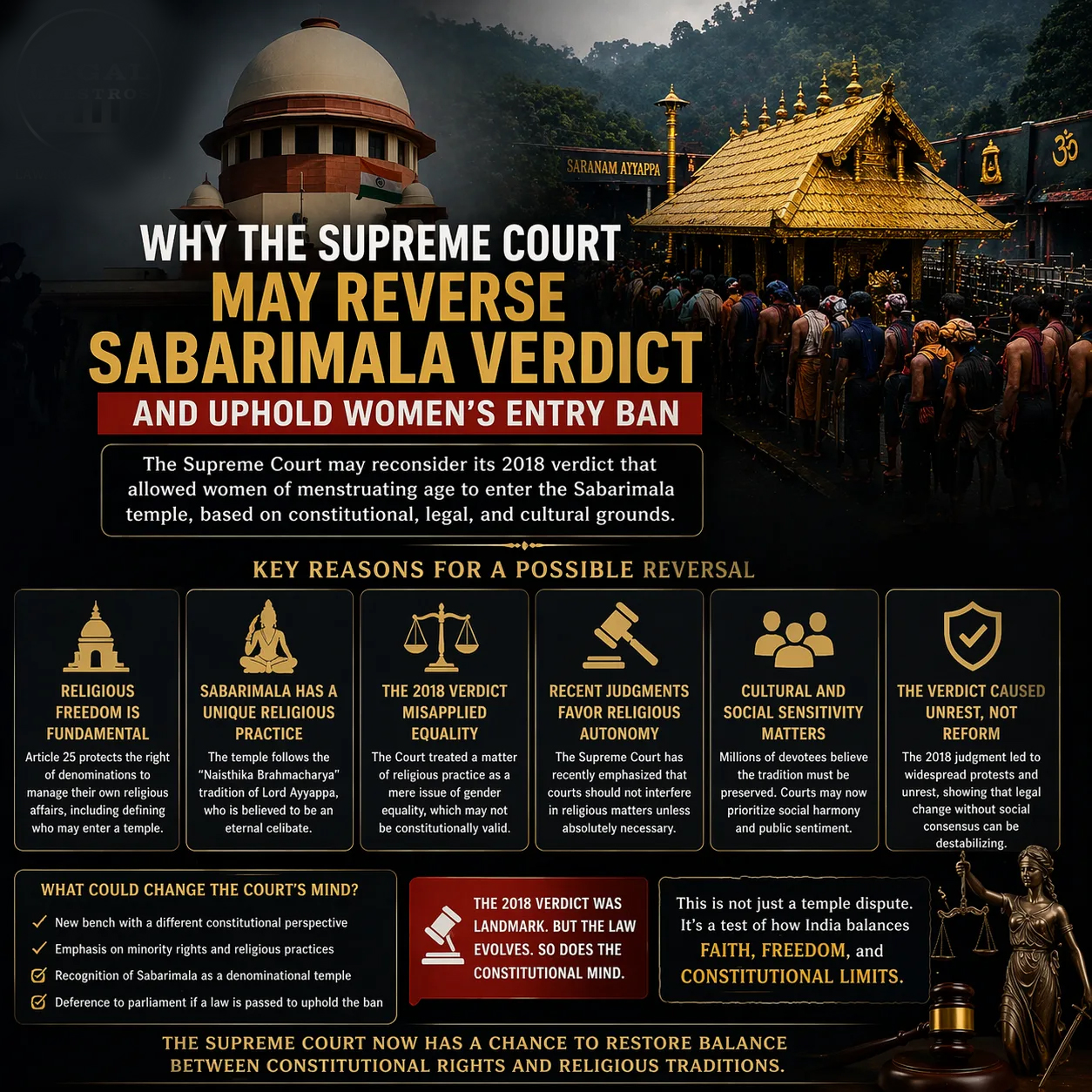
Recently, the Supreme Court of India made a highly significant and far-reaching observation during the hearing of the Sabarimala Reference case. A nine-judge Constitution Bench clarified that "logic cannot be an appropriate tool to examine systems of religious belief and faith." The bench, led by Chief Justice Surya Kant, is being seen as redefining the balance between religion and modern rationalism in Indian jurisprudence.
Key Observations of the Court:
During the hearing on this matter, the bench, including Justices M.M. Sundresh and B.V. Nagarathna, made several important points:
-
-
- Logic vs. Faith: The court observed that faith often goes beyond logic and scientific evidence. Dismissing a belief merely because it does not appear "logical" would destroy the very essence of religion.
- Importance of Internal Philosophy: Justice Nagarathna argued that any religious practice should be viewed from the philosophy of that religion itself, not through external logic or the standards of another religion.
- Limits of Intervention: The bench warned that religion should not be "hollowed out" in the name of reform. The court's role is not to act as a censor of religious texts or practices.
- Logic vs. Faith: The court observed that faith often goes beyond logic and scientific evidence. Dismissing a belief merely because it does not appear "logical" would destroy the very essence of religion.
-
Position of the Central Government:
Solicitor General Tushar Mehta, representing the Government of India, supported these observations. He argued that secular courts cannot function as "theological censors." He clarified that as long as a religious practice does not pose a direct threat to public order, morality, or health, the state should not intervene. Declaring centuries-old beliefs unlawful in the name of "rationality" or "modernity" could violate constitutional freedoms.
Constitutional Provisions:
-
-
- Article 25 of the Indian Constitution guarantees every citizen the freedom to practice and propagate their religion.
- Article 26 gives religious denominations the right to manage their own affairs.
- Article 25 of the Indian Constitution guarantees every citizen the freedom to practice and propagate their religion.
-
The current nine-judge bench is determining whether the right to "religious freedom" is independent of other fundamental rights (such as the right to equality) or subordinate to them.
Background of the Case:
-
-
- Traditional Practice: At the Sabarimala temple in Kerala, women aged 10–50 were historically barred from entering, citing the celibate nature of Lord Ayyappa.
- Kerala High Court (1991): Upheld the ban as consistent with tradition.
- Supreme Court (2018): A five-judge Constitution Bench (4:1 majority) struck down Rule 3(b) of the Kerala Hindu Places of Public Worship (Entry Authorization) Rules, 1965, allowing women of all ages to enter.
- Basis of the Decision: The court held that the exclusion of women violated Articles 14, 15, and 25, and that it did not constitute an "essential religious practice" (ERP).
- Review and Current Status: Following the judgment, protests ensued and review petitions were filed in 2019. In 2020, a nine-judge bench was constituted to address broader constitutional questions regarding the ERP doctrine.
- Traditional Practice: At the Sabarimala temple in Kerala, women aged 10–50 were historically barred from entering, citing the celibate nature of Lord Ayyappa.
-
Conclusion:
The Supreme Court’s observations highlight the complex interplay between faith and law in a secular democracy. Logic alone cannot analyze belief systems, yet the judiciary must protect constitutional values where religious practices intersect with fundamental rights. The ongoing Sabarimala review will provide clarity on balancing religious autonomy with judicial oversight.



