
QS World University Rankings by Subject 2026
Context:
Recently, The QS World University Rankings by Subject 2026, released by Quacquarelli Symonds (QS), provides a discipline-wise assessment of global higher education institutions across 55 subjects. It evaluates over 1,500 universities worldwide, making it one of the most comprehensive global benchmarks of academic excellence.
Methodology:
-
-
- The rankings are based on five key indicators:
- Academic Reputation
- Employer Reputation
- Citations per Paper
- H-index (research productivity)
- International Research Network
- Academic Reputation
- The rankings are based on five key indicators:
-
Key Highlights of QS Subject Rankings 2026 for India:
-
-
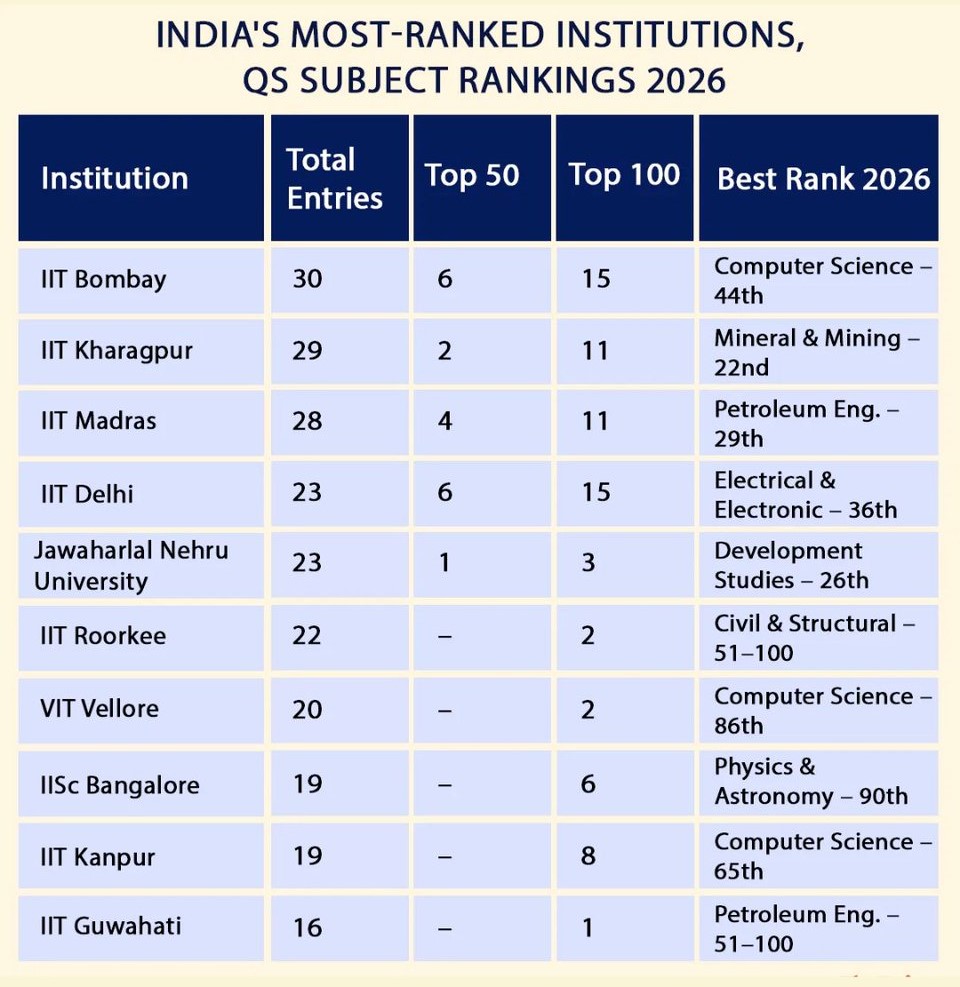
- The QS World University Rankings by Subject 2026 highlight India’s expanding global presence and improving academic performance. A total of 99 Indian institutions featured across various subject rankings, placing India fourth globally in terms of representation. Collectively, Indian institutions appeared in 599 subject entries, reflecting a significant expansion in both participation and global visibility. This trend is further reinforced by the fact that 44% of India’s entries recorded an improvement in rankings, the highest among major countries, indicating steady gains in research quality, academic reputation, and global competitiveness.
- At the top, institutions such as IIT (ISM) Dhanbad and IIM Ahmedabad emerged as India’s best performers, both securing rank 21 globally in their respective domains—mineral and mining engineering, and business and management studies/marketing. This demonstrates India’s niche global excellence in specialised fields.
- Additionally, rising institutions like IIT Kharagpur have shown remarkable progress, achieving rank 22 in mining engineering and breaking into the global top 25. Overall, India now has 27 subjects ranked within the global top 50, underscoring the rapid upward mobility and strengthening international standing of its higher education institutions.
- The QS World University Rankings by Subject 2026 highlight India’s expanding global presence and improving academic performance. A total of 99 Indian institutions featured across various subject rankings, placing India fourth globally in terms of representation. Collectively, Indian institutions appeared in 599 subject entries, reflecting a significant expansion in both participation and global visibility. This trend is further reinforced by the fact that 44% of India’s entries recorded an improvement in rankings, the highest among major countries, indicating steady gains in research quality, academic reputation, and global competitiveness.
-
Relevance for India:
-
-
- For India, the rankings carry significant implications across multiple dimensions. Firstly, improved performance enhances global academic recognition, strengthening India’s soft power and positioning it as an emerging knowledge hub. Secondly, the trends validate ongoing policy initiatives such as the National Education Policy (NEP) 2020, increased emphasis on research and innovation, and efforts toward internationalisation, making rankings an indirect indicator of policy effectiveness.
- However, concerns remain regarding employability, as a decline in employer reputation scores for some IITs highlights issues such as skill mismatch and the industry-academia gap, necessitating curriculum reforms aligned with market needs. Sectorally, India shows clear strengths in engineering, management, and computer science, but lags in humanities, medical sciences, and life sciences, underscoring the need for a more balanced academic ecosystem.
- Going forward, India must focus on increasing public investment in research, strengthening industry-academia linkages, promoting interdisciplinary education, enhancing global collaborations, and improving employability outcomes, while also prioritising underdeveloped sectors like humanities and medical research. This holistic approach is essential for sustaining India’s upward trajectory in global higher education rankings.
- For India, the rankings carry significant implications across multiple dimensions. Firstly, improved performance enhances global academic recognition, strengthening India’s soft power and positioning it as an emerging knowledge hub. Secondly, the trends validate ongoing policy initiatives such as the National Education Policy (NEP) 2020, increased emphasis on research and innovation, and efforts toward internationalisation, making rankings an indirect indicator of policy effectiveness.
-
Conclusion:
The QS World University Rankings by Subject 2026 underline that India is transitioning from expansion to excellence in higher education. While significant gains have been made in engineering and management, achieving global leadership will require balanced growth, research depth, and global integration.



