
S-400 Air Defence Systems: India, Russia Deal, Features and Strategic Importance
Context:
India is set to receive the remaining two units of the S-400 Triumf from Russia in 2026, with one expected in April and the final delivery scheduled for November. The delivery timeline has been expedited after earlier delays caused by supply chain disruptions and the Russia–Ukraine War.
About the S-400 Air Defence System:
-
-
- The S-400 Triumf (NATO designation: SA-21 Growler) is one of the world’s most advanced long-range surface-to-air missile (SAM) systems.
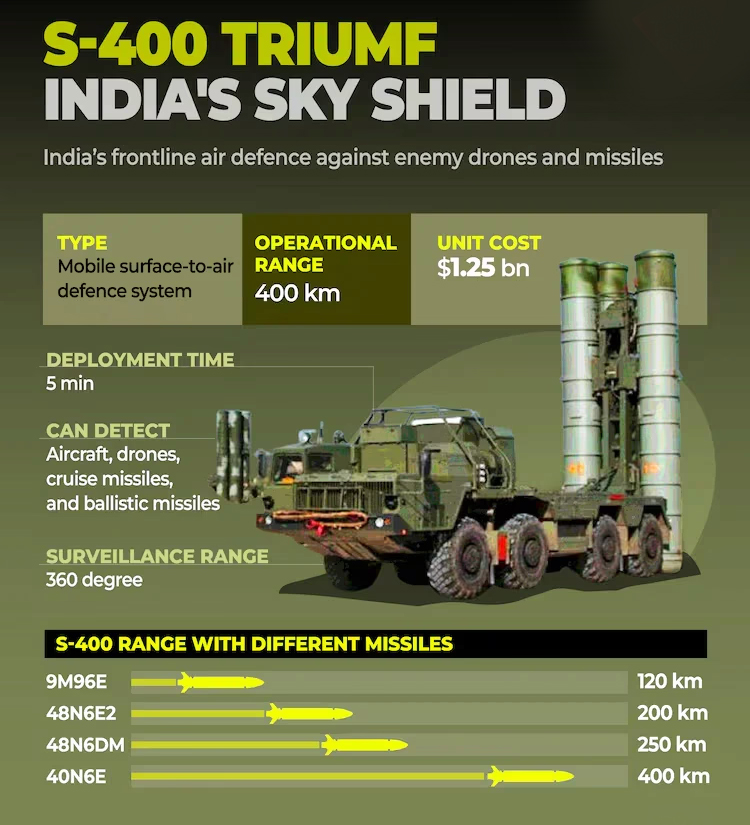
- It is capable of detecting aerial threats up to 600 km away and engaging targets at ranges of up to 400 km and altitudes of 30 km.
- Designed for layered air defence, it can neutralize a wide range of threats, including aircraft, drones, and ballistic and cruise missiles.
- The S-400 Triumf (NATO designation: SA-21 Growler) is one of the world’s most advanced long-range surface-to-air missile (SAM) systems.
-
Key Features and Capabilities:
-
-
- The system is equipped with advanced tracking capabilities, allowing it to monitor up to 300 targets simultaneously and engage around 36 threats at once.
- It uses multiple types of missiles, such as the 40N6 and 48N6, to strike targets at varying distances and altitudes, including high-speed threats moving up to Mach 14. Its high mobility enables rapid deployment, making it operational within minutes.
- Additionally, the S-400 is designed to function effectively in electronic warfare conditions, with sophisticated radars capable of resisting jamming.
- Its versatility allows it to counter a wide spectrum of aerial threats, from fighter jets to advanced missile systems.
- The system is equipped with advanced tracking capabilities, allowing it to monitor up to 300 targets simultaneously and engage around 36 threats at once.
-
S-400 and India:
India signed a $5.43 billion deal with Russia in 2018 for five S-400 squadrons. So far, three units have already been inducted into service, with the remaining two expected soon. Known as “Sudarshan Chakra” in India, the system is strategically deployed to strengthen air defence against potential threats from neighbouring countries such as China and Pakistan. Despite the risk of U.S. sanctions under CAATSA, India proceeded with the deal, highlighting its strategic autonomy in defence procurement.
About India–Russia Defence Relations:
Russia continues to remain a key defence partner for India, accounting for a significant share of its military inventory. The partnership has evolved beyond a traditional buyer-seller relationship to include joint development and production projects such as BrahMos missiles and AK-203 rifles. A long-term military-technical cooperation agreement for 2021–2031 further reinforces this strategic relationship, especially under the “Make in India” initiative.
Challenges and Strategic Implications:
Despite strong ties, challenges persist. India is gradually diversifying its defence imports by engaging with countries like the United States, France, and Israel. Western sanctions on Russia have complicated payment mechanisms and supply chains, raising concerns about timely deliveries. Additionally, Russia’s growing proximity to China poses strategic concerns for India.
Conclusion:
The timely delivery of the remaining S-400 systems will significantly enhance India’s air defence capabilities and strengthen its strategic deterrence. While India continues to diversify its defence partnerships, Russia remains a crucial partner in ensuring advanced military capability and maintaining geopolitical balance.



