
Context:
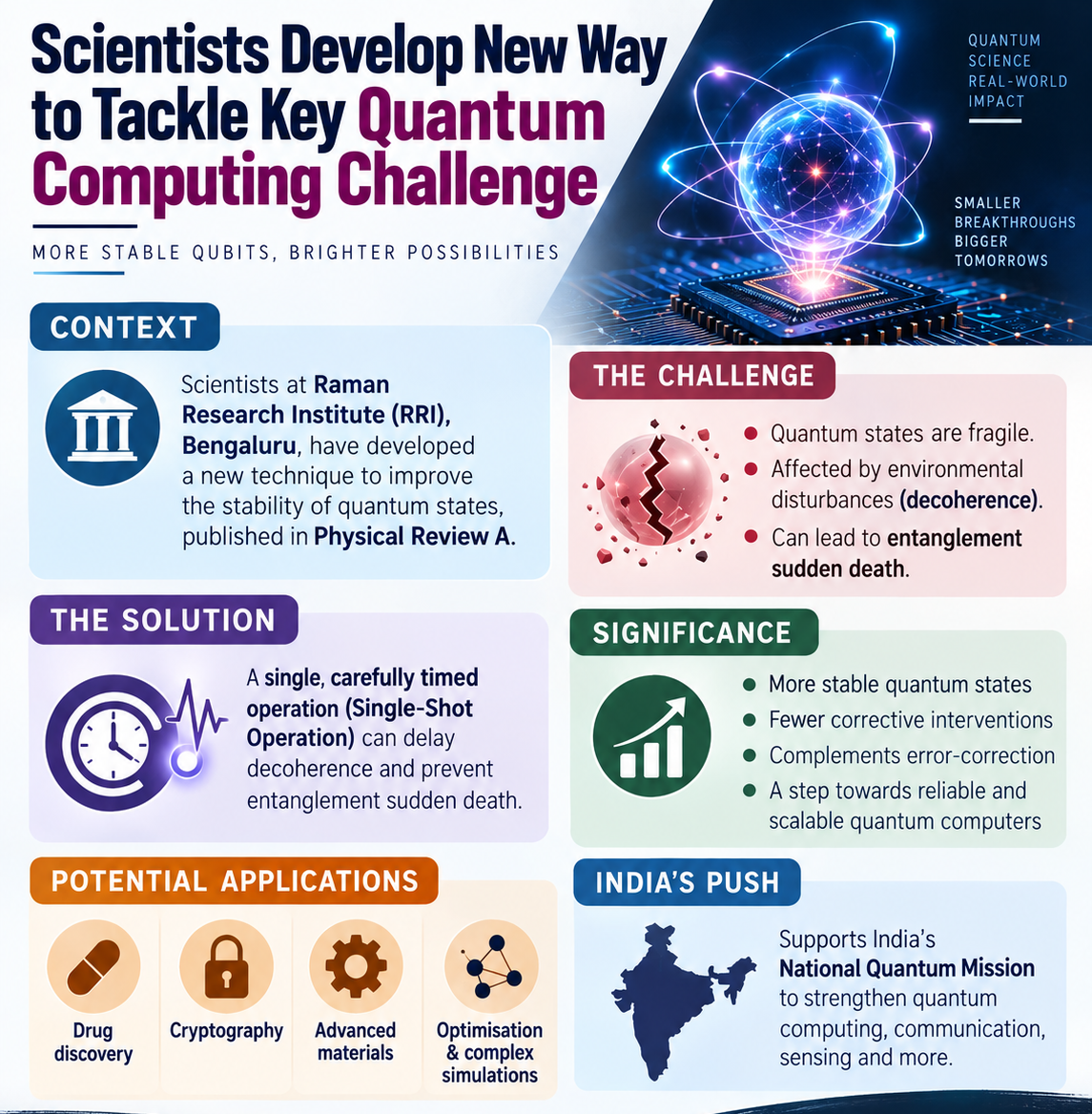
Recently, Scientists at the Quantum Information and Computing (QuIC) laboratory of Raman Research Institute (RRI), Bengaluru, have demonstrated a novel technique to improve the stability of quantum states used in quantum computing. The research, published in Physical Review A of the American Physical Society, focuses on controlling decoherence and preventing entanglement sudden death through Single-Shot Operation.
What is Quantum Computing?
Traditional computers use bits, represented as 0 or 1. Quantum computers use quantum bits or qubits, which exploit principles of quantum mechanics to process information in fundamentally different ways.
-
- Superposition:
- Quantum Entanglement:
- Superposition:
What is Quantum Decoherence?
-
-
- Quantum states are extremely fragile and can be disturbed by thermal vibrations, electromagnetic fields, radiation and other environmental interactions. The resulting loss of quantum coherence is called decoherence.
- Another related phenomenon is “entanglement sudden death”, where entanglement disappears abruptly. Decoherence and entanglement loss can introduce errors and undermine the reliability of quantum computations.
- Quantum states are extremely fragile and can be disturbed by thermal vibrations, electromagnetic fields, radiation and other environmental interactions. The resulting loss of quantum coherence is called decoherence.
-
About RRI's New Approach:
-
-
- Traditionally, scientists use repeated corrective interventions and quantum error-correction techniques to delay decoherence. However, repeated operations require significant resources and may themselves introduce errors.
- The RRI team demonstrated that a single, carefully timed operation can potentially delay decoherence and prevent entanglement sudden death. Thus, timing itself becomes a new control parameter.
- The researchers emphasise that this is a proof of concept, not a complete solution to decoherence or a replacement for quantum error correction. Further testing on different quantum computing platforms is required.
- Traditionally, scientists use repeated corrective interventions and quantum error-correction techniques to delay decoherence. However, repeated operations require significant resources and may themselves introduce errors.
-
Significance:
The approach could potentially:
-
-
- Reduce repeated corrective interventions.
- Improve control over fragile quantum states.
- Complement quantum error-correction methods.
- Contribute to the development of more reliable and scalable quantum processors.
- Reduce repeated corrective interventions.
-
Applications of Quantum Computing:
Quantum computing has potential applications in:
-
-
- Cryptography: Quantum algorithms such as Shor's algorithm could threaten existing encryption systems.
- Drug discovery: Simulation of molecules and chemical reactions.
- Materials science: Development of advanced materials.
- Optimisation: Logistics, supply chains and traffic management.
- Scientific research: Modelling complex physical and chemical systems.
- Cryptography: Quantum algorithms such as Shor's algorithm could threaten existing encryption systems.
-
India and Quantum Technology:
The research is significant in the context of India's National Quantum Mission, launched to strengthen capabilities in quantum computing, communication, sensing, metrology, materials and devices.
Conclusion:
The RRI research represents an important advance in controlling fragile quantum states. By using the timing of a single operation as an additional control parameter, it could complement existing error-correction methods. However, wider testing across different quantum-computing platforms is necessary before practical applications can be established.



