
Context:
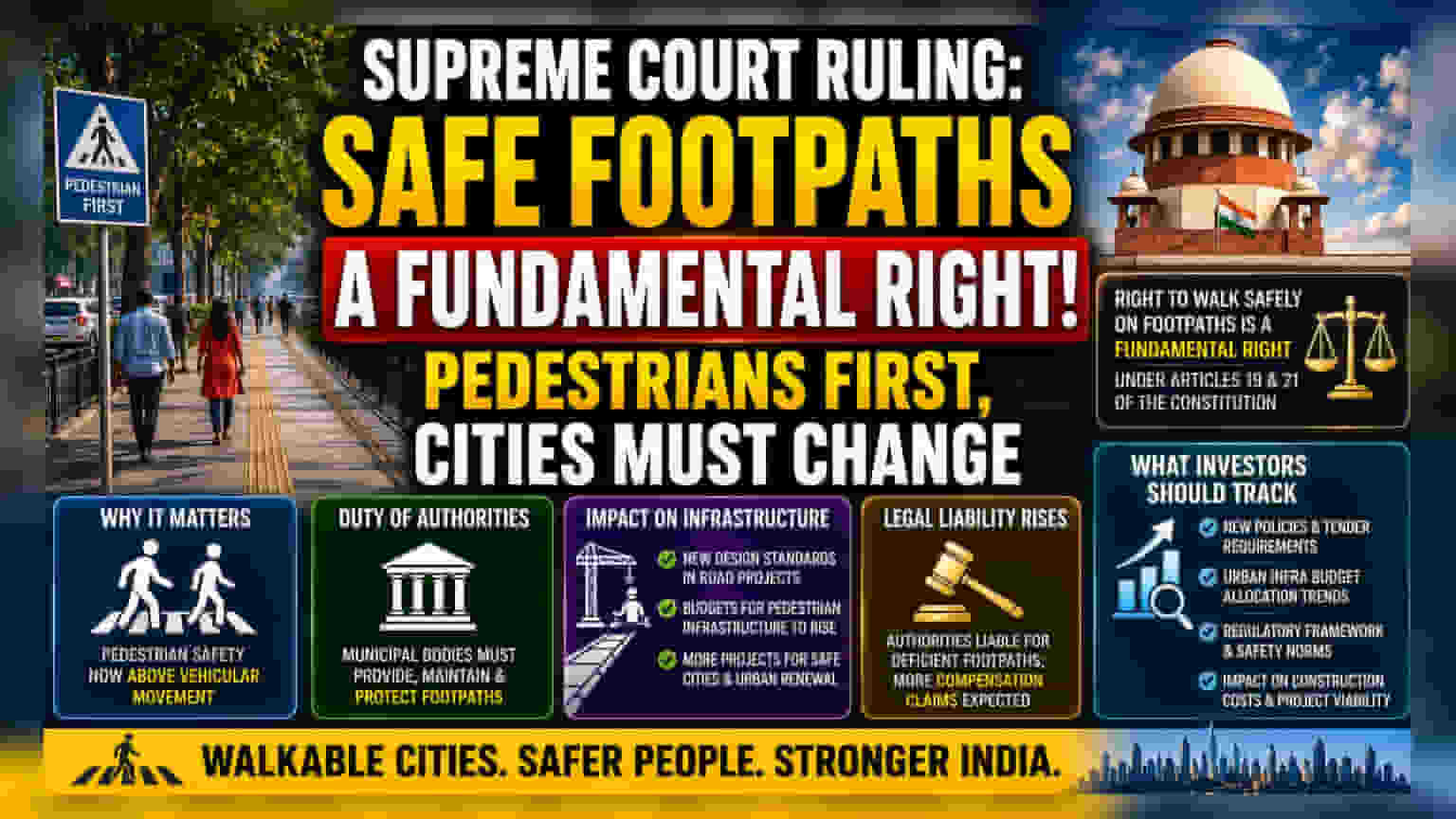
Recently, The Supreme Court, in a landmark judgment, declared that the right to walk on safe and demarcated footpaths is a Fundamental Right, deriving its constitutional basis from Article 19(1)(d) (freedom of movement) and Article 21 (right to life and dignity).
Key Highlights of the Judgment:
-
-
- Right to Walk Recognized as a Fundamental Right: The Court held that the right to walk is an integral component of the freedom of movement guaranteed under Article 19(1)(d) and is closely linked with the Right to Life under Article 21. It ruled that this right includes access to safe, well-maintained, and demarcated footpaths.
- Pedestrian Rights Have Priority: The judgment explicitly stated that pedestrian rights on footpaths shall have priority over the movement of motorized vehicles, recognizing walking as the most basic form of human mobility.
- Duty of Authorities: The Court observed that whenever a road exists, authorities have a corresponding duty to provide and maintain proper footpaths. This responsibility lies with urban development authorities, municipal corporations, municipalities, and panchayats.
- Need for a Dedicated Law and Regulator: The Court noted the absence of a dedicated legal framework governing pedestrian rights and recommended the creation of a statutory mechanism or regulator to ensure implementation, accountability, and grievance redressal.
- Right to Remedies: Citizens whose right to safe footpaths is violated can seek constitutional and legal remedies, including compensation and restitution against responsible authorities.
- Right to Walk Recognized as a Fundamental Right: The Court held that the right to walk is an integral component of the freedom of movement guaranteed under Article 19(1)(d) and is closely linked with the Right to Life under Article 21. It ruled that this right includes access to safe, well-maintained, and demarcated footpaths.
-
Constitutional Significance:
-
-
- Article 19(1)(d):
- Guarantees freedom of movement throughout the territory of India.
- The Court interpreted walking as a fundamental aspect of this freedom.
- Guarantees freedom of movement throughout the territory of India.
- Article 21:
- Protects life and personal liberty.
- The Court linked safe pedestrian infrastructure to the right to live with dignity and safety.
- Protects life and personal liberty.
- Article 19(1)(d):
-
Directive Principles and Inclusive Development:
-
-
- The judgment reinforces the constitutional vision of:
- Human-centric urban planning.
- Accessible infrastructure for persons with disabilities.
- Sustainable and inclusive mobility.
- Human-centric urban planning.
- The judgment reinforces the constitutional vision of:
-
Background:
In May 2025, the Supreme Court had already recognized the right to unobstructed and disabled-friendly footpaths as part of Article 21 and directed States and Union Territories to frame guidelines for pedestrian safety. The present judgment expands that reasoning by explicitly declaring the right to walk on safe footpaths as a Fundamental Right and calling for legislative action.
Significance for Urban Governance:
-
-
- Benefits
- Enhances pedestrian safety.
- Reduces road accidents involving walkers.
- Promotes sustainable and non-motorized transport.
- Improves accessibility for elderly citizens and persons with disabilities.
- Encourages people-centric city planning.
- Enhances pedestrian safety.
- Challenges
- Encroachment on footpaths.
- Poor urban planning and maintenance.
- Limited municipal resources.
- Weak enforcement mechanisms.
- Encroachment on footpaths.
- Benefits
-
Conclusion:
The Supreme Court’s recognition of the right to walk on safe footpaths transforms pedestrian safety into a constitutionally enforceable right, reshaping urban governance, strengthening accessibility, and deepening Article 21 jurisprudence. However, its real impact will depend on effective implementation by urban local bodies and sustained institutional enforcement, without which the judgment risks remaining symbolic rather than transformative.



