
Context:
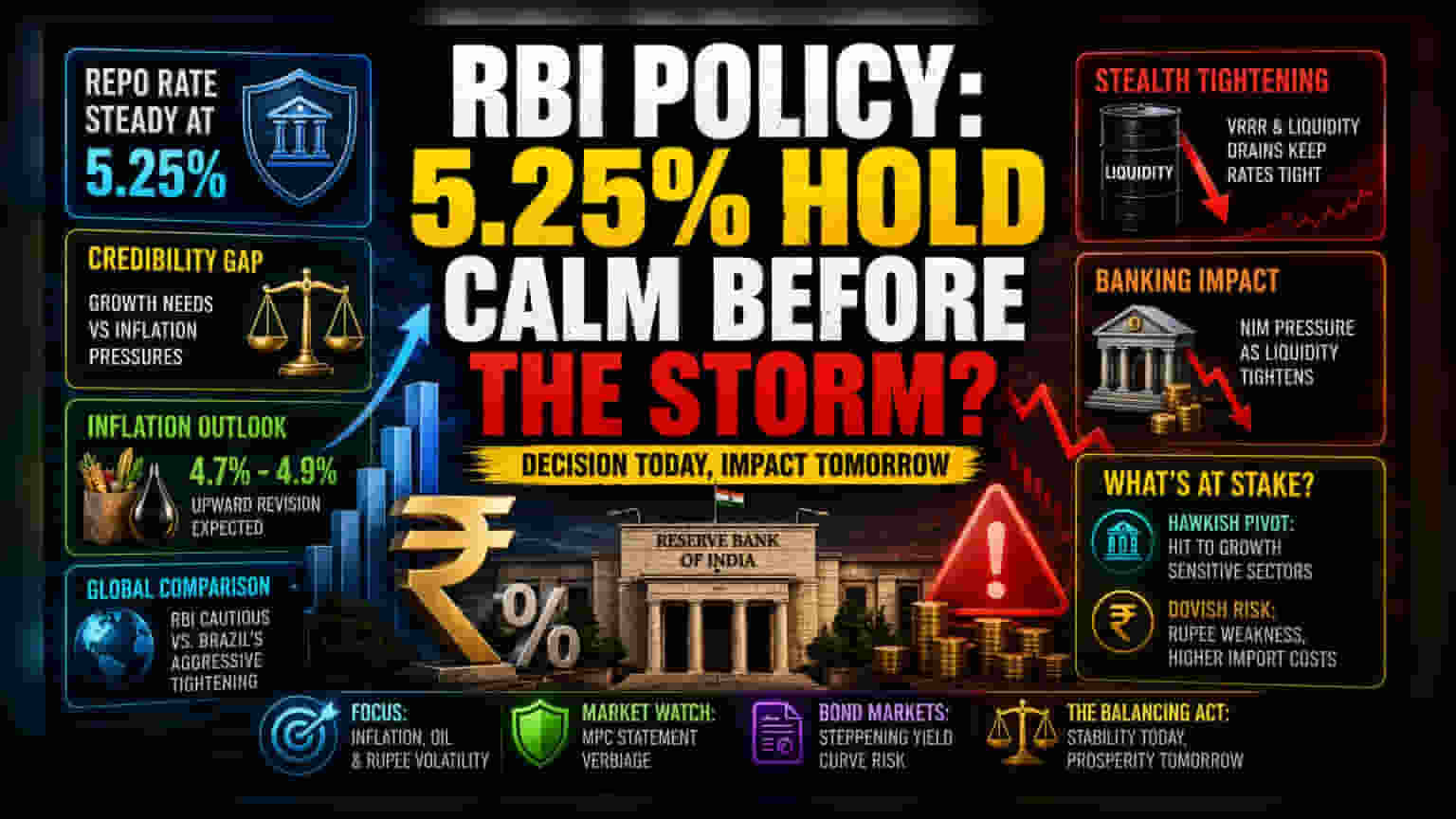
The Monetary Policy Committee (MPC) of the Reserve Bank of India (RBI) has decided to keep the policy repo rate unchanged at 5.25% while maintaining a neutral monetary policy stance. At the same time, the RBI revised its GDP growth forecast for FY 2026–27 downward to 6.6% from 6.9% and raised its inflation projection to 5.1%, reflecting concerns over global uncertainties, elevated energy prices, and supply chain disruptions.
Key Decisions of the MPC:
The MPC unanimously voted to keep the policy repo rate under the Liquidity Adjustment Facility (LAF) unchanged at 5.25%.
Consequently:
-
- Standing Deposit Facility (SDF) Rate: 5.0%
- Repo Rate: 5.25%
- Marginal Standing Facility (MSF) Rate: 5.50%
- Bank Rate: 5.50%
- Standing Deposit Facility (SDF) Rate: 5.0%
Neutral Policy Stance:
The committee decided to continue with a "neutral" stance, allowing flexibility to respond to evolving economic conditions while balancing inflation and growth concerns.
Why Did the MPC Maintain Status Quo?
According to the RBI, the global economic environment has deteriorated due to prolonged geopolitical conflicts, fragile global supply chains, and elevated energy prices.
Major Concerns
-
- Rising crude oil and energy prices.
- Continued disruptions in global supply chains.
- Geopolitical uncertainties affecting trade and investment.
- Risks associated with a sub-normal southwest monsoon.
- Possibility of El Niño impacting agricultural production.
- Rising crude oil and energy prices.
Growth Outlook for FY 2026–27
GDP Growth Forecast Revised Downward
The RBI lowered its real GDP growth projection for FY 2026–27 from 6.9% to 6.6%. The downward revision reflects concerns regarding higher production costs, weaker external demand, and supply-side constraints.
Inflation Outlook:
CPI Inflation Forecast Increased
The RBI revised its Consumer Price Index (CPI) inflation projection for FY 2026–27 to 5.1%, which is 50 basis points higher than its earlier estimate.
Factors Driving Inflation
-
- Elevated global energy prices.
- Increased transportation and logistics costs.
- Supply disruptions caused by geopolitical tensions.
- Potential food inflation due to weak monsoon conditions.
- Risks arising from El Niño weather patterns.
- Elevated global energy prices.
What is Monetary Policy?
Monetary policy refers to the actions undertaken by a central bank to regulate money supply, interest rates, and credit conditions in an economy.
Objectives of Monetary Policy
-
- Maintain price stability.
- Control inflation.
- Support economic growth.
- Ensure financial stability.
- Facilitate adequate credit flow in the economy.
- Maintain price stability.
In India, the RBI is responsible for conducting monetary policy under the Reserve Bank of India Act, 1934.
Flexible Inflation Targeting Framework
In 2016, the RBI Act was amended to provide a statutory basis for the Flexible Inflation Targeting (FIT) framework.
Inflation Target
The Government of India, in consultation with the RBI, sets an inflation target every five years.
Currently:
-
- Target CPI Inflation: 4%
- Upper Tolerance Limit: 6%
- Lower Tolerance Limit: 2%
- Target CPI Inflation: 4%
The RBI uses monetary policy tools to maintain inflation within this range.
About the Monetary Policy Committee (MPC)
The Monetary Policy Committee is a statutory body constituted under Section 45ZB of the RBI Act, 1934.
Functions
The MPC determines the benchmark policy interest rate (repo rate) necessary to achieve the inflation target.
Composition
The committee consists of six members:
1. RBI Governor (Chairperson)
2. RBI Deputy Governor in charge of Monetary Policy
3. One RBI-nominated official
4. Three external members nominated by the Government of India
Key Features
-
- External members have a tenure of four years.
- MPC meetings require a quorum of four members.
- Decisions are taken through majority voting.
- In case of a tie, the RBI Governor exercises a casting vote.
- The committee must meet at least four times every year.
- Its decisions are binding on the RBI.
- External members have a tenure of four years.
Importance of the Repo Rate:
The repo rate is the interest rate at which commercial banks borrow funds from the RBI against government securities.
Impact of Repo Rate Changes
-
- Higher Repo Rate:
- Reduces borrowing and spending.
- Helps control inflation.
- Reduces borrowing and spending.
- Lower Repo Rate:
- Encourages borrowing and investment.
- Stimulates economic growth.
- Encourages borrowing and investment.
- Higher Repo Rate:
Therefore, the repo rate serves as the RBI’s primary monetary policy instrument.
Conclusion:
The RBI kept the repo rate unchanged at 5.25%, adopting a cautious stance amid global uncertainties. Despite India's economic resilience, rising inflation risks and weaker global growth have led to a lower growth outlook and higher inflation forecast. The MPC will continue monitoring global developments, supply chains, and monsoon conditions to maintain economic stability.



