
Context:
Recently, The Reserve Bank of India (RBI) Monetary Policy Committee (MPC) has raised the policy repo rate by 25 basis points to 5.50% and changed its monetary policy stance from “neutral” to “calibrated tightening, signalling a shift towards tighter monetary conditions.
Key MPC Decision:
-
-
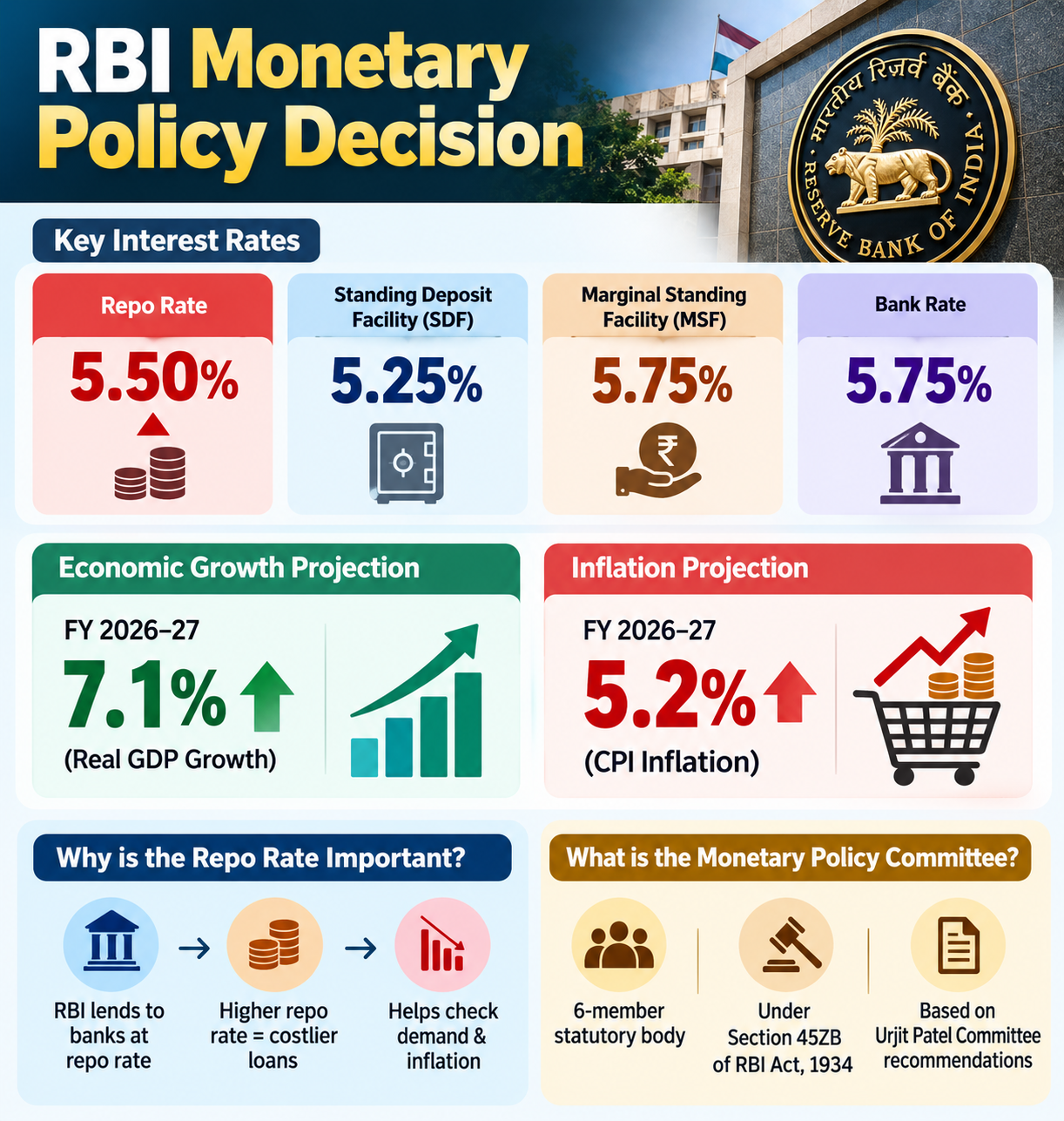
- The MPC raised the repo rate to 5.50%, while the Standing Deposit Facility (SDF) rate stands at 5.25% and the Marginal Standing Facility (MSF) and Bank Rate at 5.75%.
- The RBI also raised its FY 2026–27 real GDP growth projection to 7.1%, indicating confidence in the resilience of domestic economic activity. At the same time, the CPI inflation projection was raised to 5.2%, reflecting concerns over emerging price pressures.
- The MPC raised the repo rate to 5.50%, while the Standing Deposit Facility (SDF) rate stands at 5.25% and the Marginal Standing Facility (MSF) and Bank Rate at 5.75%.
-
Why is the Repo Rate Important?
-
-
- The repo rate is the rate at which the RBI lends short-term funds to commercial banks against eligible securities. When the RBI raises the repo rate, borrowing by banks becomes relatively more expensive, which can transmit into higher lending rates for households and businesses.
- This may moderate excessive demand and inflationary pressures. Conversely, a reduction in the repo rate can lower borrowing costs, encourage consumption and investment and support economic activity. Thus, monetary policy involves balancing the objectives of price stability and economic growth.
- The repo rate is the rate at which the RBI lends short-term funds to commercial banks against eligible securities. When the RBI raises the repo rate, borrowing by banks becomes relatively more expensive, which can transmit into higher lending rates for households and businesses.
-
What is the Monetary Policy Committee?
-
-
- The Monetary Policy Committee is a six-member statutory body established under Section 45ZB of the RBI Act, 1934, following the recommendations of the Urjit Patel Committee and the adoption of the Flexible Inflation Targeting framework.
- Its primary responsibility is to determine the policy repo rate required to achieve the inflation objective while keeping growth considerations in view. The MPC consists of three RBI representatives and three external members appointed by the Central Government.
- The Monetary Policy Committee is a six-member statutory body established under Section 45ZB of the RBI Act, 1934, following the recommendations of the Urjit Patel Committee and the adoption of the Flexible Inflation Targeting framework.
-
Inflation Targeting Framework:
-
-
- Under the Flexible Inflation Targeting (FIT) framework, the RBI seeks to maintain headline CPI inflation at 4%, with a tolerance band of 2% to 6%. The inflation target is reviewed periodically by the government. If inflation remains outside the tolerance band for three consecutive quarters, the RBI is required to submit a report to the Central Government explaining the reasons for the deviation and proposing remedial measures.
- The MPC therefore uses the repo rate as its principal policy instrument to influence inflation and economic activity. The framework gives greater predictability to monetary policy while retaining flexibility to respond to growth and supply-side shocks.
- Under the Flexible Inflation Targeting (FIT) framework, the RBI seeks to maintain headline CPI inflation at 4%, with a tolerance band of 2% to 6%. The inflation target is reviewed periodically by the government. If inflation remains outside the tolerance band for three consecutive quarters, the RBI is required to submit a report to the Central Government explaining the reasons for the deviation and proposing remedial measures.
-
Reasons behind the Rate Hike:
-
-
- The major reason for the rate hike is the renewed risk of inflation. Rising crude oil prices, geopolitical tensions and possible supply disruptions can increase India's import bill and generate imported inflation. Higher oil prices can also put pressure on the rupee, thereby making imports more expensive. Since India remains highly dependent on crude-oil imports, persistent external price shocks can have significant implications for domestic inflation.
- The RBI's decision also reflects the strength of the Indian economy. With GDP growth projected at 7.1%, the central bank has greater policy space to prioritise price stability without severely damaging economic momentum. The shift towards a calibrated tightening stance indicates that the RBI is prepared to take further measures if inflationary pressures become persistent.
- The major reason for the rate hike is the renewed risk of inflation. Rising crude oil prices, geopolitical tensions and possible supply disruptions can increase India's import bill and generate imported inflation. Higher oil prices can also put pressure on the rupee, thereby making imports more expensive. Since India remains highly dependent on crude-oil imports, persistent external price shocks can have significant implications for domestic inflation.
-
Impact on the Economy:
-
-
- A higher repo rate generally increases the cost of funds for commercial banks, which can subsequently raise lending rates. This may increase EMIs on floating-rate home, vehicle and personal loans, while potentially improving returns on deposits.
- Higher borrowing costs may moderate excessive credit demand and investment, helping control inflation. However, prolonged monetary tightening could also affect private investment and consumption.
- The policy may also provide some support to the Indian rupee by making rupee-denominated assets relatively more attractive. Nevertheless, exchange-rate movements will continue to depend on global interest rates, capital flows and crude-oil prices.
- A higher repo rate generally increases the cost of funds for commercial banks, which can subsequently raise lending rates. This may increase EMIs on floating-rate home, vehicle and personal loans, while potentially improving returns on deposits.
-
Conclusion:
The October 2026 MPC meeting marks an important shift in India's monetary-policy cycle. By raising the repo rate to 5.50% and adopting a calibrated tightening stance, the RBI has signalled that controlling inflation is becoming a priority while maintaining confidence in India's growth prospects. The effectiveness of this approach will depend on the evolution of inflation, crude-oil prices, global financial conditions and domestic demand.



