
Prototype Fast Breeder Reactor
Context:
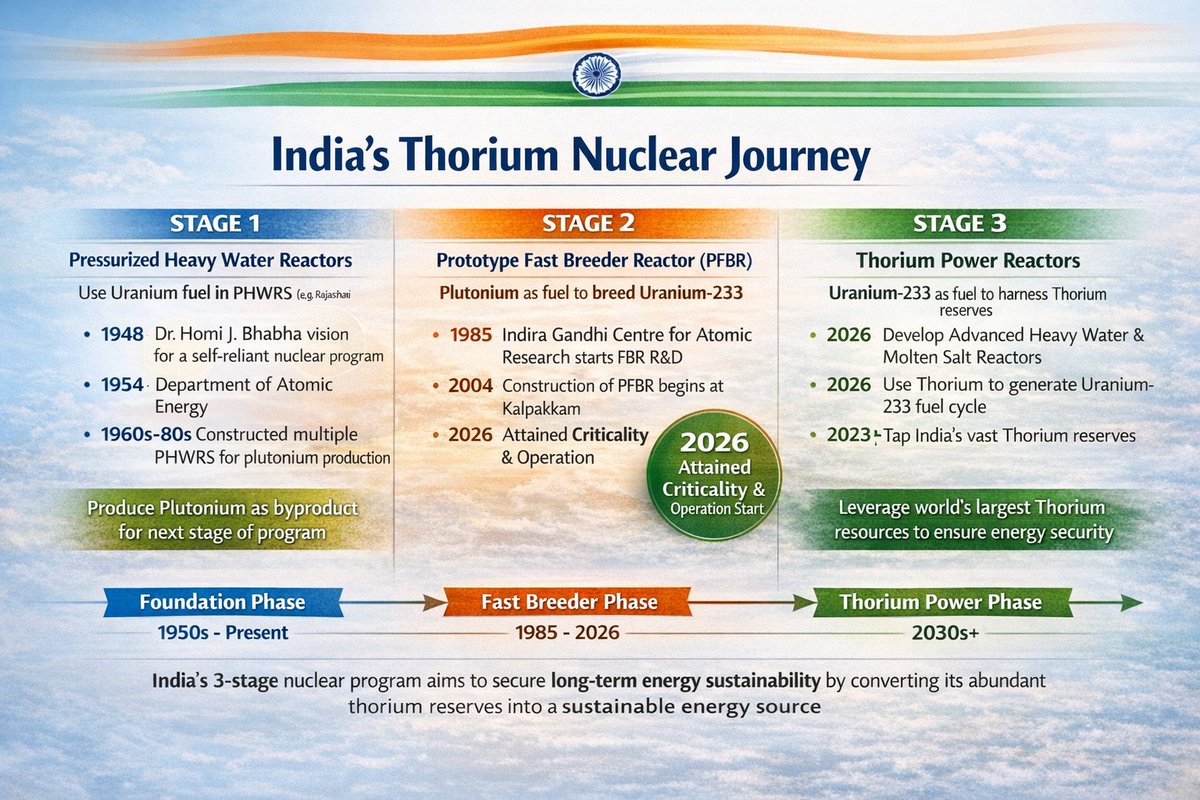
India has, in its civil nuclear energy program, achieved an important milestone. Recently, at Kalpakkam, Tamil Nadu, the Prototype Fast Breeder Reactor (PFBR) has successfully achieved criticality. This achievement is decisive in ensuring the second stage of India’s three-stage nuclear energy program and in laying the foundation for the country’s future thorium-based energy strategy.
What is Criticality?
Criticality is the state when in a reactor a self-sustaining nuclear fission chain reaction is established. It means that the neutrons produced by fission are sufficient to maintain the reaction. This is not the start of full electricity production, but is considered the most important milestone for reactor safety and operation.
About PFBR:
-
-
- PFBR is a 500 MW (MWe) fast breeder reactor, developed by BHAVINI in collaboration with the Indira Gandhi Centre for Atomic Research (IGCAR).
- This reactor uses plutonium-based mixed oxide fuel and liquid sodium as coolant.
- Unlike conventional reactors, it produces more fissile material than it consumes, increasing fuel efficiency and energy security.
- PFBR is a 500 MW (MWe) fast breeder reactor, developed by BHAVINI in collaboration with the Indira Gandhi Centre for Atomic Research (IGCAR).
-
About India’s Three-Stage Nuclear Program:
-
-
- First Stage – Pressurized Heavy Water Reactor (PHWR): Natural uranium is used as fuel. PHWR produces electricity along with plutonium-239 (Pu-239) as a by-product, which becomes fuel for the next stage.
- Second Stage – Fast Breeder Reactor (FBR): Uses plutonium-239 from PHWR and natural uranium as mixed oxide fuel. FBR produces electricity and surplus fuel like uranium-233 (U-233).
- Third Stage – Thorium-Based Reactor: U-233 and thorium-232 (Th-232) will be used. Advanced Heavy Water Reactors (AHWR) will convert thorium into fuel, making the country self-reliant in nuclear energy.
- First Stage – Pressurized Heavy Water Reactor (PHWR): Natural uranium is used as fuel. PHWR produces electricity along with plutonium-239 (Pu-239) as a by-product, which becomes fuel for the next stage.
-
Energy and Strategic Importance:
-
-
- Energy Security: Fast breeder technology uses fuel optimally and reduces dependence on imported uranium.
- Clean Energy: Provides low-carbon energy and supports India’s climate goals.
- Global Leadership: Few countries operate fast breeder reactors; PFBR’s criticality makes India a leading nation in nuclear technology.
- Energy Security: Fast breeder technology uses fuel optimally and reduces dependence on imported uranium.
-
Challenges:
Achieving criticality is an achievement, but operating at full power, connecting to the grid, and managing the fuel cycle successfully are necessary. Additional breeder reactors need to be developed to fully achieve all goals of the three-stage program.
Conclusion:
PFBR at Kalpakkam achieving criticality marks India reaching new heights in nuclear energy. This success strengthens technical skills, energy security, and strategic autonomy. It advances India toward a clean, sustainable, and efficient energy future and makes the country competitive in global nuclear technology.



