
Prison Reforms in India: Supreme Court on Overcrowding & Transparency
Context:
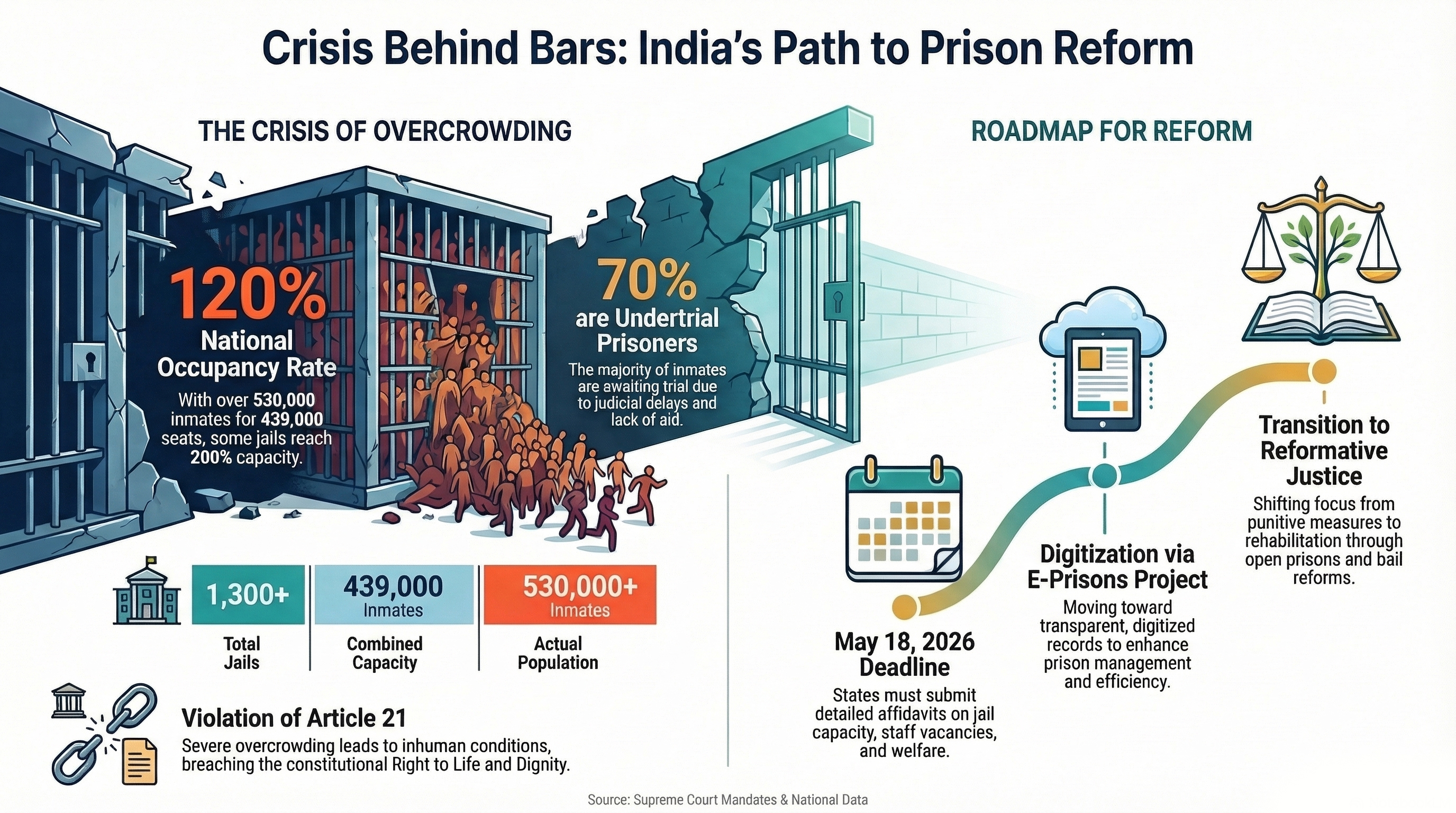
Recently, the Supreme Court of India directed all states and Union Territories to submit updated data regarding prisons, specifically statistics on overcrowding by May 18, 2026.
-
-
- According to current trends, more than 70% of inmates are undertrials, the national occupancy rate stands at approximately 120% (as of 2023), and some prisons are operating at 150–200% of their capacity—figures that clearly underscore the structural challenges plaguing the prison system.
- According to current trends, more than 70% of inmates are undertrials, the national occupancy rate stands at approximately 120% (as of 2023), and some prisons are operating at 150–200% of their capacity—figures that clearly underscore the structural challenges plaguing the prison system.
-
Key Issues Highlighted:
-
-
- India's prisons face significant challenges, including chronic overcrowding, which leads to inhuman living conditions and violates Article 21 of the Constitution (Right to Life & Dignity), as noted by the Supreme Court. The majority of inmates are undertrials, stuck due to judicial delays, lack of legal aid, and slow investigations.
- Infrastructure is inadequate, with shortages of prison staff, medical facilities, and separate women's prisons. Women prisoners and their children suffer disproportionately, lacking dedicated facilities, education, and welfare measures. These issues highlight the need for prison reforms prioritizing dignity, rehabilitation, and justice.
- India's prisons face significant challenges, including chronic overcrowding, which leads to inhuman living conditions and violates Article 21 of the Constitution (Right to Life & Dignity), as noted by the Supreme Court. The majority of inmates are undertrials, stuck due to judicial delays, lack of legal aid, and slow investigations.
-
Supreme Court Directions:
The Supreme Court has directed States and UTs to submit detailed affidavits on prison conditions, including jail-wise sanctioned capacity vs actual inmates, overcrowding percentage, steps for decongestion, details of women prisons and child welfare measures, and staff strength and vacancies. These affidavits, to be filed by Home Secretaries, will aid the ongoing suo motu case on prison conditions, helping address issues like overcrowding and inadequate infrastructure.
Significance of the Order:
-
-
- Promotes data-driven governance
- Ensures accountability of States
- Strengthens judicial oversight on prison reforms
- Focus on human rights and dignity of prisoners
- Promotes data-driven governance
-
Government Initiatives:
The government has introduced several initiatives to reform India's prison system, including the proposed Model Prisons Act, 2023, aiming to overhaul prison management. The E-prisons Project digitizes prison records, enhancing transparency and efficiency. Open prisons are being promoted to reduce overcrowding, focusing on rehabilitation. Additionally, legal aid schemes support undertrials, addressing judicial delays and access to justice. These steps aim to improve prison conditions and prioritize rehabilitation.
Way Forward:
-
-
- Speed up judicial processes and bail reforms
- Expand open and semi-open prisons
- Improve infrastructure and staffing
- Focus on rehabilitation and correctional approach
- Ensure special provisions for women and children
- Speed up judicial processes and bail reforms
-
Conclusion:
It is essential to adopt a holistic and humane approach toward prison reform. The number of undertrial prisoners can be reduced by expediting judicial processes and reforming the bail system. Expanding open and semi-open prisons will be instrumental in alleviating overcrowding and promoting rehabilitation. Also, improvement in the infrastructure and human resources of prisons is necessary. The prison system should prioritize the rehabilitation of inmates, shifting its focus from being punitive to being reformative. Additionally, ensuring special facilities and safety measures for female inmates and their children is of paramount importance.



