
Context:
Recently, NASA has selected PRAXIS (Planetary Rings Autonomous EXploration with In-situ Sampling) for Phase I funding under its Innovative Advanced Concepts (NIAC) 2026 programme. The mission proposes the world's first direct in-situ sampling of planetary ring particles.
What is PRAXIS?
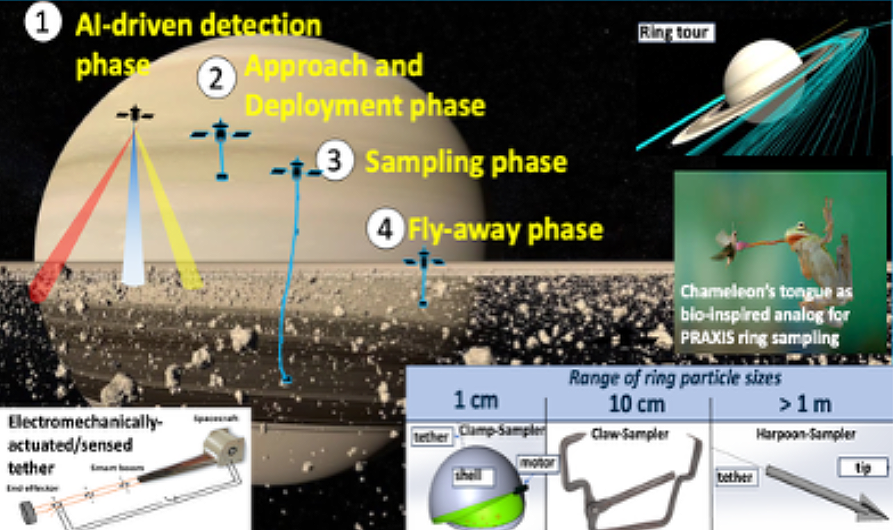
PRAXIS is an innovative mission concept designed to study the ring systems of planets, particularly Saturn, by directly collecting and analyzing ring particles. Unlike previous missions that relied on remote sensing and photography, PRAXIS aims to physically sample particles from planetary rings using an AI-enabled, bio-inspired robotic explorer. It is currently a mission concept and has not yet been approved for launch.
Objectives of the Mission:
The mission seeks to answer several key scientific questions identified by NASA's Planetary Science Decadal Survey, including:
-
-
- Understanding how planetary rings are formed and how they evolve over time.
- Determining the composition, size, and porosity of ring particles.
- Studying differences between dense rings (such as Saturn's) and thinner ring systems around Uranus and Neptune.
- Enhancing knowledge about the evolution of the Solar System.
- Understanding how planetary rings are formed and how they evolve over time.
-
Key Technological Features:
PRAXIS incorporates several advanced technologies:
-
-
- AI-powered Autonomous Navigation: Artificial Intelligence enables the spacecraft to identify suitable particles, avoid collisions, and make real-time decisions without constant human intervention.
- Bio-inspired Robotic Explorer: The robotic system is designed to operate efficiently in the complex and dynamic environment of planetary rings.
- Touch-and-Go Sampling: Instead of flying through dense rings, the spacecraft will remain at a safe distance and deploy a long flexible boom to briefly touch and collect particles, minimizing collision risks.
- In-situ Analysis: Onboard miniaturized instruments will immediately analyze particle size, porosity, and chemical composition.
- AI-powered Autonomous Navigation: Artificial Intelligence enables the spacecraft to identify suitable particles, avoid collisions, and make real-time decisions without constant human intervention.
-
PRAXIS vs. Cassini Mission:
Unlike the Cassini Mission (1997–2017), which primarily used remote sensing and imaging to study Saturn's rings, PRAXIS proposes direct physical sampling. Cassini avoided dense ring regions due to collision hazards, whereas PRAXIS employs an AI-assisted touch-and-go technique to safely collect samples.
Significance:
The selection of PRAXIS under NIAC Phase I allows researchers to conduct simulations and refine the mission's engineering design. If successful, it may progress to prototype development and eventually become a full-fledged mission. The technologies developed could also support future missions to other ringed planets.



