
Context:
Recently, The Union Cabinet has approved the Pradhan Mantri Viksit Gram Swaraj Yojana (PM-VGSY) as a Centrally Sponsored Scheme for the period 2026–27 to 2030–31. The scheme aims to strengthen grassroots governance, improve Panchayat-level planning and transform rural local bodies into empowered, accountable and self-reliant institutions.
Key Features of the scheme:
-
-
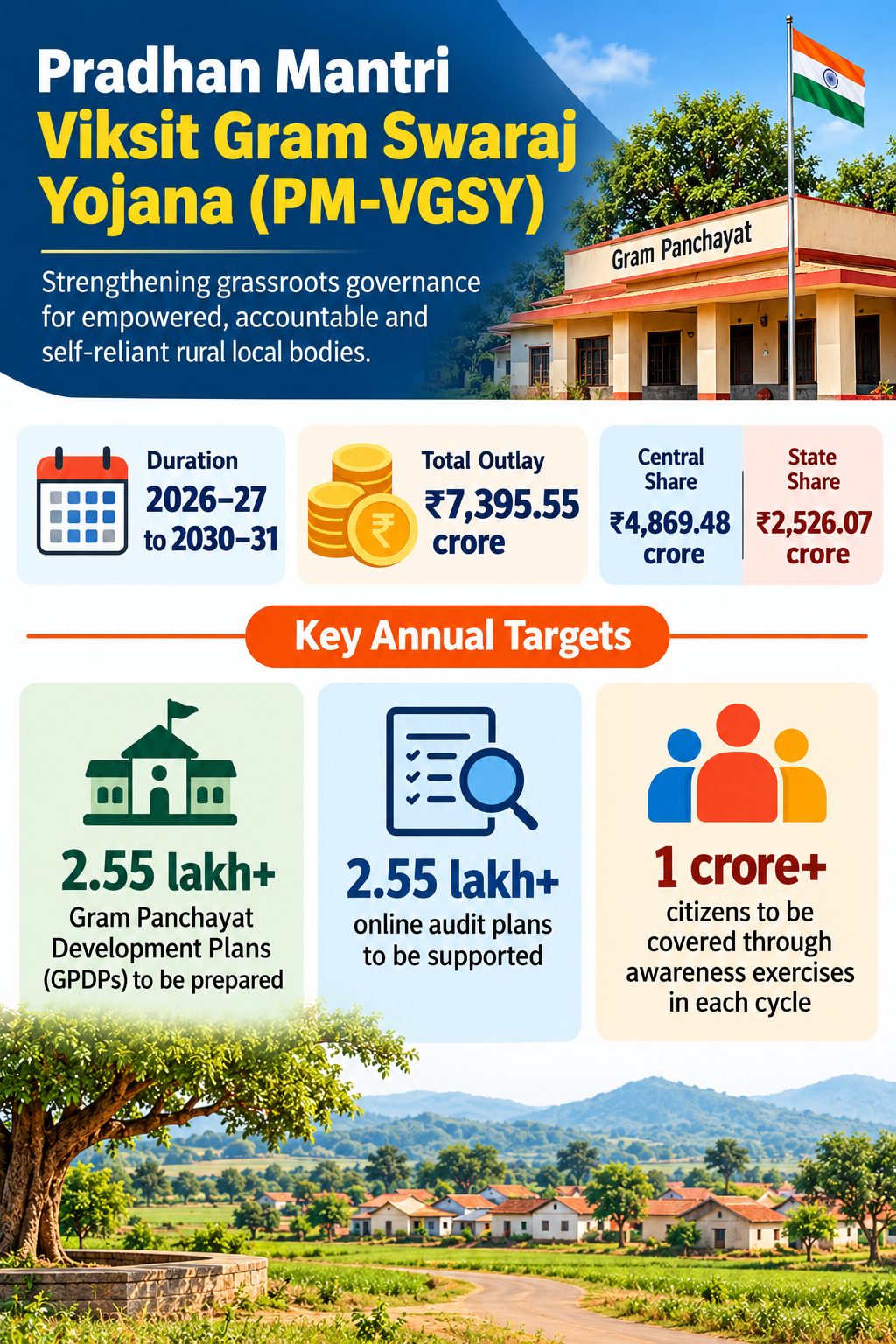
- The scheme has a total financial outlay of ₹7,395.55 crore, comprising a Central share of ₹4,869.48 crore and a State share of ₹2,526.07 crore. It aims to cover over 2.55 lakh Panchayats and traditional local bodies and benefit approximately 32 lakh elected representatives, Panchayat functionaries and other stakeholders.
- Its annual targets include preparing more than 2.55 lakh Gram Panchayat Development Plans (GPDPs), supporting at least 2.55 lakh online audit plans and conducting citizen-awareness exercises targeting at least one crore citizens per exercise.
- The scheme covers States and Union Territories, including eligible traditional rural local bodies in areas where Part IX of the Constitution does not apply.
- The scheme has a total financial outlay of ₹7,395.55 crore, comprising a Central share of ₹4,869.48 crore and a State share of ₹2,526.07 crore. It aims to cover over 2.55 lakh Panchayats and traditional local bodies and benefit approximately 32 lakh elected representatives, Panchayat functionaries and other stakeholders.
-
Background:
Rural local bodies often face inadequate administrative capacity, fragmented development planning, limited revenue mobilisation and weak financial accountability. PM-VGSY seeks to address these challenges through integrated planning, digital governance, capacity building and citizen participation. It will strengthen platforms such as eGramSwaraj for planning and AuditOnline for financial accountability.
Constitutional Aspects:
-
-
- The 73rd Constitutional Amendment Act, 1992 inserted Part IX, comprising Articles 243–243O, and added the Eleventh Schedule, which contains 29 subjects that may be devolved to Panchayats. Article 40, a Directive Principle of State Policy, directs the State to organise village Panchayats as units of self-government. Article 243G enables State Legislatures to devolve powers and responsibilities to Panchayats for economic development and social justice.
- Article 243I provides for State Finance Commissions to review Panchayat finances, while Article 280(3)(bb) concerns Union Finance Commission recommendations for supplementing Panchayat resources. Article 243ZD provides for District Planning Committees to consolidate plans prepared by Panchayats and Municipalities. Thus, PM-VGSY can strengthen decentralised governance, although effective devolution depends substantially on State laws and administrative arrangements.
- The 73rd Constitutional Amendment Act, 1992 inserted Part IX, comprising Articles 243–243O, and added the Eleventh Schedule, which contains 29 subjects that may be devolved to Panchayats. Article 40, a Directive Principle of State Policy, directs the State to organise village Panchayats as units of self-government. Article 243G enables State Legislatures to devolve powers and responsibilities to Panchayats for economic development and social justice.
-
Significance of the scheme:
-
-
- The scheme can deepen democratic decentralisation by bringing decision-making closer to citizens and promoting cooperative federalism through coordination among Central, State and local governments. Integrated planning can improve rural service delivery and reduce duplication of development expenditure.
- Digital accounting and online audits can strengthen transparency, while capacity building can improve the ability of Panchayats to utilise public funds effectively. The scheme can also support the localisation of Sustainable Development Goals through village-level initiatives in sanitation, health, education, livelihoods and environmental sustainability.
- The scheme can deepen democratic decentralisation by bringing decision-making closer to citizens and promoting cooperative federalism through coordination among Central, State and local governments. Integrated planning can improve rural service delivery and reduce duplication of development expenditure.
-
Conclusion:
PM-VGSY can help bridge the gap between constitutional recognition and effective grassroots self-government. Empowered Panchayats, transparent finances, participatory planning and genuine decentralisation are essential for inclusive rural development and the broader vision of Viksit Bharat.