
Parliament Passes CAPF (General Administration) Bill, 2026
Context:
Recently, The Indian Parliament has passed the Central Armed Police Forces (General Administration) Bill, 2026 through a voice vote in both Houses.
About CAPFs:
The Central Armed Police Forces (CAPFs) are a group of central security forces under the Ministry of Home Affairs responsible for internal security, border management, and counter-insurgency operations. These include forces like the CRPF, BSF, CISF, ITBP, and SSB.
Key Features of the Bill:
-
-
- Unified Administrative Framework: The Bill seeks to create a common legal and administrative framework governing recruitment, promotion, seniority, and service conditions of Group A officers across CAPFs.
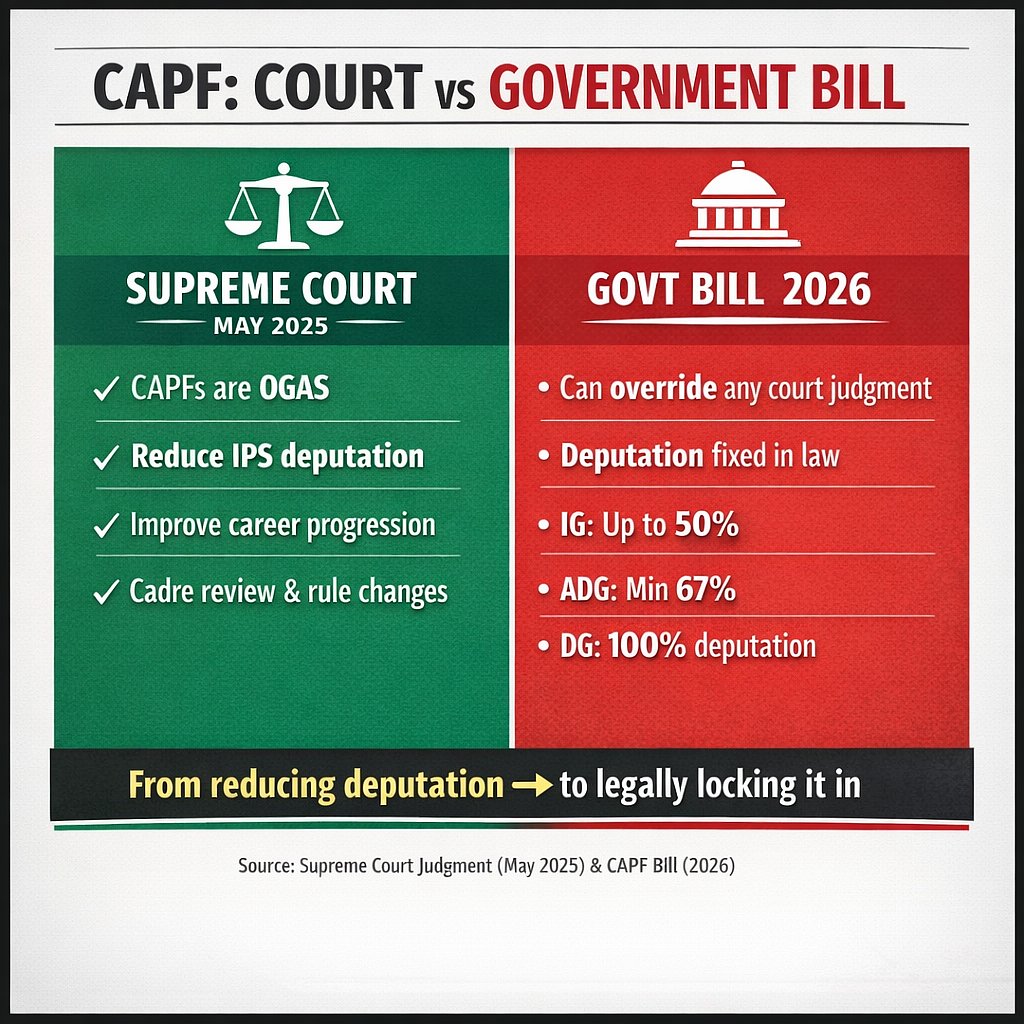
- Deputation of IPS Officers:
- 50% of Inspector General (IG) posts
- At least 67% of Additional Director General (ADG) posts
- 100% of Director General (DG) and Special DG posts
will be filled through deputation of Indian Police Service (IPS) officers.
- 50% of Inspector General (IG) posts
- Rule-Making Powers: The Central Government is empowered to frame rules on recruitment, promotions, and service conditions, ensuring uniformity and clarity.
- Overriding Effect: The provisions of the Act will override any inconsistent laws, court judgments, or administrative orders.
- Unified Administrative Framework: The Bill seeks to create a common legal and administrative framework governing recruitment, promotion, seniority, and service conditions of Group A officers across CAPFs.
-
Objective:
The government has stated that the Bill aims to strengthen India’s internal security framework, remove inconsistencies, and improve coordination among CAPFs and state police forces.
Significance of the Bill:
-
-
- Administrative Reform: Introduces uniform service conditions, reducing fragmentation across forces.
- Operational Efficiency: Enhances coordination and command structure in internal security operations.
- Legal Clarity: Provides a statutory framework replacing multiple rules and executive orders.
- Strengthening Security Architecture: Aims to modernise governance of CAPFs in line with evolving threats.
- Administrative Reform: Introduces uniform service conditions, reducing fragmentation across forces.
-
Concerns and Criticism:
-
-
- Impact on Morale: Opposition leaders and experts argue that reserving senior posts for IPS officers may demotivate CAPF cadre officers and limit career progression.
- Promotion Stagnation: Concerns have been raised regarding potential stagnation, including claims of delayed promotions and limited upward mobility.
- Federal Concerns: Critics argue that centralised control over appointments and service rules may undermine the spirit of cooperative federalism.
- Legislative Scrutiny: Opposition demanded that the Bill be referred to a parliamentary committee, citing lack of adequate consultation.
- Impact on Morale: Opposition leaders and experts argue that reserving senior posts for IPS officers may demotivate CAPF cadre officers and limit career progression.
-
Way Forward:
To ensure the effective implementation of the CAPF (General Administration) Bill, 2026, it is essential to maintain a balanced approach in cadre management between CAPF officers and IPS officers on deputation, thereby addressing concerns related to career progression and morale. Transparent and well-defined promotion policies should be introduced to foster motivation and a sense of fairness among CAPF personnel. Strengthening consultative mechanisms with stakeholders, including force representatives, state governments, and experts, will help in addressing operational and administrative challenges collaboratively.
Conclusion:
The passage of the CAPF (General Administration) Bill, 2026 marks a major reform in India’s internal security governance. While it aims to bring uniformity, clarity, and efficiency, concerns regarding cadre management and morale must be carefully addressed. The success of the legislation will depend on its balanced implementation, ensuring both administrative efficiency and fairness within the forces.



