
Promotion and Regulation of Online Gaming Rules, 2026
Context:
Recently, The Government of India notified the Promotion and Regulation of Online Gaming Rules, 2026 under the Promotion and Regulation of Online Gaming (PROG) Act, 2025. The Rules will come into force from 1 May 2026.
Background:
The PROG Act, 2025 was enacted to:
-
-
- Prohibit online money gaming (RMG)
- Promote e-sports and online social gaming
- Protect users from financial, psychological, and social harm
- Prohibit online money gaming (RMG)
-
It reflects India’s ambition to become a global gaming hub while ensuring user safety and regulatory oversight.
Purpose of the Rules:
The 2026 Rules operationalize the Act by:
-
-
- Defining a clear mechanism to classify games
- Establishing a central regulatory authority
- Introducing a registration regime
- Ensuring user protection and transparency
- Providing penalty and appeal mechanisms
- Defining a clear mechanism to classify games
-
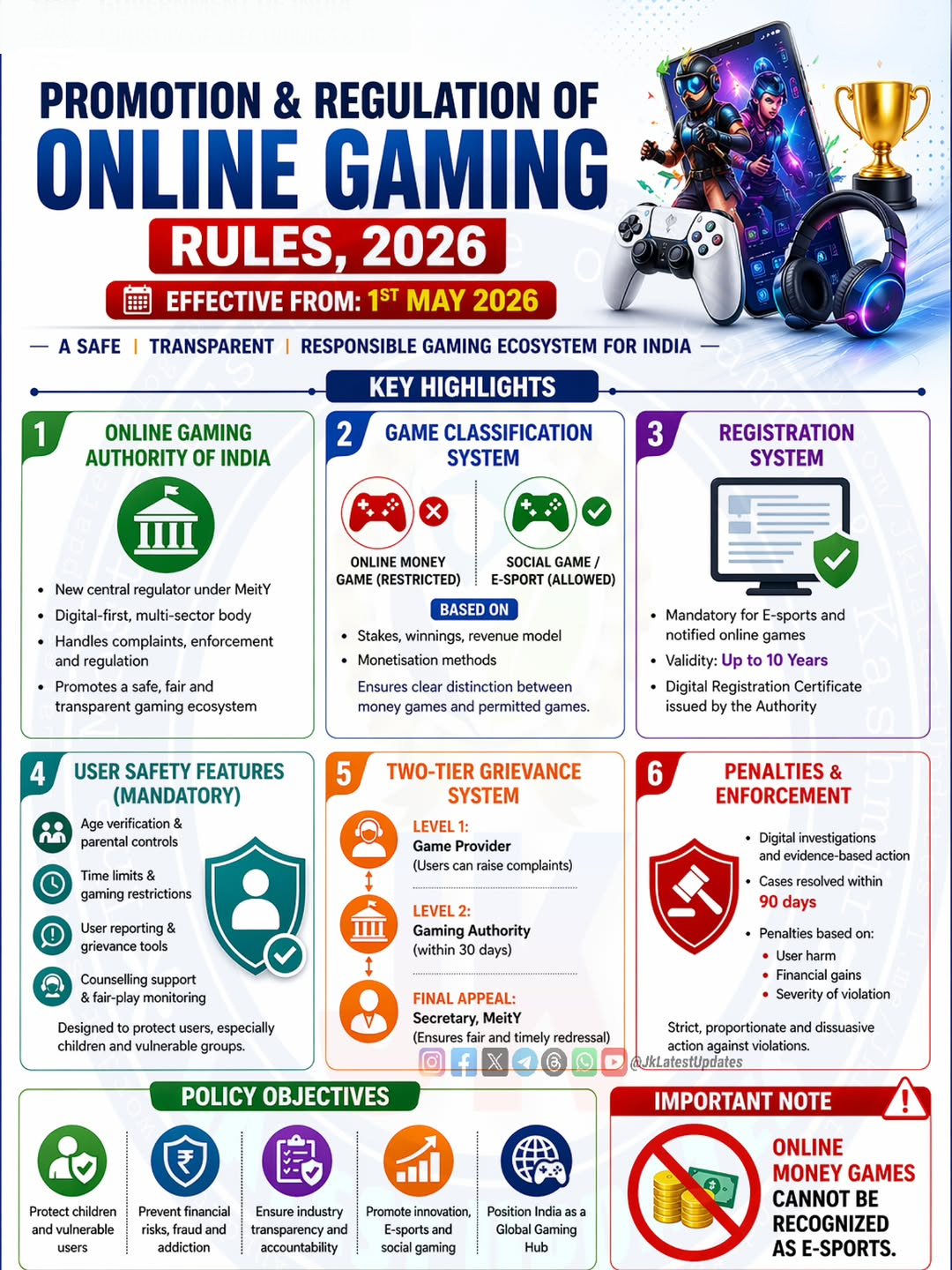
Key Features of the Promotion and Regulation of Online Gaming Rules, 2026:
|
Component |
Key Provisions |
|
Online Gaming Authority of India (OGAI) |
Established under MeitY; headquartered in Delhi; multi-ministerial representation from key departments. |
|
Functions of OGAI |
Classify games; maintain public registry; handle grievances and appeals; coordinate enforcement with banks and agencies. |
|
Classification of Online Games |
Based on stake payment, expectation of winnings, revenue model, and monetisation of in-game assets. |
|
Timeline for Determination |
Classification decision to be completed within 90 days. |
|
Registration Framework |
Mandatory for e-sports and notified social games; registration certificate valid up to 10 years. |
|
Restriction on E-sports |
Online money games are explicitly prohibited from being recognised as e-sports. |
|
User Safety Features |
Includes age verification, parental controls, time limits, reporting mechanisms, counselling support, and fair-play monitoring. |
|
Grievance Redressal System |
Two-tier system: (1) Platform level, (2) OGAI, with final appeal to Secretary, MeitY. |
|
Enforcement Mechanism |
Digital proceedings; time-bound disposal within 90 days; penalties based on severity, recurrence, user harm, and gains from violation. |
Significance:
The Promotion and Regulation of Online Gaming Rules, 2026 are significant as they enhance consumer protection by curbing addiction, financial losses, and misleading advertisements. They provide regulatory certainty through clear rules and time-bound decisions, while promoting a legitimate gaming industry and discouraging illegal platforms. Additionally, they help reduce gambling addiction and youth exploitation, encouraging responsible gaming.
Challenges:
-
-
- Defining skill vs chance remains complex
- Enforcement across offshore platforms
- Risk of over-regulation impacting startups
- Coordination with States (public order, betting laws)
- Defining skill vs chance remains complex
-
Way Forward:
-
-
- Strengthen technological enforcement (AI-based monitoring)
- Enhance digital literacy and awareness
- Foster global cooperation on cross-border gaming
- Maintain a balance between regulation and innovation
- Strengthen technological enforcement (AI-based monitoring)
-
Conclusion:
The Online Gaming Rules, 2026 mark a decisive shift in India’s digital governance. By combining strict prohibition of money gaming with promotion of e-sports, the framework aims to create a safe, transparent, and innovation-driven gaming ecosystem.



