
Context:
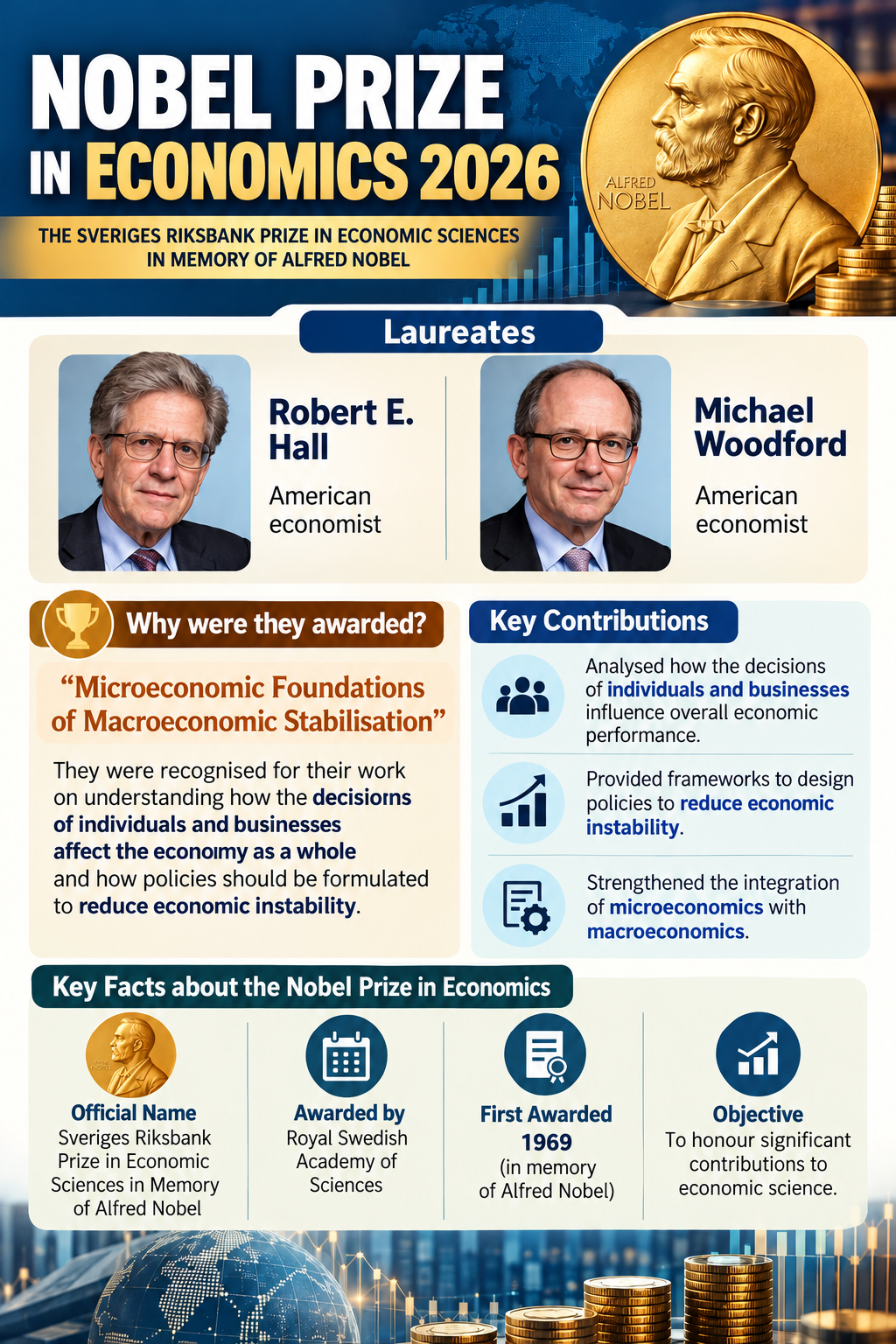
Recently, the Royal Swedish Academy of Sciences awarded the 2026 Sveriges Riksbank Prize in Economic Sciences in Memory of Alfred Nobel to American economists Robert E. Hall and Michael Woodford. Both economists were recognised for their work on the “Microeconomic Foundations of Macroeconomic Stabilisation.” The main objective of their research is to understand how the decisions of individuals and businesses affect the economy as a whole and how policies should be formulated to reduce economic instability.
What is the Nobel Prize in Economics?
The award is officially known as the Sveriges Riksbank Prize in Economic Sciences in Memory of Alfred Nobel.
-
-
- Established: 1968 by Sveriges Riksbank, Sweden’s central bank, to mark its 300th anniversary.
- First awarded: 1969.
- Purpose: To recognise outstanding contributions to economic sciences.
- Selection: The Royal Swedish Academy of Sciences selects the laureates.
- Established: 1968 by Sveriges Riksbank, Sweden’s central bank, to mark its 300th anniversary.
-
Contributions of the Laureates:
-
-
- Robert E. Hall: An American economist associated with Stanford University, Hall's research focused on household consumption, saving decisions, labour markets and unemployment. He highlighted how expectations about future income influence present spending and overall economic activity.
- Michael Woodford: An American economist and professor at Columbia University, Woodford's work significantly influenced modern monetary economics. His research examined interest-rate policy, inflation management and the role of expectations and central bank communication in influencing economic decisions.
- Robert E. Hall: An American economist associated with Stanford University, Hall's research focused on household consumption, saving decisions, labour markets and unemployment. He highlighted how expectations about future income influence present spending and overall economic activity.
-
Understanding the Core Concept:
Macroeconomic stabilisation refers to government and central bank measures to reduce excessive fluctuations in economic growth, inflation and employment. During a recession, policymakers may reduce interest rates or increase public expenditure. During excessive inflation, they may increase interest rates or reduce fiscal stimulus.
Microeconomic foundations of macroeconomics connect individual economic decisions with overall economic outcomes.
|
Microeconomics |
Macroeconomics |
|
Studies individual consumers, households and firms. |
Studies the economy as a whole. |
|
Examines individual consumption, saving and pricing decisions. |
Examines aggregate consumption, inflation, employment and GDP. |
|
Focuses on individual economic behaviour. |
Focuses on overall economic outcomes. |
For example, when households expect their future income to decline, they may reduce current spending. If many households behave similarly, aggregate demand, production and employment may decline. Therefore, understanding individual decisions helps policymakers analyse economic fluctuations and formulate effective monetary and fiscal policies.
Significance of the Research:
-
-
- Improvement in monetary policy: Their research provides a theoretical foundation for analysing how interest-rate changes affect consumption, investment and inflation.
- Role of expectations: Economic decisions depend not only on present conditions but also on expectations about future prices, income and policy measures.
- Importance of central bank communication: Clear and credible communication can influence economic behaviour even before a policy change takes effect.
- Better management of economic shocks: The framework helps policymakers analyse how events such as energy-price shocks, sudden changes in household consumption and global economic disruptions affect the economy.
- Understanding business cycles: The research helps explain why economies experience periods of expansion and contraction, and how policy can moderate these fluctuations.
- Improvement in monetary policy: Their research provides a theoretical foundation for analysing how interest-rate changes affect consumption, investment and inflation.
-
Conclusion:
The 2026 Nobel Prize in Economics highlights that studying indicators such as inflation, output, and employment alone is not sufficient for formulating effective economic policies. It is also essential to understand the behaviour of households and businesses and their expectations about the future. This approach is important for achieving economic stability and sustainable development.



