
Context:
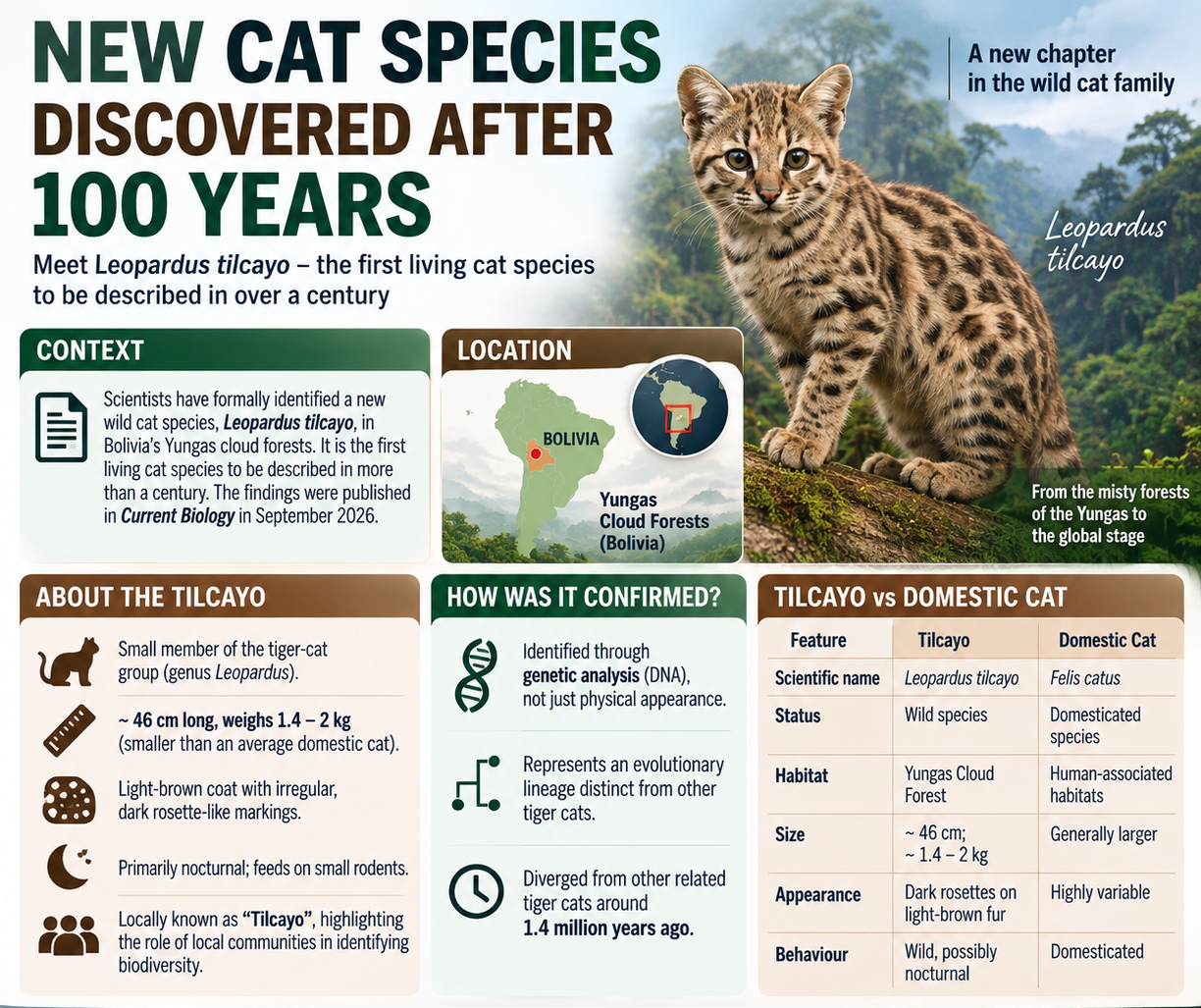
Recently, Scientists have formally identified a new wild cat species, Leopardus tilcayo, in Bolivia’s Yungas cloud forests. It is significant because this is the first living cat species to be formally described in more than a century. The findings were published in the journal Current Biology in September 2026.
About the Tilcayo:
-
-
- The Tilcayo is a small member of the tiger-cat group belonging to the genus Leopardus. It is reported to be approximately 46 centimetres long and weigh around 1.4 to 2 kilograms, making it even smaller than an average domestic cat. It has a light-brown coat with irregular, dark rosette-like markings on its body, giving it the appearance of a miniature leopard.
- Preliminary observations suggest that it is primarily nocturnal and feeds on small rodents.
- The animal was locally known as “Tilcayo,” highlighting the role of local communities in identifying and documenting biodiversity.
- The Tilcayo is a small member of the tiger-cat group belonging to the genus Leopardus. It is reported to be approximately 46 centimetres long and weigh around 1.4 to 2 kilograms, making it even smaller than an average domestic cat. It has a light-brown coat with irregular, dark rosette-like markings on its body, giving it the appearance of a miniature leopard.
-
How Was the Species Confirmed?
-
-
- The species was identified not merely on the basis of its physical appearance but through genetic analysis. Researchers studied its DNA and confirmed that it represents an evolutionary lineage distinct from other tiger cats.
- According to researchers, its evolutionary lineage diverged from other related tiger cats approximately 1.4 million years ago.
- The species was identified not merely on the basis of its physical appearance but through genetic analysis. Researchers studied its DNA and confirmed that it represents an evolutionary lineage distinct from other tiger cats.
-
How Is It Different from a Domestic Cat?
|
Feature |
Tilcayo |
Domestic Cat |
|
Scientific name |
Leopardus tilcayo |
Felis catus |
|
Status |
Wild species |
Domesticated species |
|
Habitat |
Yungas Cloud Forest |
Human-associated habitats |
|
Size |
~46 cm; ~1.4–2 kg |
Generally larger |
|
Appearance |
Dark rosettes on light-brown fur |
Highly variable |
|
Behaviour |
Wild, possibly nocturnal |
Domesticated |
Significance:
-
-
- Biodiversity: The discovery highlights the existence of cryptic species, species that may appear similar but are genetically distinct.
- Role of Genetic Taxonomy: Modern genomic techniques can reveal evolutionary relationships that conventional morphological classification may overlook.
- Conservation: The Yungas is under pressure from deforestation, agriculture and mining. Since the population and ecological requirements of the Tilcayo remain poorly understood, further surveys are necessary to assess its conservation status.
- Indigenous and Local Knowledge: The local name and community-level recognition of the animal demonstrate how traditional ecological knowledge can complement modern scientific research.
- Biodiversity: The discovery highlights the existence of cryptic species, species that may appear similar but are genetically distinct.
-
Conclusion:
The discovery of Leopardus tilcayo shows that the world’s biodiversity remains incompletely documented. It underlines the need to combine modern genomic science, field research and local ecological knowledge with stronger habitat protection to conserve species before they become threatened or extinct.



