
Context:
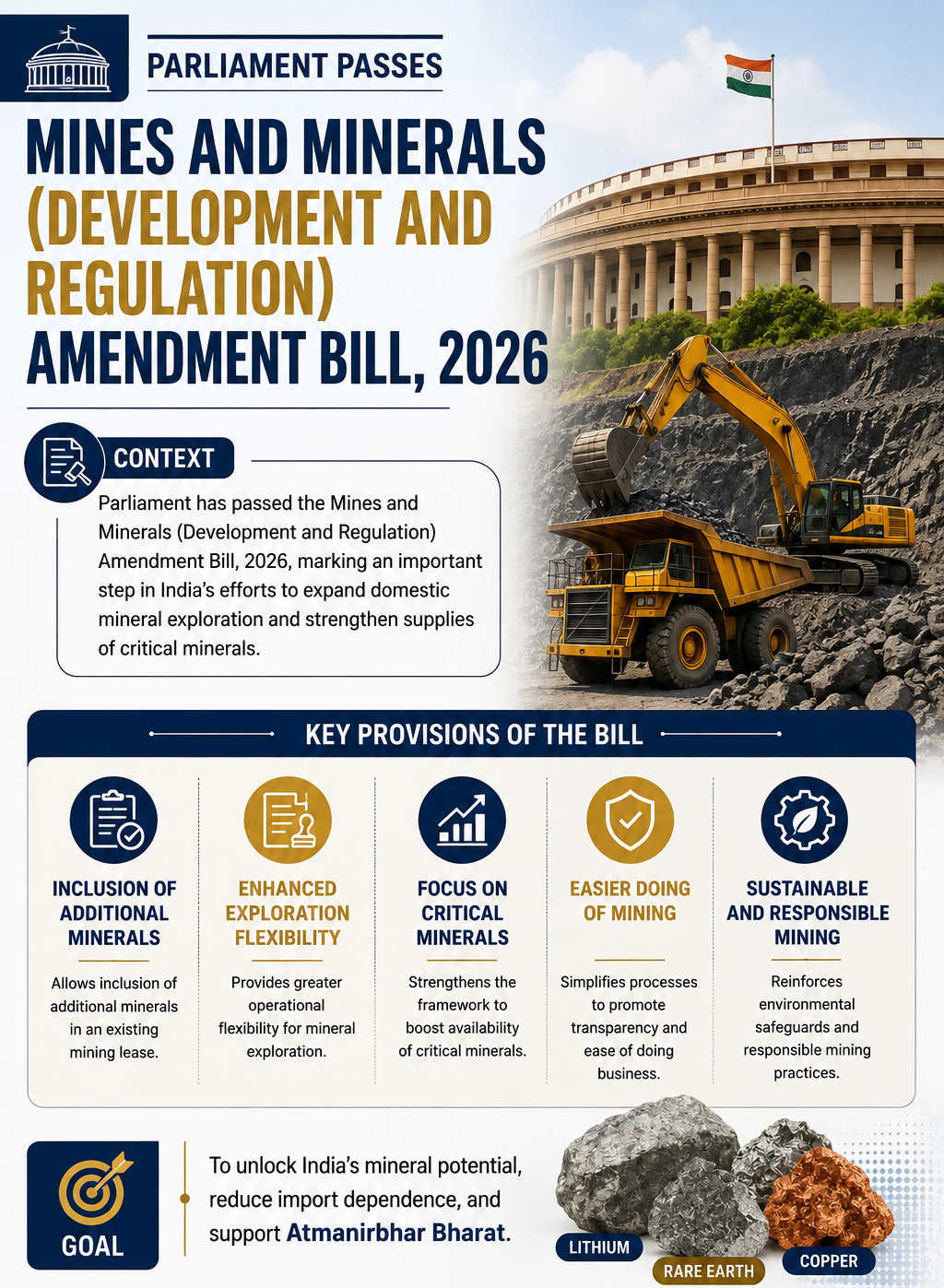
Recently, Parliament has passed the Mines and Minerals (Development and Regulation) Amendment Bill, 2026, marking an important step in India’s efforts to expand domestic mineral exploration and strengthen supplies of critical minerals.
Key Provisions of the Bill:
-
-
- Inclusion of Additional Minerals: The Bill allows holders of mining leases to apply for the inclusion of additional minerals in an existing lease. No additional payment is required for specified critical and strategic minerals, including lithium, graphite, nickel, cobalt, gold and silver, providing greater incentives for their production.
- Removal of 50% Captive Mining Sales Limit: The Bill removes the existing 50% ceiling on the sale of minerals from captive mines. After meeting the requirements of the linked end-use plant, miners can sell their remaining production, subject to applicable payments. This is expected to improve resource utilisation and increase mineral availability in the market.
- Expansion of Mining Areas: For deep-seated minerals located more than 200 metres below the surface, the Bill permits a one-time expansion of contiguous mining areas. The expansion can be up to 10% of the existing area for a mining lease and 30% for a composite licence.
- National Mineral Exploration and Development Trust: The National Mineral Exploration Trust is being expanded and renamed the National Mineral Exploration and Development Trust. Its mandate covers exploration and development of mines and minerals, including activities in offshore areas and outside India.
- Mineral Exchanges: The Centre will have powers to promote mineral exchanges for trading minerals, concentrates and processed forms. Such exchanges could improve transparency, price discovery and market efficiency.
- Inclusion of Additional Minerals: The Bill allows holders of mining leases to apply for the inclusion of additional minerals in an existing lease. No additional payment is required for specified critical and strategic minerals, including lithium, graphite, nickel, cobalt, gold and silver, providing greater incentives for their production.
-
Focus on Critical Minerals:
Critical minerals such as lithium, cobalt, nickel and graphite are essential for electric vehicles, batteries, renewable energy, electronics and advanced manufacturing. The reforms aim to reduce import dependence and strengthen India’s mineral security.
Importance for India:
The amendment seeks to make the mining sector more flexible and investment-friendly. Faster exploration and development of domestic mineral resources could support India’s clean-energy transition, industrial growth and strategic supply chains.
Challenges Ahead:
Implementation remains crucial. India will need greater private investment, advanced exploration technology, processing capacity and infrastructure. Questions relating to Centre-state powers over mineral taxation may also require careful resolution.
Conclusion:
The MMDR Amendment Bill, 2026 is a significant reform aimed at transforming India’s mineral sector. By encouraging critical-mineral exploration, allowing additional minerals in existing leases, removing the captive-mining sales ceiling, expanding exploration support and enabling mineral exchanges, the Bill seeks to strengthen domestic mineral production and reduce India’s dependence on overseas supplies.



