
Mission Drishti Satellite
Context:
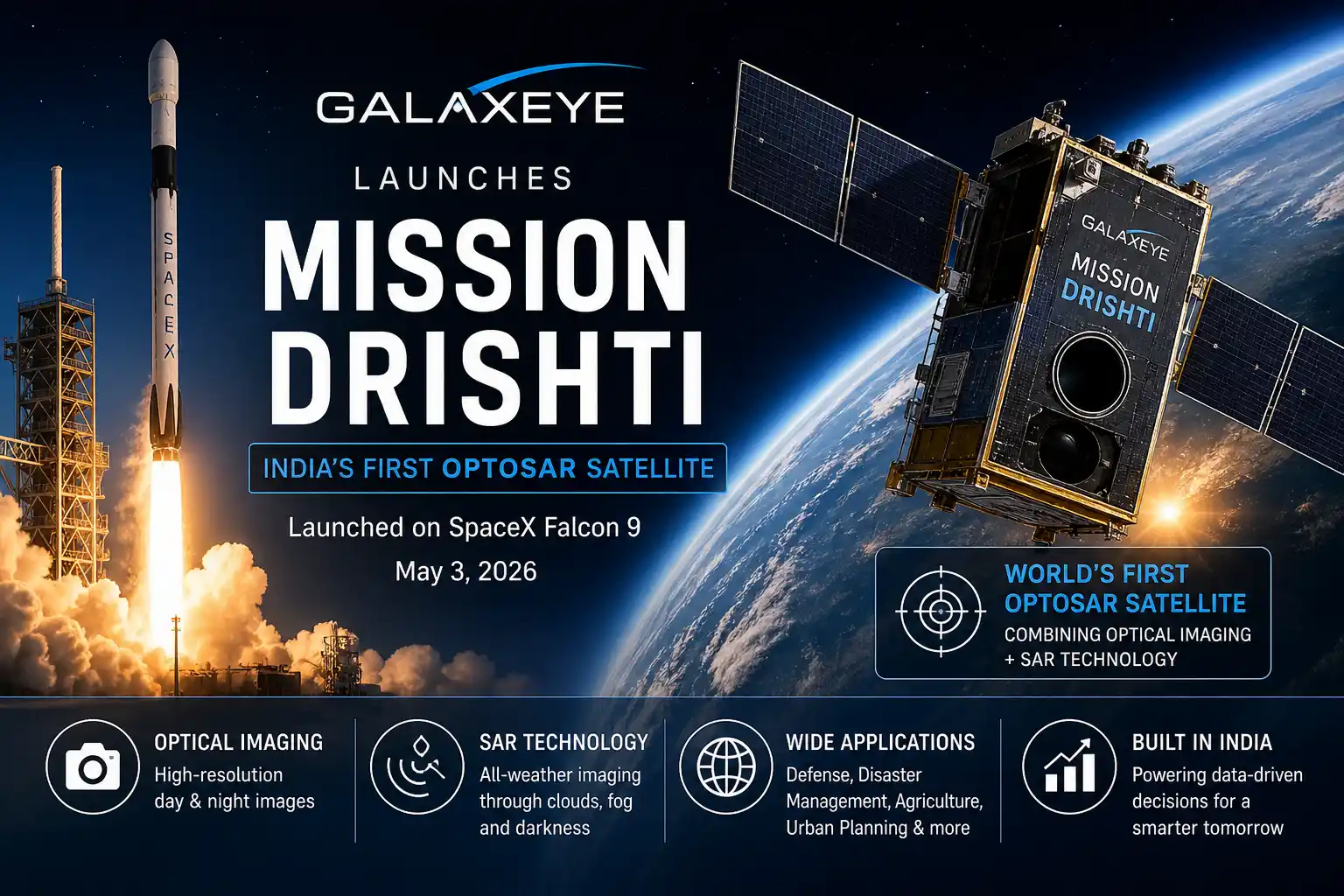
Recently, Bengaluru-based space-tech startup GalaxEye successfully launched Mission Drishti satellite, marking a significant milestone in India’s private space sector. The satellite was launched aboard a SpaceX Falcon 9 rocket and successfully placed into orbit. It is being India’s largest privately built spacecraft and the first-of-its-kind OptoSAR satellite.
About Mission Drishti:
Mission Drishti is a remote-sensing satellite developed by the Indian startup GalaxEye, designed to enhance Earth observation by integrating multiple sensing technologies into a single platform.
Key features:
-
-
- Developed by a private Indian space-tech company (GalaxEye)
- Launched using SpaceX Falcon 9 rocket
- Successfully placed into orbit through a commercial launch mission
- Represents a major milestone in India’s private space ecosystem
- Demonstrates growing capability of Indian startups in satellite technology
- Developed by a private Indian space-tech company (GalaxEye)
-
About OptoSAR Technology:
The satellite uses OptoSAR (Optical + SAR) technology, combining two advanced imaging systems:
-
-
- Optical imaging: Provides high-resolution images in visible light conditions
- Synthetic Aperture Radar (SAR): Enables imaging through clouds, darkness, and all weather conditions
- Optical imaging: Provides high-resolution images in visible light conditions
-
Significance:
-
-
- Enables all-weather, day-and-night Earth observation
- Improves accuracy and continuity of geospatial data
- Useful for defence, agriculture, disaster management, and climate monitoring
- Enables all-weather, day-and-night Earth observation
-
Significance for India’s Space Sector:
-
-
- Strengthens India’s private space ecosystem under IN-SPACe reforms
- Shows capability of startups in building advanced satellite systems
- Promotes innovation in dual-sensor (optical + radar) technology
- Reduces dependence on foreign satellite data services
- Supports India’s vision of becoming a global space economy leader
- Strengthens India’s private space ecosystem under IN-SPACe reforms
-
Private Space Sector in India:
Private participation in India’s space sector is undergoing a major shift from vendor-based manufacturing to end-to-end mission capability, driven by reforms introduced since 2020. The sector is now supported by a structured policy and institutional framework that promotes startups and private innovation.
Key Institutional Pillars:
-
-
- IN-SPACe (Indian National Space Promotion and Authorisation Centre): Single-window autonomous body under the Department of Space for regulating and promoting private players
- NSIL (NewSpace India Limited): Commercial arm of ISRO responsible for technology transfer and launch services
- Indian Space Policy 2023: Formalises role of private entities in building rockets, satellites, and providing space services
- IN-SPACe (Indian National Space Promotion and Authorisation Centre): Single-window autonomous body under the Department of Space for regulating and promoting private players
-
FDI Reforms (2024):
-
-
- Up to 74% FDI in satellite manufacturing
- 49% in launch vehicles
- 100% in satellite components
- Up to 74% FDI in satellite manufacturing
-
Key Achievements:
India’s private space ecosystem is rapidly expanding with over 200 startups working in satellites, launch vehicles, and data services.
-
-
- Skyroot Aerospace: Launched Vikram-S (India’s first private rocket, 2022)\
- Agnikul Cosmos: Developed 3D-printed rocket engine and private Launchpad
- OneWeb India: Approved for satellite broadband services via IN-SPACe
- Skyroot Aerospace: Launched Vikram-S (India’s first private rocket, 2022)\
-
These developments show India’s transition into a competitive space economy driven by innovation and entrepreneurship.
Way Forward:
Mission Drishti highlights India’s transition from a government-led space programme to a collaborative space economy model. With rising private participation, India is steadily moving toward becoming a global hub for advanced satellite technology, Earth observation systems, and geospatial intelligence services.



