
Context:
Recently, a pan-India assessment by the Wildlife Institute of India (WII) has highlighted the nesting patterns of marine turtles in India. The assessment recorded 18,713 solitary Olive Ridley nests during 2024–25 and identified Galathea Bay in Great Nicobar Island as a critical nesting habitat for Leatherback turtles. The findings assume significance amid concerns over the proposed ₹92,000-crore Great Nicobar Island development project.
Major Findings of the Assessment:
The WII assessment covered 360 beach stretches across more than 1,300 km of coastline, using field surveys, literature reviews and nesting records maintained by State Forest Departments.
-
- Olive Ridley: 18,713 solitary nests were recorded in 2024–25, representing approximately 8,000 nesting females.
- Leatherback: 643 nests were recorded at Galathea Bay in 2023–24 and 478 in 2024–25.
- Green Turtle: Mainly recorded in Gujarat, Lakshadweep and the Andaman and Nicobar Islands.
- Hawksbill: Found sparsely in Lakshadweep and the Andaman and Nicobar Islands.
- Olive Ridley: 18,713 solitary nests were recorded in 2024–25, representing approximately 8,000 nesting females.
Olive Ridley turtles are famous for Arribada, a phenomenon involving mass nesting by thousands of females. Odisha's Gahirmatha and Rushikulya beaches are important nesting sites.
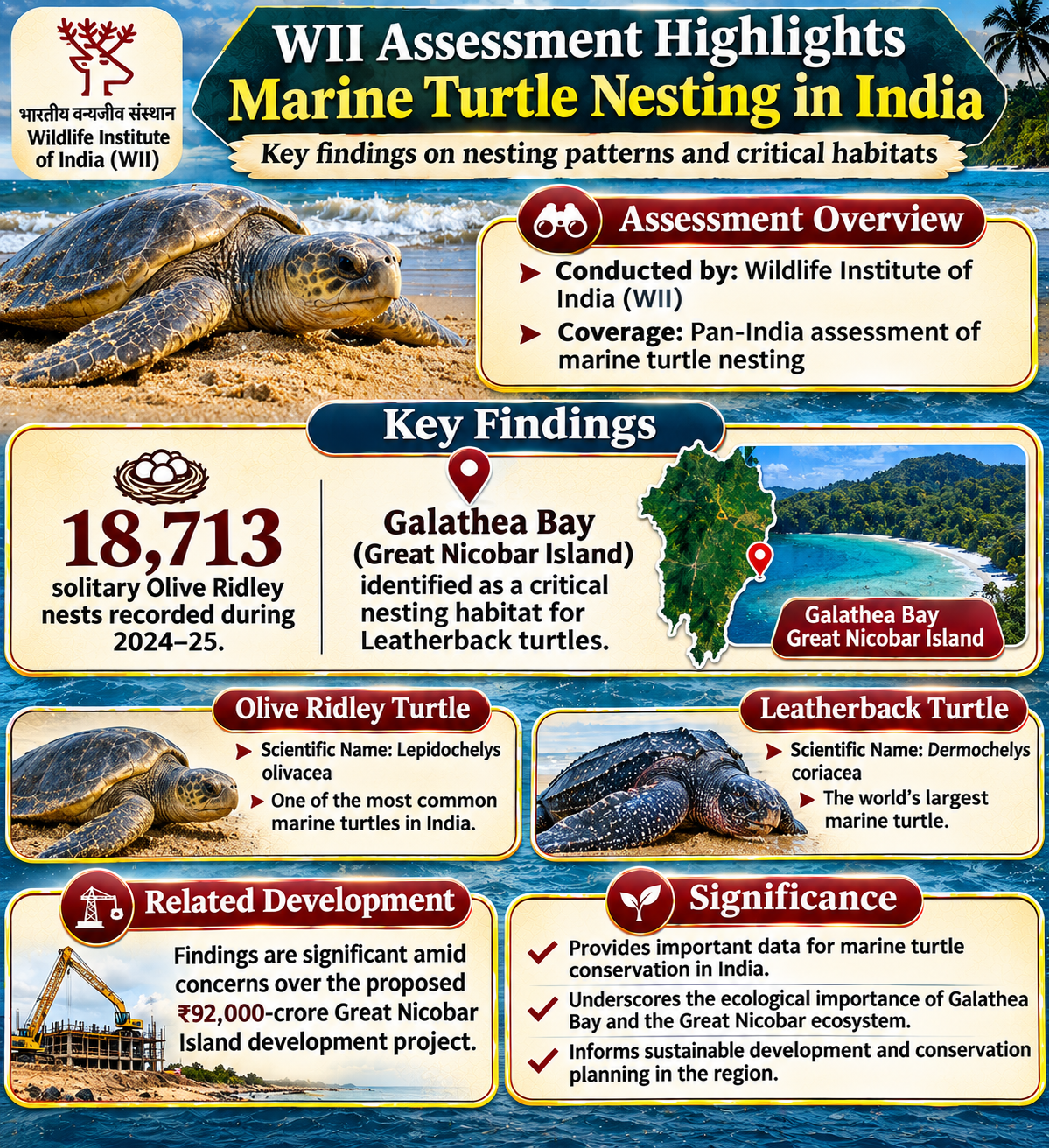
About Marine Turtles Found in India:
India's coastal waters support five species of marine turtles.
|
Species |
Key characteristics |
|
Olive Ridley (Lepidochelys olivacea) |
Smallest among the sea turtles discussed here; famous for mass nesting called Arribada. |
|
Leatherback (Dermochelys coriacea) |
Largest living sea turtle; has a leathery shell instead of a hard bony shell. |
|
Green Turtle (Chelonia mydas) |
Adults are primarily herbivorous and feed on seagrasses and algae. |
|
Hawksbill (Eretmochelys imbricata) |
Associated with coral reefs; feeds mainly on sponges. |
|
Loggerhead (Caretta caretta) |
Has a large head and powerful jaws, adapted to crush hard-shelled prey. |
Ecological Significance of Galathea Bay:
Galathea Bay, situated on Great Nicobar Island, is a critical nesting habitat for Leatherback turtles, the world's largest living sea turtle.
Its ecological importance has increased because it is also the proposed location of the International Container Transshipment Terminal (ICTT), a component of the Great Nicobar development project.
Potential environmental concerns include:
-
-
- Destruction and fragmentation of nesting beaches.
- Artificial lighting that disorients hatchlings.
- Dredging and coastal reclamation.
- Noise pollution and increased shipping activity.
- Disturbance of sensitive marine ecosystems.
- Destruction and fragmentation of nesting beaches.
-
Major Challenges Identified:
The assessment highlighted several conservation gaps:
1. Inadequate monitoring in remote areas of Lakshadweep and Andaman and Nicobar Islands.
2. Underestimation of predation on turtle eggs.
3. Excessive dependence on hatcheries instead of protecting eggs in their natural habitats.
4. Coastal degradation and disruption of river mouths.
5. Limited scientific information about turtle migration patterns.
The assessment found that river mouths provide favourable nesting conditions due to sediment supply and natural beach formation. The Mahanadi, Godavari, Krishna and Kaveri river systems are particularly important.
Hatchling emergence success was higher on the east coast (81.5%) than on the west coast (64.5%).
Conclusion:
The WII assessment provides an important scientific baseline for marine turtle conservation in India. It highlights the need to balance infrastructure development with biodiversity protection, particularly in ecologically fragile island ecosystems. A sustainable development approach must ensure that economic and strategic priorities do not compromise critical wildlife habitats.